“From 1984 to The Handmaid’s Tale and everything in between, the best science fiction pulls from current events to create terrifying alternate futures and shine a light on the political and social issues of today. Could these realities come true? Join Sue Burke (Semiosis), Kristen Simmons (Metaltown, The Glass Arrow, the Article 5 Series), Ada Palmer (The Will to Battle, Terra Ignota Series) and Sam J. Miller (Blackfish City) as they gaze into dystopian worlds eerily similar to our own.”
Then we’ll be at an autographing session from 2:45 to 3:45 p.m. at tables 33 and 34 in the Autographing Area. Books will be available for purchase, but the autographs will be free, and we’ll be glad to talk to people. (For some celebrities, free autographs isn’t the case. I’m definitely not a celebrity.)
C2E2 will be held April 6 to 8 at the South Building at McCormick Place, 2301 S. Lake Shore Drive. It’s a Chicago convention for fans dedicated to comics, pop culture, books, graphic novels, anime, manga, video games, toys, movies, and television. Last year 80,000 people attended. C2E2 is especially known for its cosplay championships.
On Earth, plants are active, aggressive, and sometimes they fight to the death for sunlight. They employ cunning weapons and strategies, both offensive and defensive.
For example, strangler figs (several varieties of Ficus) start as seedlings that germinate up on tree branches and trunks in jungles. As they grow, their roots wrap around the host tree and eventually strangle and kill it. The fig starts halfway up to sunshine, which is an advantage.
But how do the seeds get up there? Birds eat fig fruit, and the seeds have a gluey covering that sticks to a bird’s feathers when it defecates. The bird wipes off its vent on tree branches and trunks, where the seeds adhere and germinate.
To combat this, the kapok or silk cotton tree (Bombax ceiba) grows spike-like thorns on its trunk and branches. Birds would risk injury to clean themselves there.
The photo shows just how risky. This is a white-flowered silk cotton tree in Gambia, and it’s well-armed against strangler fig seed deposits.
Do roses have thorns for the same reason? No. Wild roses clamber over other plants to pursue light, and they anchor their thorns into them to facilitate climbing. Like the strangler fig, they might mercilessly kill other plants in the process, in this case by starving them of sunlight.
In the plant kingdom, thorns are an offensive and defensive weapons in the battle for survival.
Veggies in space! If we’re going to go on long space missions, we’ll need to grow food, and plants respond differently in microgravity. NASA is growing plants on the International Space Station. Here’s more about the experiment, and how accidentally overwatering lettuce turned out to be the right thing to do.
Every tree tells a story. This National Geographic article introduces a number of legendary trees from around the world, including Newton’s apple tree in England and the Montezuma cypress in Mexico.
MIT has found a way to make plants glow. The scientists hope that someday trees might become self-powered street lights, or that you will read by the light of your houseplant.
Finally, Henry David Thoreau saw trees as living prayers. When he walked through a forest, he wrote, “It is as if I always met in those places some grand, serene, immortal, infinitely encouraging, though invisible, companion, and walked with him.”
Once was not enough fun! I’ll be in another Reddit AMA (Ask Me Anything), this time in the Books subreddit on Monday, March 19, starting at about 1 p.m. CST.
At the Fantasy subreddit last week (you can see it here) I got some serious questions about my novel Semiosis. In the Reddit spirit, I also got some lighthearted questions to probe my personality. For example, “If you were a worm, how long would you be?” “What’s your favorite pasta?” “What’s the dumbest way you’ve ever been injured?”
When you say “Ask Me Anything” at Reddit, redditors really might ask anything — all in good fun.
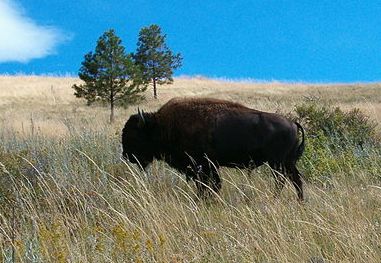
A bison in the National Bison Range in Montana. Photo by Paul Frederickson.
Prairie grass loves the buffalo that eat it.
It’s a mutual love story that began during the Miocene epoch about 23 million years ago. This was the time when kelp forests appeared in oceans, birds and mammals were well established (including our ancestors, who were splitting from chimpanzees), and grass-grazer ecosystems took over large parts of the world.
Grass is like few other plants. Its stems grow underground. What we see as grass are merely the leaves. Buffalo can eat the leaves (or we can chop the leaves off with a lawn mower), and the grass can keep on growing.
As grasses evolved and expanded their territories, so did animals to eat them, as varied as deer, elk, elephants, wooly mammoths, sheep, horses, zebras, rabbits, cows, buffalo, and bison. (American bison are called “buffalo” because they were named by French fur trappers, who apparently weren’t taxonomy experts.) Large grazers were key to the spread of grasslands.
Here’s why: trees will take over any land they can, including prairies. As they grow, they block the sun, killing the grass. So for grass to flourish, trees must be eliminated. Grazers do this by eating seedlings as they munch the grass and by trampling the seedlings. They also eat other kinds of plants that grow with above-ground stems and would compete with the grass.
So buffalo need grasslands for grazing, and grasslands need buffalo to keep arboreal intruders from encroaching on their territory. America’s Great Plains and the American bison created and maintained each other.
If we look at it from the point of view of grasses, we can see that they get to reign supreme by putting up with the inconvenience of being grazed on from time to time. Grasslands cover almost a third of the planet’s land: they’ve found a winning strategy.
When I was researching ecologies to worldbuild a planet where plants might have more ability to control their environment, time and again I found situations were plants used animals for their own ends — that is, plants would intentionally use animals, if plants could scheme. And if plants could scheme…
The ratio of flora to fauna on Earth is 100 to 1. We humans consider ourselves the dominant species, but I think we should be more humble. There’s a lot going on, and we’re just one small player in a big, complicated game where we might not be much loved beyond our usefulness.
On Thursday, starting at 11 a.m. (CST), I’ll be in a Reddit AMA (Ask Me Anything) at the Fantasy subreddit to talk about writing, my novel Semiosis, and, of course, anything else.
My novel Semiosis was released by Tor a month ago, and here’s some of the latest news and reviews.
I wrote an article about writing non-human points of view at Unbound Worlds: “…plants lead lives of quiet desperation, in constant combat using a variety of weapons.”
At the signing at Anderson’s Bookstore in La Grange, Illinois, I talked about what would happen if I could practice photosynthesis. You can see a video of the 5-minute talk here and read the short essay here.
Today, at Lawrence Schoen’s blog Eating Authors, I describe my most memorable meal – a snack at the Eiffel Tower that proved something essential about the French people.
You can read an interview of me by Sean McLachlan, who helped me write the book as a beta reader, at Black Gate, and an interview by Paul Semel.
Photo by Sue Burke at the Mitchell Park Conservatory.
A “poop plant” is mentioned a couple of times in Semiosis:
The poop plant has proven possibilities for mischief. It looks like a pile of brown plump stems. — Chapter 3
The carved lid to a child’s chamber pot made me laugh out loud, but no one was in a mood to laugh, so no one looked pleased. “It’s the pattern,” I explained. It looked at first like the intricate pattern of lines on a Glassmaker tile mural. Subtle differences in the height of certain parts of the pattern revealed a small, low plant. “It’s a poop plant,” I said. — Chapter 5
Where did the idea for the poop plant come from? From Earth. Specifically, the Euphorbia decaryi from Madagascar. The succulent grows there in dry forests and shrubland, and like many other native species, it’s endangered due to loss of habitat and collection. For some ambitious gardeners, it makes an interesting and rewarding houseplant.
I used to live in Milwaukee, Wisconsin, and I first encountered the plant at the Mitchell Park Conservatory — also known as The Domes for its three domed greenhouses. The Desert Dome has a special Madagascar collection, including many kinds of Euphorbia. One day, during a visit, I saw what looked like a pile of old, dry turds on the ground. But no, it was the Euphorbia decaryi, with its lumpy grayish-brown stems bearing just a few leaves too tiny to notice. It didn’t look like something good to eat, which might serve as protection against predators.
The existence of a plant camouflaged as animal feces was a detail I knew I’d have to use in my writing — somehow. Eventually, I had the opportunity to have a little fun with it in Semiosis.
Our home planet, the Earth, is an amazing place. It has poop plants.
(A brief, moralizing rant cut from the original manuscript because the book was getting too long.)
Sadly, I am the only one of my species. In addition to genetic advantages, sexual reproduction provides certain physical pleasures, and thus some hedonistic plants are self-pollinating despite the congenital defects that often occur; self-pollinators must make many seeds to ensure a reasonable number of healthy ones.
More abstemiously, I create asexual, agamospermic inflorescences whose always-healthy seeds result from modified meiotic division of the chromosomes inside the reproductive cells in virgin ovaries, rather than through fertilization by my own pollen. Some genetic crossover occurs, providing a certain amount of variation, although the offspring are very nearly clones. It is the best I can hope for, being alone.
Instead, I use flowers and pollen mostly for other purposes: pollen for communication, and flowers for the sheer beauty.
 I’ll be at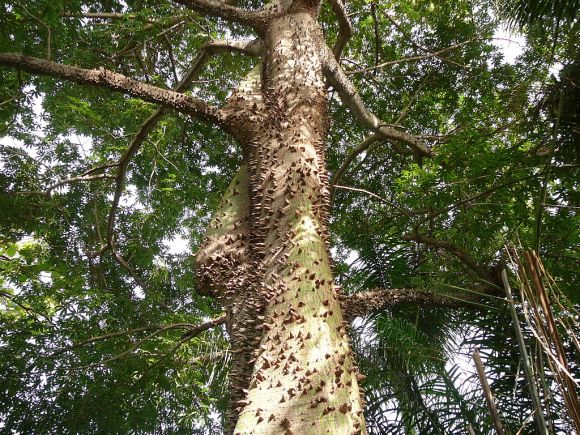
 On Thursday, starting at 11 a.m. (CST), I’ll be in a Reddit AMA (Ask Me Anything) at the Fantasy subreddit to talk about writing, my novel Semiosis, and, of course, anything else.
 (A brief, moralizing rant cut from the original manuscript because the book was getting too long.)
 Semiosis