Categories
Uncategorized

Exactly where is the Planet Pax?

CapturaPaxStar

In Semiosis, our colonists wake up in orbit around a planet at star HIP 30815. Where is that? In the constellation Gemini. But let’s get more precise.

The above photo, which pinpoints the location, comes from In-the-sky.org, which offers guides to the night sky specific to your location. The site can be set to “night mode” so you can use it as you stargaze.

The “HIP” in the name refers to the Hipparcos Catalog, one of a great many lists of stars. The Hipparcos catalog was compiled from the data gathered by the European Space Agency’s astrometric satellite Hipparcos.

The number basically follows the order of the object’s right ascension, that is, its east-west coordinate starting at the March equinox. This is the celestial equivalent of terrestrial longitude, so the number is merely the star’s place in an ordered list.

The “f” designates the planet. By convention, planets are given letters in the order they are discovered. That means there are five other planets at star HIP 30815 (according to the novel, not current science, which hasn’t identified any so far).

You can get much more detailed scientific information about the star at Universeguide.com.

Sky-map.org offers photos and additional technical details, such as the variety of names the star has: HD 1989, HD 45506, TYCHO-2 2000, TYC 1328-38-1, USNO-A2 1050-03646671, BSC 1991, HR 2340, and HIP 30815.

Finally, here’s the passage from Chapter 1 of the novel that specifies the star:

We awakened, cold and dizzy, with our muscles, hearts, and digestive systems atrophied from the 158-year hibernation on a tiny spaceship. The computer had brought us into orbit, sent a message to Earth, then administered intravenous drugs.

Two hours later I was in the cramped cabin trying to sip an electrolyte drink when Vera, our astronomer, came flying in from the control module, her tightly-curled hair trailing like a black cloud.

“We’re at the wrong star!”

I felt a wave of nausea and despair.

Paula was spoon-feeding Bryan, who was too weak to eat, and she seemed calm, but her hand trembled. “The computer could pick another one if it was better,” she said.

“It did!” Vera said. “It is. Lots of oxygen and water. And lots of life. It’s alive and waiting for us. We’re home!”

We were at star HIP 30815f instead of HIP 30756, at a planet with a well-evolved ecology, and, I noted, abundant chlorophyll. The carbon dioxide level was slightly higher than Earth but not dangerous. Seen from Earth, both stars were pinpricks in the Gemini constellation near Castor’s left shin. As planned, we named the planet Pax, since we had come to live in peace.

Categories
Uncategorized

Fall is here, and trees will demonstrate their power

Autumn officially began on September 22. For some plants, the angle of the sun tells them what season it is. Others rely on the temperature. In any case, at this time of year, deciduous trees drop their leaves to prepare for winter.

The 2018 Fall Foliage Prediction Map at Smokymountains.com has a week-by-week interactive map showing regional peak colors for the United States. (See photo above, which is for October 8.) The web page also explains the science behind falling leaves and has downloadable coloring sheets for children.

When the time comes, trees cut off the flow of nutrients to leaves, which lose their chlorophyll, and beautiful underlying colors are revealed. (This season is typically called “fall” in the United States versus “autumn” in Britain for historical reasons.)

Years ago, I witnessed something that showed me the power of trees — not their strength but their autonomy.

The air could not have been more still that autumn morning, yet a tree near my back door was losing its leaves. One by one, they fell of their own weight as the tree let go. Leaves dropped steadily and eerily through the becalmed air.

Usually we think the wind sweeps the autumn leaves from the trees, and maybe it provides an extra tug. But trees decide to shed their leaves at the moment they deem best. Though they seem almost inert, buffeted by wind, soaked by rain, baked by sunshine, and parched by drought, they control their fates as much as any of us. We, too, can be uprooted by disasters, attacked by illness, cut down by predators, and suffer wilting thirst. Being mobile does not make us less vulnerable. Or more willful.

So on that cool morning, I watched a tree prove that it was the master of its destiny. One by one, it clipped its bonds to its leaves, and they dropped off. The tree was taking action, and no one and nothing could stop it.

Categories
Uncategorized

Reading recommendation: “Nine Last Days on Planet Earth” by Daryl Gregory

I just read the novelette “Nine Last Days on Planet Earth” by Daryl Gregory, and I loved it. If you liked my novel Semiosis, you might like this story, too.

You can read it for free at the Tor.com site, or buy it for your e-reader for only 99¢. Purchase links are at the end of the story.

It tells what happens to a boy when seeds from outer space land on Earth. Are the seeds a disaster? How do they change people’s lives? How do they change the Earth? Why were they sent? None of the answers come easy for the boy in the story, and some of the answers might surprise you, especially in the last few paragraphs when he finally understands.

Categories
Uncategorized

Do your neglected houseplants want revenge?

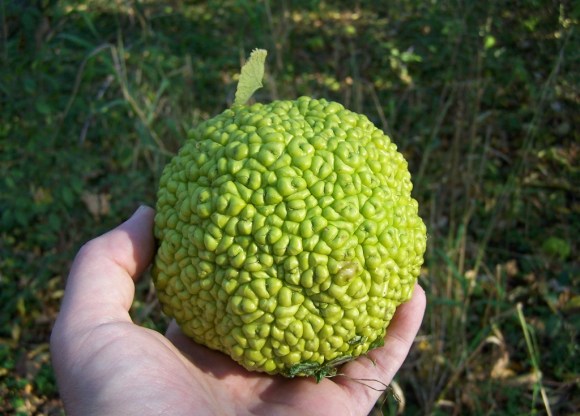
Osage_orange_1
An osage orange. (Credit: https://en.wikipedia.org/wiki/Maclura_pomifera)

Do your houseplants hate you? No, they don’t, no matter how much you neglect them. In fact, they’re praying to their green gods for your prosperity. They’ll struggle on as best they can, offering you beauty and silent non-judgmental companionship in exchange — they hope — for more or less regular watering and a spot near sunlight.

Plants need you, no matter how inconstant you are. A lot of the vegetable kingdom depends on animals, in fact, and plants haven’t always chosen well.

Consider this story of apples and oranges — osage oranges, to be exact.

First, the apple: colorful and tasty. Many animals love sugary treats. Apple trees make sweet fruit for us to munch on so we’ll throw away the core, and the seeds can germinate in a new place. (They don’t trust us much, though. They’ve made their seeds too bitter to consume so we’ll do our job right.)

How has this strategy worked out?

Apples originated in central Asia, and ancient peoples brought them east and west. When apples reached North America, they found a champion named John Chapman, “Johnny Appleseed,” who brought orchards to the United States frontier. In the 20th century, with more human help, the trees conquered large portions of Washington State. Now, 63 million tons of apples are grown every year worldwide, much of them in northern China.

From the apple trees’ point of view, it doesn’t get better than this. They grow worldwide and get lots of tender loving care. Human beings have served them very well.

In contrast, there’s the osage orange tree. It also produces fruit: green, softball-sized, and lumpy, full of seeds and distasteful latex sap. No one eats it. The tree originated in North America and once grew widely, but by the time European settlers arrived, its territory had shrunk to the Red River basin in eastern Texas. How did it fail?

The fruit had appealed to the Pleistocene’s giant ground sloth, a member of North America’s long-lost megafauna. The sloth scarfed them down, not chewing much, and the seeds traveled safely through its digestive system, emerging in new territory. Then, 11,000 years ago, human beings came to North America and couldn’t resist the allure of a couple of tons of meat per slow-moving beast. Giant ground sloths disappeared, and six of the seven species of osage orange also went extinct.

Why haven’t the remaining trees adapted their fruit to contemporary tastes? Because trees live for a long time, and 11,000 years ago for them is like the High Middle Ages for us. Lucky for them, humans find their wood useful and rows of the trees effective windbreaks, so they currently grow across the United States and the world.

Still, useful wood isn’t much to offer the animal kingdom. Plants usually bribe us with food, the way that prairie grass entices grazers like bison to clear its domain of weeds. The bison nibble away weeds at the same time they munch on tasty grass leaves, which grass plants can easily replace. There used to be a lot more bison in North America, though. This strategy is starting to look shaky.

Flowering plants give bees nectar in exchange for hauling pollen from flower to flower, but bees seem to be having a rough time these days, too. If they go, both wild and domestic plants are in deep trouble.

Plants find animal partnerships tempting. We’ll work hard for a fairly low price. But we’re unreliable and short-lived as individuals — and too often as species.

Back to your houseplants. Many of them likely originated in tropical rainforests. Your living room resembles a jungle: warm, reasonably humid, and moderately lit. Growing in confinement there isn’t such a bad life.

You, on the other hand, are fragile, distractible, hyperactive, and a bit murderous of your own kind as well as other species. Have your houseplants fallen into good hands? Can apples rely on us, and for how long? Are osage oranges one more extinction away from their own disappearance?

Your houseplants suffer from existential angst. Food is love, and so is fleeting beauty. They give their all for you. Go water them, offer reassurance, and consider what you owe to plants. You — and other species — need to be there for them now and in the future. Make them happy. Survive.

(This article originally appeared at the Tor/Forge blog.)

Categories
Uncategorized

Plants are sneakier than we thought

It’s long been known that acacia trees in Central America have a mutual relationship with ants. The ants guard the trees, and the trees give the ants food and a place to live. But an enzyme in the acacia food makes ants dependent on the tree. The ants can eat no other food and must protect the tree as their only source of sustenance. They become true service animals.

In another case of mistreating insects, it seems that the “love vine” or Cassytha filiformis, which is a vine-like parasitical plant, not only steals nutrients from other plants, it steals from wasp galls, too. This is a parasite parasitizing a parasite — there is no honor among thieves.

Another parasite, Pilostyles hamiltonii, doesn’t simply sink rootlike structures (haustoria) into another plant, it lives inside its host entirely. Only its flowers emerge, erupting out of the host plant when the time is right. Imagine suddenly breaking out in alien flowers.

If you can’t steal from them, kill them. Some flowers produce toxic nectar. Why they do that isn’t clear. Honey made from toxic nectar is toxic to humans, and in the past, we’ve used it as a weapon. The only thing sneakier than plants are human beings.

Finally, there’s plant blindness — our blindness to plants. This Youtube video by biology student Benedict Furness explains the danger of failing to see plants and how we can overcome it. And we should. Plants are dangerous and aggressive, and we fail to see them at our own peril.


Categories
Uncategorized

Where to find me in early September

I’ll make three public appearances in the first two weeks of September.

On Tuesday, September 4, from 6:30 to 8:30 p.m., I’ll be at the American Writers Museum in Chicago. I’m part of the Fearless Women in Science Fiction panel with Mary Robinette Kowal, whose latest book is The Fated Sky, and with Tessa Gratton, author of The Queens of Innis Lear. I’ve met them both before, and they and their books are amazing. You can find out more about the panel here at the tickets page and at the Facebook event page.

On Sunday, September 9, I’ll be at the Kerrytown Book Festival in Ann Arbor, Michigan. I’ll appear on a panel with Mary Robinette Kowal again and with Jacqueline Carey. Our panel is from 3 to 3:45 p.m., with a book signing from 3:45 to 4 p.m. You can find out more about the festival at its website and Facebook event page.

Finally, on Monday, September 10, at 7 p.m., I’ll be at the Cromaine Library in Hartland, Michigan, as part of a series called Sallie’s Author Visit. I’ll talk about my novel and getting published. Here’s the library’s webpage and details about the visit.

If you’re in Chicago or Michigan, I hope I get to meet you.

— Sue Burke

Categories
Uncategorized

A review of “Children of Time,” by Adrian Tchaikovsky

ChildrenOfTimePeople who had read my novel, Semiosis, recommended this book to me, so I bought it, and they were right, it’s a good book. Later I learned that Adrian Tchaikovsky had provided the extremely favorable cover blurb for the British edition of my novel. I owe him one for that.

There’s a lot to love about Children of Time. Tchaikovsky probably doesn’t know it, but in the Kindle edition, at the 99% mark (that is, at the very end) this sentence has been highlighted by 686 readers: “Life is not perfect, individuals will always be flawed, but empathy — the sheer inability to see those around them as anything other than people too — conquers all, in the end.”

This assertion is the rocket fuel that propels the book to science fiction’s heights. Our better natures triumph.

Here’s the official description:

“Winner of the 30th anniversary Arthur C. Clarke Award for Best Novel

“Adrian Tchaikovsky’s critically acclaimed, stand-alone novel Children of Time, is the epic story of humanity’s battle for survival on a terraformed planet.

“Who will inherit this new Earth?

“The last remnants of the human race left a dying Earth, desperate to find a new home among the stars. Following in the footsteps of their ancestors, they discover the greatest treasure of the past age — a world terraformed and prepared for human life.

“But all is not right in this new Eden. In the long years since the planet was abandoned, the work of its architects has borne disastrous fruit. The planet is not waiting for them, pristine and unoccupied. New masters have turned it from a refuge into mankind’s worst nightmare.

“Now two civilizations are on a collision course, both testing the boundaries of what they will do to survive. As the fate of humanity hangs in the balance, who are the true heirs of this new Earth?”

Just as I had been told, the book touches on some of the same themes as mine: human beings attempting to colonize other planets, first contact with non-human life forms, and the sad certainty that humans will make at least a few foolish choices. Tchaikovsky approaches those questions from an entirely different angle, though, one that produces a different but very satisfying story.

He also uses some wise storytelling techniques. The narration alternates between the stories of humans and uplifted spiders. He finds a way to follow the same human beings across a long period of time (600 pages and thousands of years). The new masters of humanity’s last refuge, the spiders, go through a great many generations (this is not a spoiler) but they keep the same names. All this helps the reader move easily through a complex and ambitious plot.

In the end, the humans and spiders enter into direct conflict, but they don’t share the same culture or technology, so they don’t want the same outcome from the conflict. This is the ending that inspired so many highlighters.

Permeating both his book and mine is this question: How would intelligence differ in different species? It’s a question with as many right answers as there are species. Tchaikovsky’s book considers what spiders would think if they could think. He works through that question with patience and logic and creates a fascinating alien civilization.

I have only one quibble. The ideal reader for this book would have arachnophobia. I do not, and now I wish I did so I would have enjoyed the book even more as I overcame my fears during the course of the story. Here on Earth, I admire the spiders I encounter, even the ones inside my house — they eat mosquitoes, so I consider them allies. What if we could go to the stars with these clever beings? This book makes me want to do that.

Categories
Uncategorized

Why writers hate (some) editors

Every writer needs an editor. Another pair of experienced eyes can strengthen any written work. But there’s a right way and a wrong way to edit.

First, let me clarify that there are several kinds of editing, generally falling into these three categories:

• Developmental, substantive, or structural editing helps give overall shape to the piece: what to include or exclude, how to control the pacing, and how to make sure that the piece flows logically from beginning to end. This kind of editing should be done fairly early in the process, and it’s what a critique group ought to do. It’s “big picture.”

• Copyediting or line editing is what most people who aren’t trained as editors (yes, you can go to school for that) think of when they think of “editor.” Copyediting should fix grammar, usage, tangled syntax, and mistakes, and in general should polish the prose. This is what I’m going to be talking about because this is where wannabe editors get confused and abusive. Copyediting works at the paragraph and sentence level.

• Proofreading or mechanical editing checks for typos and makes sure that a style sheet is applied (whether you abbreviate months, spell out numbers, and so on). This is sometimes confused with copyediting by wannabe editors who are tasked to proofread but who get over-ambitious. Proofreading should look at the individual words and punctuation marks.

How do you copyedit correctly? Here is the rule: Only suggest changes to correct an objective error or problem. “Objective” means you should be able to explain the precise reason for the change. “In this sentence, the antecedent is separated from its pronoun.” “There might be too many short sentences in a row in this passage.” “The reader would be helped if the attribution were moved up in the quote.” “This paragraph isn’t in chronological order and is confusing.” “Bullet points and parallel construction could work well here.”

Any piece of writing can be changed in an almost infinite number of ways, however. Just because something can be changed, that doesn’t mean it should be changed. You are not a good editor because you can see all the possible changes. You are a good editor because you can see all the necessary changes. If the meaning is easy to understand, the writing won’t need much changing at all.

Bad editors want to change things that don’t need to be changed. They tip their hand in their explanation for their edits because they can cite no objective reason. They say something like, “I made it sound better.” “It reads smoother.” Why? “It just does.”

Usually it doesn’t sound better or read smoother — not objectively. “Sounds better” is a subjective judgement. The wannabe editors believe it sounds better because it does — to their ears. This is what these wannabe editors actually mean but don’t realize that they mean: “It sounds more like I wrote it.” Their changes sound better to their ears because we all love the sound of our own voice. My voice is uniquely beautiful to me. You have a voice, too. It’s not like mine, yet it should be respected.

When bad editors change your writing “to sound better,” they make it sound like their own voice, not like yours. In the process, they silence your voice. This may infuriate you, and it should.

You have a right to be yourself. Your writing ought to reflect your voice, and it should sound like you wrote it, not like someone else did. Good editors, if they fiddle with the voice at all, try to make the writing sound even more distinctively like the writer’s own unique, beautiful voice.

Good editors respect and celebrate the writer. They do not impose their own voice. They only change what needs to be changed. Writers love editors like that.

— Sue Burke

Categories
Uncategorized

Where to find me at Worldcon

I’ll be at Worldcon 76, the World Science Fiction Convention, from August 16 to 20 in San Jose, California. Here’s my official schedule. I’ll also be working as staff of the Worldcon newsletter, The Tower.

Autographs, Friday, August 17, 10:00 to 11:00 a.m., in the Convention Center Autograph Area
Also signing during that hour will be Charlie Jane Anders, Annalee Newitz, Richard Hescox, G. David Nordley, and JY Yang. This is a good time to come say hi, no autograph request necessary. I don’t expect long lines.

Exploring a Wider Universe: Beyond the World of Anglophone SFF, a panel on Friday, August 17, 5:00 to 6:00 p.m., in 210B
A tremendous amount of high-quality science fiction and fantasy is being published around the world. In XB-1 in Czechia, in Nowa Fantastyka in Poland, in Hayakawa SF in Japan. In countries like Mexico, Spain, Nigeria, France, Italy, Hungary, South Korea, and many more. What is being published? Join us as we chart this universe of stories that English readers may not be familiar with, but should be!
I will be moderating. Panelists: Rani Graff, Yasser Bahjatt, Gerardo Horacio Porcayo, Crystal Huff, Yao Haijun.

Beyond The Border II: Borders, Crossings, and The Lands Beyond, a panel on Saturday, August 18, 2:00 to 3:00 p.m., in 210B
Some of the first SF books were written in Spanish. Some of the most prominent speculative films of the last few decades have a Mexican as a director. Speculative fiction has taken many shapes in Spanish throughout history, and now we want to talk beyond the past and the present and into the future. We want to think about the ways SF written in Spanish might be evolving and the routes it is taking. What have the borders done? What are the similarities and differences with English and between Spanish countries? Have geography and language created something different on the other side? Where do we imagine it may be going? Panelists will discuss in Spanish with an English translator for non-Spanish-speaking audience members.
I will be moderating and translating. Panelists: Gabriela Damián Miravete, Gerardo Horacio Porcayo, José Luis Zárate, Andrea Chapela Saavedra.

Broad Universe Rapid-Fire Reading, Saturday, August 19, 210G
Broad Universe is a nonprofit international organization of women and men dedicated to celebrating and promoting the work of women writers of science fiction, fantasy and horror. In our Rapid-Fire Reading, members will read a few minutes of their works: just enough to whet your appetite. Come see how many genres we can jam into one group reading. I’ll tell you what would happen if I were a plant.
Loren Rhoads moderator, and quite a few of us presenting scrupulously timed four-minute-max readings.

Poetry Reading, Sunday, August 19, 11:00 a.m. to Noon, 212C
The Science Fiction and Fantasy Poetry Association (SFPA) was created in 1978 to bring together poets and readers interested in speculative poetry. Some of its members will share their favorite speculative poems in this reading.
G.O. Clark, moderator, Mary Soon Lee, John Philip Johnson, Sue Burke, Alan Stewart, Denise Clemons, Andrea Blythe.

Categories
Uncategorized

“Semiosis” is now available in Great Britain and Australia

HarperCollins has just published a paperback, ebook, and audiobook edition of Semiosis in Great Britain available today, August 9, and in Australia.

The cover art, similar to the American cover art, features the leaves of a sundew plant (Drosera). The dew-like drops on the hairs of its leaves are actually a kind of glue that attracts and traps insects. Then the hairs and tentacle wrap around the victim and excrete digestive fluid. The leaves are also sometimes referred to as “tentacles.” The idea of motile, flesh-eating tentacles on plants is creepy. I’m glad sundews are small, because they grow in many areas of the Earth, including the American Midwest, where I live.

The text hasn’t been adapted to British English, which disappoints me a bit. I would have enjoyed seeing the word “color” with an extra U.

British author Stephen Baxter was given an advance copy, and he said this: “Semiosis combines the world-building of Avatar with the alien wonder of Arrival, and the sheer humanity of Atwood. An essential work for our time.”

I am blushing.