Categories
Uncategorized

Science fiction vs. literary fiction: Losing control

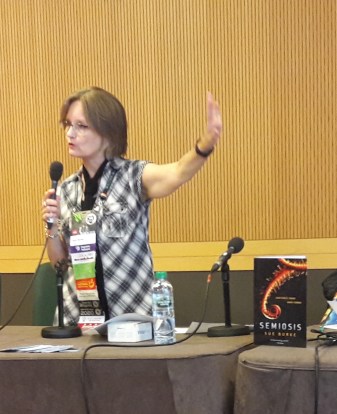
DeepDish03oct19.In case you couldn’t attend the Speculative Literature Foundation’s Deep Dish reading October 3 at Volumes Bookcafe in Chicago, here’s the essay I read. It appeared in a longer form at From Earth to the Stars, the blog of Asimov’s Science Fiction Magazine.

Tonight I want to talk about a big difference between science fiction and literary fiction. The difference starts with the idea that we all need to achieve self-realization. We’ve been told this by Sigmund Freud and Carl Jung, among others, because if we understand ourselves deeply, we’ll awaken our highest potential and find inner peace.

On the other hand, Martians could suddenly land and blast all of humanity into ashes. Knowing our true selves won’t save us from that.

This way of thinking about things — that external events matter more than individual self-realization — might account for the difficulty some people have with science fiction. Its stories tell an uncomfortable truth, according to Barry N. Malzberg, an author known for his dark humor.

In 1980, Malzberg tried to define science fiction. He said it “holds that the encroachment of technological change will make the future different and that it will feel different to those within it.… Lasting, significant change … is uncontrollable and coming in uncontrollably. Regardless of what we think or how we feel, we have lost control of our lives.” This is “inimical to the middle class (which has been taught that increased self-realization is increased control). It will be these changes — those imposed extrinsically and by force — which really matter.”

He wrote this in 1980. How much has changed since then, and how much control have we lost?

Cyberpunk appeared in the 1980s, and it criticized electronic society and the way it might control us. If cyberpunk dystopias haven’t become real, these warnings weren’t in vain because the future isn’t over yet.

So far, we’ve lost anonymity, for one thing. Now anyone can be famous whether they want to be or not. You can, deservedly or by accident, get mobbed on Twitter, sometimes including credible death threats. You can’t hide, and nothing is forgotten. We can never be anonymous again.

Another thing we’re losing is truth. In the 1980s, unofficial lies had a hard time spreading. Now, the barriers to retelling lies have fallen to zero, and “truth” has become weaponized.

What can we do about the loss of anonymity or truth? Not much. Even if you don’t use the internet, the internet will use you.

Technology also effects the climate, weaponry, medicine, legal and illegal drugs — and the economy, including our ability to earn a living wage. Our world is changing, and we have problems.

Yet we keep on telling science fiction stories in the face of knowing that our lives and the lives of our characters are in many ways beyond our control. Despite that, we do something puzzling: Some of our stories don’t spiral down into despair.

I suggest that’s because deep down we understand that self-realization won’t save us, but something else might. If we understand our world and universe, we can fight despair and even dabble in optimism.

I may know my true self perfectly, but that won’t stop the Martians. If I have a phaser and set it on stun, I can hope to slow down the Martians long enough for peace talks.

Now, of course, you should try to know yourself. It will bring you benefits like increased self-control, which we all need. But that wisdom alone won’t save us from external out-of-control change. Our understanding of science and technology might. We can imagine how to respond effectively. That kind of knowledge is power, and it’s what fuels our genre.

Categories
Uncategorized

September sale

In case you or someone you love hasn’t read Semiosis yet, the ebook edition is on sale for the rest of September for only $2.99 wherever ebooks are sold. More information is here.

InterferenceCover_SmallThe sequel, Interference will be available October 22 as an ebook, audiobook, or hardcover. Links to on-line and brick-and-mortar booksellers are here. You can read Chapter 1 here.
Incidentally, Semiosis has a Wikipedia page.

Semiosis is available in French, and through the magic of translation, I have an interview about it in French at the site of the publisher, Albin Michel Imaginaire.

Semiosis is also available in Japanese.

Categories
Uncategorized

“Interference” has a surprise for my husband


Dedication_Jerry
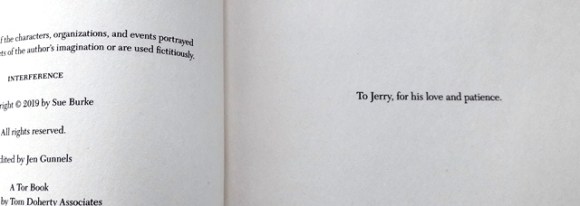
To Jerry, for his love and patience.

I’ve received an early copy of Interference. The book has a surprise for my husband, Jerry. Today is his birthday, by the way.

The novel will be officially released on October 22 (you can find out how to preorder it here).

Categories
Uncategorized

I’ll be at two Volumes Bookcafe events in Chicago in October

Deep Dish October 2019The Speculative Literature Foundation’s October 3 Deep Dish SF/F reading in Chicago will feature Silvia Moreno-Garcia, Jane Rosenberg Laforge, and Scott Huggins. The Rapid Fire Readers that evening will be me, Mary Anne Mohanraj, Jeremy John, and Anaea Lay. I’ll read an essay about a key difference between literary fiction and science fiction.

The readings will start at 7 p.m. at Volumes Bookcafe, 1474 N. Milwaukee Ave. Volumes offers snacks and beverages, including wine, beer, coffee, and soft drinks. And it sells lots of fine books and gifts.

More information is at the Volumes website and the Facebook event.

I’ll also be at Volumes at 7 p.m. on Thursday, October 24, to launch the novel Interference, the sequel to Semiosis.

More information is at the Volumes website and the Facebook event.

You’ll be very welcome at either or both evenings!

Interference launch Volumes

Categories
Uncategorized

Lucky Bamboo part II: The Rewilding

LuckyBamboo column for sale
Prim and pretty.

Last week in part I, I told how I had received two planters of Lucky Bamboo as gifts in February 2018. The plant’s scientific name is Dracaena sanderiana (it’s not really bamboo), and it’s commonly sold as stalks growing in water.

My planters (my sister-in-law calls them the Steves) kept growing and growing until I thought it best to plant them in dirt. Steve One adapted happily (see part I). It’s growing faster than ever and looks beautiful. Steven Two didn’t turn out as expected.

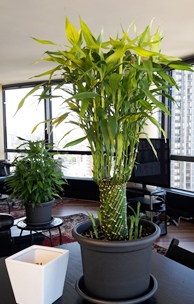
Above is a florist’s promotional shot of what Steve Two’s kind of planter looks like when you buy it: Stalks of Lucky Bamboo have been grown to wrap primly around a hidden plastic column. It’s pretty, and it was growing upwards at a healthy speed, so I thought if I put it in soil, it would continue to grow in a lovely tree-like shape.

LuckyBamboo excapes to outside
I want to grow free!

Well, the stalks grew upwards nicely. But that’s not all they did. They clearly do not like being confined to that column and have found new ways to grow.

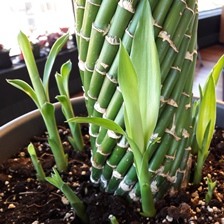
Shoots are poking up from the soil, as you can see, eleven at last count, but that number increases every week.

LuckyBamboo escape from within
Let me out!


They’re also poking through the inside of the plastic column.

I could trim the shoots back, but that seems cruel. Or I could just stand back and let anarchy reign. The plant seems aggressively healthy, and what more can I ask for?

luckybamboo-goes-wild.jpg
Anarchy reigns next to the original container. Steve One is in the background.
Categories
Uncategorized

Lucky Bamboo part I: The Joy of Dirt

LuckyBamboo sales pictureLucky Bamboo is usually sold as stalks that grow in water, and they’re often braided, curled, or bundled into attractive shapes. The plant is Dracaena sanderiana, and like many Dracaena varieties, it makes an excellent and attractive houseplant.

They’re notoriously easy to care for — unless you’re me. My problem is the same one I have with a lot of plants: they grow way too much.

I received two planters of Lucky Bamboo as gifts in February 2018 when my book Semiosis was published because its hero is a bamboo. Thank you, Lori and the Burke Family.

There are several solutions to overgrown Lucky Bamboo. In some cases, you can trim the plants — I couldn’t, given their tight arrangements. Instead, I opted for putting them into bigger containers. Then I moved to an apartment with abundant light (the building management calls it a greenhouse). When growing in water, Lucky Bamboo should stay out of direct light, but I had few shady places, so I decided to plant them in soil, hoping that in the new growing medium, they would feel comfortable in the afternoon sun.

Happy Lucky BambooThey are more than comfortable. Lucky Bamboo grows slowly in water. In dirt, they’ve sped into overdrive. Here’s what happened to one of the plants. The photo at the top of this article is used on florist websites. For a while, that’s exactly what I had.
Here’s what I have now (at left). Next to it is the original container, which now holds pine cones. The Dracaena stalks are flourishing and happy, and so am I.

The second arrangement is also flourishing — out of control. I may have made a glorious mistake.

Next week, I’ll post Lucky Bamboo part II: the Rewilding.

Categories
Uncategorized

Trees in deadly battle

This video (above or here) by Dimitar Karanikolov shows two minutes of a tropical rain forest viewed from above. The photographer calls it Forest Therapy. It’s intensely peaceful and relaxing.

It’s also a chance to see trees at war with each other. Trees — and all plants — compete mercilessly for light, even in some gardens where there are more plants than available sky. (Or if there’s enough sunlight, they fight over something else, like water.) In 1820, botanist and taxonomy pioneer Augustine Pyrame de Candolle said, “All plants of a given place are in a state of war with respect to each other.”

If you visit a tropical rain forest, the darkness at ground level may surprise you. Now look up. You can see a green ceiling, the forest canopy. That’s why it’s so dark. The leaves up there absorb all the sunlight.

Look down. On the forest floor, you can see a few ferns, struggling saplings, gaunt seedlings, some moss, and a lot of roots, but not much else. Few leaves grow beneath the canopy. It’s too dark. Everything aims for the canopy to grab the sunlight.

Trees use brute force, investing in thick trunks to carry their branches upward. Saplings stand here and there in the jungle, but young trees flourish only after an old tree crashes down, ripping a hole in the canopy. Light pours onto a waiting sapling that will rise like a titan.

Trees joust with each other. Softwood trees grow faster and outrace the hardwoods to reach the top first for their day in the sun. Hardwoods follow, slowly sawing their way up: hardwood branches, stirred by winds, grind against softwood branches and carve through, amputating softwood branches one by one.

When I see this video, I see trees wafting like gentle waves — and I see carnage, horrible sap-bleeding injury, and heartless brutal warfare. For me, a walk in the woods is both glorious and horrific, a place of exquisite cooperation and life-or-death competition. A tree faces its challenges fully armed and dangerous, an invaluable ally and a potent foe. Beware.

Categories
Uncategorized

“Semiosis” is now available in French

semiosis France

You can now get Semiosis in French. It’s just been published by
Albin Michel Imaginaire
.

I love love love the cover art.

The book has been getting good reviews, as far as I can tell (I don’t really speak French): “J’ai été intriguée, puis enchantée par le mystère de Pax !” “…si un ami, un parent, un jour vous demande de quoi parle la science-fiction, vous pourrez toujours lui tendre Semiosis et lui dire : ça parle notamment de ça.” “Semiosis a été un bouleversement. Une petite pépite de science-fiction qu’il serait dommage de laisser de côté.”

The translator contacted me with a few questions as she was working on it. As a translator myself, I was happy to answer. There was a lot of world-building, and I had to keep copious notes to keep all the details straight. Her questions:

1) Lizards: They’re mentioned several times, and I understand there are different species and sizes. But are winged lizards, moth-winged lizards, bug-lizards and moths the same?

The winged lizards, moth-winged lizards, and bug-lizards are all varieties of lizards. The moths are more or less insects.

2) Bluebird reefs: Are they reefs “made” by bluebirds? Are they mineral or maybe animal? Is there any link between the bluebird reefs and the land corals?

Yes, the bluebirds make the reefs, which are very large communal nests. They’re made out of mud, sticks, grass, etc. They are unrelated to the land corals — although that’s a very logical question.

3) Boxer birds: Is the name due to aggressive behaviour?

Yes. The boxer birds will fight with other species. [This question probably owed to the multiple meanings of “boxer” in English. Does a boxer make or pack boxes, or does a boxer fight? It could be either, and the French word would be different for different kinds of boxers.]

4) Moderators: Are all Tatiana’s predecessors women? (I counted Paula, Vera, Sylvia, Rose’s mother, Rose herself, and 3 others are mentioned but not named.)

Yes, they are all women. [French is a gendered language, so again, the word for “moderator” might depend on their gender.]

5) Page 18, about a moon called Chandra, I feel like one or more words are missing from the following sentence: “That orbits almost the same Pax’s rotation.”

Yes, it should say, “That orbit’s almost the same as…” [She was apparently not working from the final copy-edited version.]

6) Page 32, could you explain what you mean with “I had brought a mind and a heart to Pax”?

That means he [Octavo] had brought both an intellect and sentiments: emotions and moral judgment.

Categories
Uncategorized

The fun of an Irish Worldcon

PanelAtWorldcon
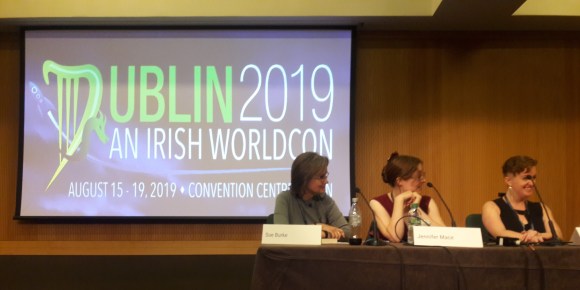
On Saturday afternoon, I participated in the panel “Into the Woods: How have forests shaped fiction?” with Navah Wolfe, Jennifer Mace, Sarah Gailey, and Seanan McGuire, and we had fun.
ECmHiJ6X4AEPH_0
This is what winterhazelly took from it. https://twitter.com/winterhazelly/status/1164615304451973121

Report: Dublin 2019, an Irish Worldcon
The 77th World Science Fiction Convention was held in Dublin, Ireland
August 15 to 19

Future Worldcons should be held in a Tardis. Popular events could be put on a time loop so anyone could attend even if they conflicted with other events. More importantly, every room for panels, ceremonies, readings, or other events could be bigger on the inside than the outside so everyone would fit in.

As with some other Worldcons, space became an issue in Dublin. The convention was sold out at about 5,800 people, which was a few more than the Convention Centre Dublin (CCD) could handle. To accommodate that, the Spencer Hotel hosted children’s programming. The Odeon Point Square, a movie theater and unfinished commercial space almost a kilometer from the CCD, hosted the Art Show, book launches, acoustic concerts, craft workshops, art projects, displays, autographs, some panels, and the academic program.

Convention volunteers and venue staff did the best they could for crowd control cheerfully and efficiently. Despite the inconvenience, the snaking queues to get into events became good places to meet new people.

ReadingAtWorldcon
On Sunday afternoon, I gave a reading, specifically the opening of Chapter 6 from Interference, in which Stevland gets into an argument with a locustwood tree.

Other than that, the convention was splendid: well-organized and always on time. Events started at 9 a.m. with accessible yoga and a “stroll with the stars” morning walk, and ended in the wee hours at Martin Hoare’s Bar – known as Martin’s, named for the volunteer who was to be Fan Bar Manager but who died a few weeks before the convention.

The city of Dublin made visitors welcome with a good selection of hotels and other accommodations, convenient trams and buses, museums, sightseeing, restaurants, and bars. Like many people from overseas, I came early to tour the city and country, which was as green and beautiful as I’d been told.

During the Worldcon, thousands of tempting events vied for attention. I was drawn to panels, talks, readings, a couple of concerts, a medieval combat demonstration, a stand-up comedy show, and a dance; I wandered through the Art Show and Dealer’s area, perused displays and fan tables, attended parties, and spent a lot of time meeting friends from around the world. I could have also attended podcast recordings, plays, films, and workshops, gone on a treasure hunt, run through the park, and joined in role-playing or board games.

Convention organizers deserve praise for the volume, quality, and variety of programming, including some deftly made last-minute additions and changes due to crowds or popular demand. We never forgot for a moment the delight of attending an Irish Worldcon and being wished a hearty fáilte (welcome) at every turn. The convention newsletter, The Salmon of Knowledge, often included bits of local lore, such as the legendary origin of the Giant’s Causeway.

Like many people, I watched the Hugos in the overflow viewing area, the Second Stage, with the ceremony live-streamed on a large screen. The room had tables, a bar and a rapt audience. The ceremony, with charming and enthusiastic presenters, was marred only by a robot captioning system that we quickly learned to ignore after it turned Ada Palmer’s references to Lord of the Rings and Game of Thrones to “bored with the rings” and “cream of thrones” during her introduction to the Campbell Award winner. Of course there was a word or two by the evening’s recipients that ignited controversy, but that’s a feature of the Hugos, not a bug, and it seems to have accomplished something.

For me, one of the many highlightss of the convention came on Saturday evening at the Bright Club Ireland, a stand-up comedy show. Steve Cross made an obessively deep textual reading of The Hitchhiker’s Guide to the Galaxy to determine the exact date that the Earth is destroyed by the Vogons. (Listen to a version of it here on BBC radio.)

John Scalzi’s Saturday night “Dance Across the Decades” turned one of the CCD halls into a three-hour writhing, rhythmic celebration of fannish ecstasy. It may become legend. Its stomping, sweaty crowd no doubt broke at least three distinct safety regulations, but the CCD staff wisely turned a blind eye.

Categories
Uncategorized

“Semiosis” is on sale!

SEMIOSIS_comp_revGet an ebook of Semiosis for only $2.99. The sale is on during all of September.

The publisher, Tor, has links to all major ebook sellers here.