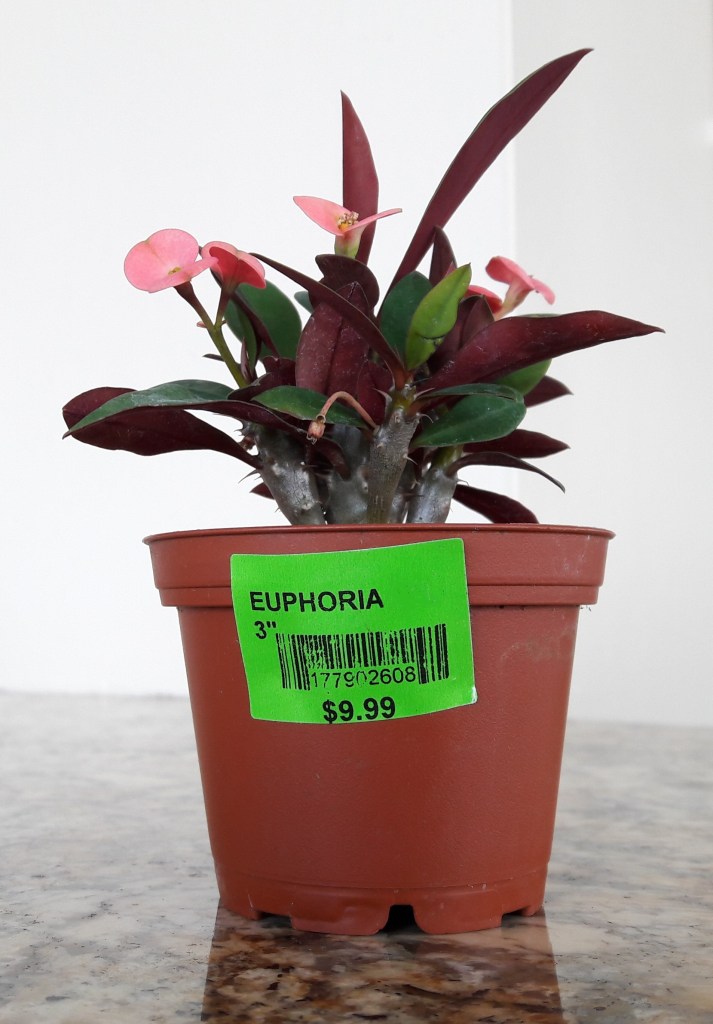
Euphoria: a feeling of elation.
Euphorbia: a flowering plant, often called “Crown of Thorns.”

Euphoria: a feeling of elation.
Euphorbia: a flowering plant, often called “Crown of Thorns.”

“Spring is the most beautiful and the most impatient season. Plants must grow fast or perish…”
— from Semiosis

I’m the guest at this week’s Tales From the Bridge: All Things Sci-Fi podcast. Sam and Kevin were a lot of fun and asked smart questions about topics ranging from plant sentience to feminism in science fiction.
You can listen to it on Apple Podcasts, Spotify, and Google Podcasts. Find it here:
TFTB Ep.32: A Conversation with Sue Burke
***
I also Zoomed in to the February meeting of the Beam Me Up Science Fiction Book Club. Our lively conversation was summarized in even livelier notes on the book club’s blog. Read it at Beamer Books.
When the sundew reaches with its tentacles for you, be ready to say “Adieu!”

“We had the sky up there, all speckled with stars, and we used to lay on our backs and look up at them, and discuss about whether they was made or only just happened.” — from The Adventures of Huckleberry Finn by Mark Twain.
***
If you look up at the sky at night, how many stars do you think you see? Perhaps you hear the voice of Carl Sagan from his television series Cosmos intoning in a way that inspired so many of us: “There are in fact 100 billion galaxies, each of which contain something like 100 billion stars. Think of how many stars, and planets, and kinds of life there may be in this vast and awesome universe.”
You actually see a lot fewer stars than billions, or even millions.
In the second century CE, the Greco-Roman astronomer Ptolemy created a definitive guide to the heavens, the Almagest, which listed the names and locations of only 1028 stars. In 1602 in Denmark, Tycho Brahe, perhaps the all-time best naked-eye astronomer, listed 1000 stars in his guide, the Progymnasmata. No one has counted since, but the estimate of the stars visible to the bare eye in a given place and night has doubled to 2000 — far short of a billion.
I know this, and when I look at the sky, I see a lot fewer due to big-city light pollution, yet it feels like billions. Why? Because I know they’re there.
In 1610, Galileo Galilei became the first person to peer through a telescope at the night sky. He saw “stars in myriads which have never been seen before, and which surpass the old previously known stars in number more than ten times.” He saw that the mysterious, murky Milky Way was not “celestial exhalations” as some had speculated but in fact “a mass of innumerable stars planted together in clusters.”
The Milky Way contains a hundred billion stars — and there are billions of galaxies. The Hubble Space Telescope focused deep on a speck of the sky in December, 1995, and photographed galaxies in all shapes and colors, several hundred of them never seen before.
The only stars we see with our bare eyes at night are in our own galaxy, the Milky Way — but even if we didn’t have telescopes peering ever deeper into the sky, the other galaxies would still be there, billions upon billions of stars indeed, out of sight but not out of mind.

Little stone cylinders that looked like screw threads: those were my first fossils. By early grade school I knew what fossils were — and what excitement to find a real one! They were common in the local white rock that I eventually learned was limestone. My little friends and I would eagerly pick through dusty new gravel looking for our very own fossils.
These screw-like things had served as a stalk for something called a crinoid that had lived in the sea. Sometimes I found loose individual plates of the stalk: the stalks looked like screws because they were made of many round flat pieces. Occasionally, I could find a bit of the flower-like thing at the top of the stalk, although the best place to see that was in museums. Museums had even better fossils, though, especially trilobites. I lusted for a trilobite and did not dare to dream of having my own dinosaur fossil, but I happily settled for crinoid stems.
Humble though they were, crinoids resembled nothing in my environment. They looked like flowers on long stalks, but they were animals, wondrously strange. They proved that another kind of Earth had existed, and that fact opened so many possibilities. The past had been different, the future would be different, too, and the present itself was unimaginably big for a grade-school girl in Milwaukee, Wisconsin. Those little round fossils made my childhood world enormous.
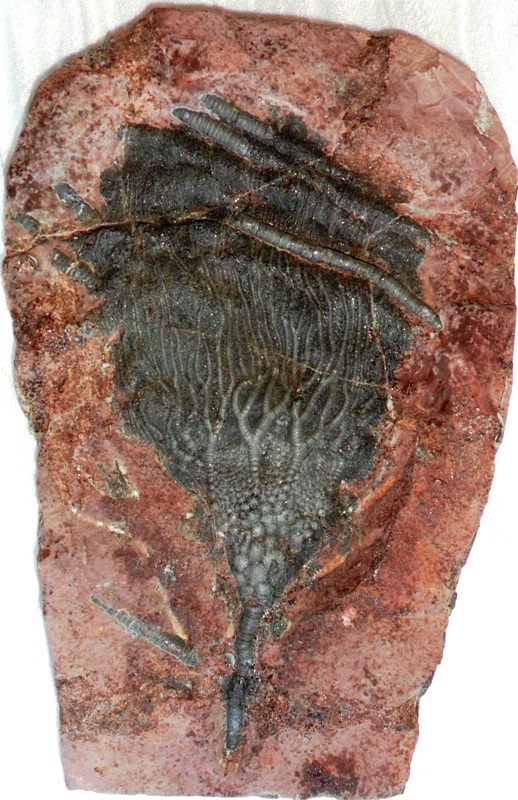
My husband got me the crinoid pictured here as a gift. He could not have guessed what it meant to me.
This specific fossil is a fine example of a species called Scyphocrinites elegans that lived in the late Silurian to the early Devonian. At that time, primitive plants had carpeted the mega-continents, Gondwana and Euramerica, providing homes to primitive arthropods. The shallow, wide oceans were filled with fish, shellfish, reefs, and trilobites.
The sea also held an abundance of crinoids, a species related to starfish, along with sand dollars and sea urchins. A few crinoids still live in the oceans, but so deep that we rarely see them. They spread their arms out like the petals of a flower to filter plankton from the water. Some are anchored in place, and some can “walk” with their root-like feet or drag themselves with their arms.
But the Scyphocrinites was different. It grew a “lobolith” or floating sphere that allowed it to hang upside down and drift with the currents. Star-shaped plates covered its beautiful calyx, the flower-like head. Because it could travel, it spread wide across the Earth.
This particular fossil came from the Sahara Dessert — how the world has changed over the eons! — specifically from the Errachidia Province of Morocco.
I can display it as a thing of beauty, but every time I look at it, I remember how excited I felt as a little girl to find proof of how big and astounding the world was. As the years have gone by, the world has grown even bigger and better.

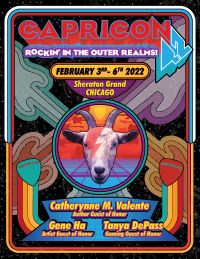
You’ll be able to find me in a variety of places at Capricon 42, a four-day science fiction convention held annually in the Chicagoland area. This year it will be from February 3 to 6 at the Sheraton Grand Chicago Riverwalk hotel downtown — in person with proof of vaccination and a high-quality mask. (Also with a virtual component. See you there, too!)
You can find me on some panels, and I’ll wander through the dealer’s room and art show looking for unique purchases. In the evening, I hope to pop into a few parties to meet old friends and make new ones. If you’re at Capricon, say hello!
My schedule:
How to Moderate Panels, Missouri Room, Friday, 2:00 p.m. Great moderation can make the difference between a mediocre panel and a fantastic one. Janice Gelb, moderator; Sue Burke, Helen Montgomery, Brother Guy Consolmagno.
Writing Serial Fiction, Huron Room, Friday, 6:00 p.m. Serialization has come to dominate many corners of science fiction and fantasy. What unique challenges does it present and how can they be managed or even used to make a work better? Mark Huston, moderator; Bob J. Koester, Kathryn Sullivan, Sue Burke.
Regional/International Fandom, Missouri Room, Saturday, 1:00 p.m. Hear about different fan cultures across North America and throughout the world from fans who live in places outside Chicagoland. Janice Gelb, moderator; Sue Burke, Alexander von Thorn.
We Can (Can We?) Fix Global Warming! Superior Room, Saturday, 2:00 p.m. Geoengineering, large-scale deliberate changes to the atmosphere (etc.) to deal with global warming, is almost a taboo topic in environmental circles, often met with open hostility. What are the possibilities, why are they so unpopular, and can we really avoid needing them? Sue Burke, moderator; Chris Gerrib, Brother Guy Consolmagno.
Whose Hero’s Journey? Erie Room, Saturday, 4:00 p.m. The Hero’s Journey is a storytelling staple. But to what extent does it encode a male point of view? People criticize the protagonists of Mulan and Captain Marvel for being “Mary Sues” who didn’t work to achieve their powers. Men get told to roll up their sleeves and work their way to the top while women have to struggle to be heard and recognized for their contributions. Is the Hero’s Journey fantasy for women about the fight to be acknowledged for the power they already possess? Maria Schrater, moderator; Karen Herkes, Ada Palmer, Sue Burke, Jeana Jorgensen, Michi Trota.
How I Wrote This, Erie Room, Sunday, 12:00 noon. A panel of authors will describe the path of a work of fiction from idea to first draft, second draft, beta reader, more drafts, and finally publication. Where did the idea come from and how did the storytelling take shape? Here’s a chance to look at how inspiration intersects with craft in real life. Maria Schrater, moderator; Sue Burke, Brendan Detzner, John Everson, Cassandra R. Moritz, Chris Gerrib.

I’ll be participating in the second annual online Stabbycon convention at r/fantasy at Reddit. Specifically, I’ll be on the February 1 panel about “Unusual Biology.” It should open around noon.
If you’re a redditor, drop in, join the discussion, and, as is the Reddit way, ask questions somewhat relevant to the panel topic.
If you don’t know much about Reddit, it’s a text-based social media site. What I love are the lively, unpredictable conversations. You can find plenty of humor, lots of comradery, and occasional glimpses of wisdom. I don’t post much, but I lurk regularly and sometimes upvote.

I’ve discovered that one more work of mine appeared in 2021, a republication of my translation into English of the short story “Francine (draft for the September lecture)” by Maria Antònia Martí Escayol, at Apex Magazine on December 28. This evocative, haunting story will make you wonder what’s real: after Renée Descartes’s daughter dies, he and his fellow scientists try to bring her back to life using 17th-century science.
As a reminder, here are my works that were first published in 2021 (and eligible for awards):
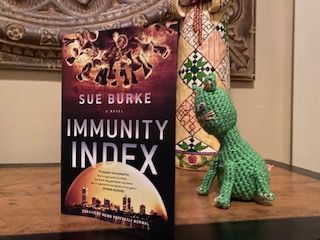
Immunity Index, a novel, published by Tor (read an excerpt). It’s about a coronavirus epidemic, but a much better one than our own covid-19 — because it’s over at the end of the book. Also, the novel includes a very loveable woolly mammoth.
“Embracing the Movement” by Cristina Jurado, which I translated into English, published in Clarkesworld Magazine’s June 2021 edition. The original short story, “Abrazar el movimiento,” won Spain’s Ignotus Award for Best Short Story 2021, the equivalent of a Hugo Award. The story’s lush prose hides horror.
Two of my short works were republished in 2021:
“Who Won the Battle of Arsia Mons,” a novelette about robots in a fight to the death on Mars, in Clarkesworld Year Twelve: Volume One (Clarkesworld Anthology).
“In the Weeds,” a short story about plants fighting climate change, in Over the Edge Again: The Edgy Writers Anthology. Other members of the Edgy Writers Critique Group shared some thoughts about their stories in these posts: “Sport” by Z Jeffries, and “Wild Heart” by Samuel Durr.

Wildfires have a “30-30-30 Rule”: they most likely burn when temperatures are above 30C/86F, winds are above 30 kph/18.6 mph, and humidity is below 30%. That threshold is being crossed more often lately.
What does this mean to trees? If we talked to them, we might learn their stories before the disaster.
The eucalyptus grove, planted for cellulose but abandoned when prices fell, has grown old and resin-rich, and now its denizens live in fear.
Cork oaks know that their bark, if left unharvested, will save them from small fires, but rarely do they get to keep their precious bark.
Lofty holm oaks hope they have grown higher than the flames will reach, but how can they be sure?
Some pines live fast, die young, and don’t care; a fire will open their cones for the next generation.
***
Photo by John McColgan, Bureau of Land Management, public domain. It’s sometimes called Elk Bath, and was taken on August 6, 2000, in the Bitterroot National Forest, Montana. It was one of Time Magazine’s Photographs of the Year 2000.


I had a few things published in 2021.
Immunity Index, a novel, published by Tor.
Library Journal gave it a starred review: “★ This dystopian biothriller reads like a 21st-century version of Michael Crichton’s The Andromeda Strain, crossed with George Orwell’s 1984. The clone sisters and their creator each provide alternating perspectives of a chaotic world and evince that individuals can make a difference. The story they tell is hopeful, heartbreaking, and compelling at every turn. Highly recommended for readers of dystopian science fiction or political technothrillers.”
Publishers Weekly: “Burke endows her characters with distinct personalities and conjures a frighteningly real sense of national destabilization as events spiral out of their control.…This hits close to home.”
Amazon named it one of the best SFF books for May, and Bustle recommended it as one of the 40 best books out in May.
***
“Embracing the Movement” by Cristina Jurado, which I translated, published in Clarkesworld Magazine’s June 2021 edition. The original story, “Abrazar el movimiento,” won Spain’s Ignotus Award for Best Short Story 2021, the equivalent of a Hugo Award. (Yay, Cristina!)
***
Two of my short works were republished in 2021:
“Who Won the Battle of Arsia Mons,” a novelette about robots in a fight to the death on Mars, in Clarkesworld Year Twelve: Volume One (Clarkesworld Anthology).
“In the Weeds,” a short story about plants fighting climate change, in Over the Edge Again: The Edgy Writers Anthology.