Categories
Uncategorized

The lyrics to Higgins’ song, “Grief Evergreen”

Photo by Sue Burke

In the novel Semiosis, Chapter 3 ends as Higgins says:

“I would go out to share some truffle with Pitman soon, and I would sing him a sad song about fear and hope, failure and healing, about sweet and fresh sap in leaves evergreen with grief. Maybe I could teach the pack to coo along. Music the Pax way. Cross-species communication. They never did that on Earth. Singing fippolions. Dancing fippokats. Helpful, talkative plants with a sophisticated appreciation of abstract ideas. Good times. They can happen. Wait and see.”

Here are the words to that song. Feel free to set them to music.

Grief Evergreen (Higgins’s Song)

People will die, and I knew that yesterday.

People will cry, and I know that now today.

I would have been fine just knowing that yesterday.

I didn’t want to learn I was right today.

(Chorus)

Fresh sap in the leaves evergreen,

clean and new every season,

grief evergreen.

The ache of a soul that lived a night too long,

the one that brought sorrow and failure and wrong,

the one I saw coming. I knew all along

I couldn’t stop it. I wish I were that strong.

(Repeat chorus)

Life is a song, and time never stops breathing.

I can’t be quiet, I can’t refuse to sing.

I can’t stop sunrise, and I can’t stop the spring.

It hurts more to keep silent. I have to sing.

(Repeat chorus)

Categories
Uncategorized

At last! Cover art for “Dual Memory”

Here’s the cover for my next novel, Dual Memory, available May 16 (but you can pre-order now).

I love the art by Mike Heath—the combination of organic and inorganic minds tells you a lot about the novel. The colors and motif suggest a frigid island with waves whipped by stormy winds. Under the stars, someone and something are thinking together.

The art was delayed because at first my editor at Tor suggested using art from an AI, since there is an aspiring artificial intelligence artist in the book. Then problems with AI art were revealed, and it didn’t seem like such a good idea. So the process started over with a human artist.

A review by Library Journal sums up the novel well, I think:

Antonio Moro, climate change refugee, undercover mercenary, and self-taught artist, teams up with a chatty rogue AI with ADHD and a whole lot of attitude in this cli-fi techno-thriller. After the “Anthropocene Tip,” the economies and social networks of Earth are collapsing. The Arctic island of Thule, bastion of the wealthy and almost militantly neutral Sovereign Practitioners Association of medical oligarchs, is under attack by global pirates. Antonio and the sophisticated band of machine intelligences led by his AI will bend the laws of humans and robotics to save themselves—and save the islanders from their own selfish consequences as well. A story of human greed wrapped in a thriller, fronted by a confused and frequently petrified human who sees all too clearly that the machines are already running the world and that the best thing he can do is to strap in for a wild ride.

VERDICT This rollicking thriller from Burke moves at a fast pace but manages to maintain its focus on the true threats of climate change and human hubris, all the while keeping readers riveted and entertained.

“Rollicking thriller.” I love that, too. Who doesn’t want to rollick?

Categories
Uncategorized

Where to find me at Capricon

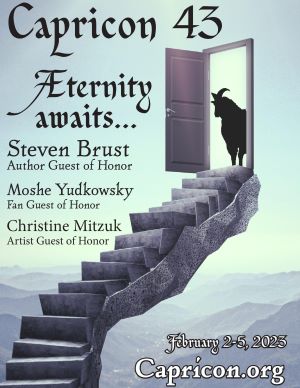
I’ll be at Capricon, a Chicago science fiction convention that’s been held annually for the past 43 years. This year it will be downtown from February 2 to 5 in the Sheraton Grand Chicago. The theme is “Eternity Awaits…”

“For centuries, writers and artists have speculated on What Comes After; some with smug anticipation, others in abject terror; with abated breath or baited curiosity. Often with a degree of bald humor — gallows, or otherwise. Mythologies and entire religious experiences have been built around these themes, as have stories, novels, poems, plays, movies, and television shows. The Afterlife has become not only a subject for contemplation, but also for entertainment, social commentary, and even adventure. At Capricon 43, we will embrace it all. At Capricon 43, Death is where the story begins.”

What will we do? Capricon describes itself this way:

“We celebrate the best of science fiction and fantasy, with a focus on literature. We are part of the world-wide fannish community, where diversity is encouraged and all are welcome. During the day, members attend programming on a variety of topics: books, movies, television, anime, space exploration, and science. There’s something for everyone including a special children’s track for our young fans and a teen lounge. Visit the dealer’s room, see the art show and attend the auction, get into gaming, karaoke, filk, or party all night long!”

The program of activities and events is here. You can attend for the whole weekend or just one day. Registration information is here.

I’ll be on some panels:

Saturday, February 4, 1:00 p.m. – Flash Fic Meets Scribble Art: A flash-fic/scribble-art challenge: A prompt will be presented and the authors will write a few paragraphs while the artists do quick sketches. Perhaps some will actually go together. Tammy Coxen (moderator), Dex Greenbright, Gene Ha, Tina Jens, Alessandra Kelley, Christine Mitzuk, and Sue Burke.

Saturday, February 4, 2:30 p.m. – I’m a Writer! Now What?: Writing is a solitary act that has few rules of the road. Measuring success and setting expectations as a writer is hard when often we try to compare ourselves to the giants of genre. This session is about how to set your own writing career goals, growing your own audience, and staying on a path of success without having self-defeating expectations. Mary Mascari (moderator), Jonathan Brazee, Sue Burke, Heshe Leontess, and Donna J.W. Munro.

Saturday, February 4, 4:00 p.m. – Writing Short Fiction: What are the beats to a short story? How many plots should you have? Learn why a short story is more than just a smaller novel.    Jonathan Brazee (moderator), Sue Burke, Brendan Detzner, Donna J.W. Munro, and Sophie Partlow.

Sunday, February 5, 1:00 p.m. – Killing Characters for Plot Reasons: No matter how well loved a character is, sometimes they need to die. Shaun Duke (moderator), Jonathan Brazee, Sue Burke, Reina Hardy, and Jeri Sherpherd.

***

By the way, my report about Chicon 8, the World Science Fiction Convention held in Chicago from September 1 to 5, 2022, has been posted at Concatenation.

Categories
Uncategorized

Barnes & Noble pre-order sale, 25% off

From January 25 to 27, Barnes & Noble is taking 25% off the price of all pre-orders: dead-tree books, audiobooks, and ebooks.

This includes my next novel, Dual Memory, available May 16. The coupon code for checkout is PREORDER25

Soon, my novel will have cover art. I’ll explain the delay later. Meanwhile, it’s a good time to pre-order all the books you’re waiting for if B&N is your bookseller. You can find a listing of some great upcoming books here.

By the way, Dual Memory is included in The Most Anticipated Chicago Books of 2023 by Chicago Review of Books!

Categories
Uncategorized

What do plants think of vegetarianism?

Among the many arguments against eating meat, one seems undeniable: Animals don’t want to be eaten. What about plants?

Sometimes, plants do want you to eat certain parts of them. Most fruits — apples, watermelons, and avocados — depend on animals to take the fruit, eat it, and deposit the seeds in a place where a new plant might be able to grow. That’s how plants expand their territories.

Some plants know we’ll eat their seeds and use a brute-force strategy to cope. Cereal grains like wheat or rice produce so many seeds at once that we animals can’t eat them all. Some nut-bearing trees do the same thing: in “mast years” oaks produce an massive number of acorns, guaranteeing that a few will get the chance to germinate. I can’t imagine, though, that the grains and trees are overjoyed to feed us.

Prairie grass wants animals to eat its leaves. In the United States Great Plains, bison and other grazers tend to munch everything above ground. Grass faces competition from other plants. The stems of their competitors rise above the ground, but grass stems are actually underground, so when bison chew their way across the landscape, they inflict mortal damage on the competition. Grasses can easily replace their lost leaves.

We humans eat a lot of grass seeds — such as corn and rye — but not a lot of grass leaves. When we do eat the leaves of a plant, we tend to chop off the entire plant, such as a head (bud) of cabbage or lettuce, which is mortal damage. Carrots and potatoes are roots, and artichokes and broccoli are flowers, and plants undoubtedly consider those parts valuable. They clearly don’t want to be eaten that way: think of all the plants that grow thorns or poisons to defend against us. They fight back.

We are predators of animals and plants. When possible, plants use our hunger to their advantage, or they find ways to minimize the damage, or they try to fight us off. This, I think, is the difference between meat and vegetables. Cows don’t necessarily realize that we intend to eat them. Tomatoes and cactuses have us figured out.

Categories
Uncategorized

My Goodreads review: “In Defense of Plants”

In Defense of Plants: An Exploration into the Wonder of Plants

In Defense of Plants: An Exploration into the Wonder of Plants by Matt Candeias
My rating: 4 of 5 stars

“Plants are nothing like us, which is part of the reason why I like them so much.”

That quote comes from Chapter 5, The Fight for Survival, in which author Matt Candeias describes how plants try to fight each other by growing taller than other plants or poisoning the ground to keep away competitor plants. They try to fight off herbivores (like us) by growing thorns, drenching themselves with toxins, or using chemicals to convince caterpillars to eat each other rather than the plant they’re on (yikes!).

Plants are wonderful and creepy. Most of the book describes what they do with lively details, but the opening two chapters tell how the author became interested in plants, and the last chapter describes the problems plants face, which are uncontrolled habitat degradation and destruction. If nature is like an analog clock, plants are the gears that make it work, and we are wantonly smashing the gears. Candeias offers some mitigating suggestions and, in the meantime, encourages us to enjoy the plants in our neighborhoods. He’s trying not to be gloom and doom, but I’m not sure that’s enough to make our future livable.

The book is educational and, except for the last chapter, fun to read. Color illustrations would have improved it, though, or even better quality black-and-white photos.

You might also enjoy the author’s ongoing podcasts at In Defense of Plants, https

View all my reviews

Categories
Uncategorized

Behold the tree!

Because I live in a small apartment crammed with books and plants, I have very little room for holiday decorations, so each year one of the houseplants volunteers to play the role of Christmas tree. This year the Dracaena sanderiana saw it as an opportunity to live out its secret aspiration to be a real tree rather than a lanky distant cousin of asparagus.

Dracaena sanderiana is also known as “lucky bamboo,” although it is in no way related to real bamboo. As houseplants, Dracaena of many species grow well from cuttings of old plants. This particular potted individual has a name, Son of Steve One, which harkens to an honorable pedigree; the original plant came to me years ago as a gift.

It now wears seventy feet of inexpertly draped garland and could not be prouder.

Categories
Uncategorized

I have flowers in December

Because they are indoors, some of my houseplants think December is a good time to blossom — even though, on the other side of the windows, local plants have lost their leaves, died back, and hunkered down for a frozen, snowy winter.

Categories
Uncategorized

How to begin a story

If you’re telling a tale — a novel, a movie, or a short story — where do you start? The opening needs to make the reader, viewer, or listener want to keep going.

Often stories start with action or dialogue, especially in movies and television, although written fiction has more options. You can use questions to appeal to curiosity. A character, setting, or problem can introduce and reveal the world.  It’s also possible to cast a spell on the reader, viewer, or listener through intense emotions.

This is the opening paragraph to Prodigies by Angélica Gorodischer, a book that I translated for Small Beer Press. It’s been described as an “enchanting novel of the women whose lives pass through a nineteenth century boarding house. Moving, subtle, and dreamlike.” Its first words set the tone: slow, strange, and compelling.

***

On the day Madame Nashiru arrived at the boarding house on Scheller Street, a brief tremor passed through the house, unnoticed by everyone except Katja. The foundations of the world did not shudder, plagues did not break out, first-born did not die, there were no catastrophes, the waters of the Genil River did not inundate a dozen towns, black death did not arrive at Addis Ababa, the sorcerers of Yauyuos did not dream about dogs with human heads, the walls of Nerja Cave did not crack, ships did not sink in the inlets of Baffin, volcanoes did not erupt, islands did not disappear, orchards did not suffer drought, the lintels of old cathedrals did not become besooted, cemetery guards did not worry needlessly, nor did police officers or transportation inspectors or sergeants or jailors or tax collectors or judges or executioners; but the house shook, and Katja, who was in the courtyard bending over a tin-plate pan, looked at the water and told herself that there are beings with wings and yet they hide them. She did not know what she meant by that, but she was used to those sudden obscure thoughts, so she was not frightened and did not stop what she was doing to stand still and think about what it might be, what it might mean, why she had thought it, if it was a memory, something she had heard in passing, whatever it was. She already knew how, silently and unsurprised, to tell herself things that seemed meant for someone else and perhaps they were, whose meaning escaped her like a fairy, like a fearful little animal that might also have wings, hidden or not, with hardened forewings that enclosed tender, weak hindwings that the wind, even the wind could rip. She let them escape, it’s okay, you can go, I won’t stop you, the afternoon is too beautiful, close your eyes at night and may nothing foul from mirrors or from far away trouble your mind, and don’t think about it in the morning. There are beings who have wings and yet they hide them. In the pan, the water rippled as if from a puff of wind, and Katja waited; waited, rag in hand to clean the windowpanes, until they calmed. I’m not going to put a rag there – she had created and understood that thought. I’m not going to put a rag there into the winged beings between the drops in the water. She waited while Madame Helena welcomed Madame Nashiru, and the house felt suspicious, but only Katja noticed.

Categories
Uncategorized

My Windycon schedule

This weekend I’ll be at Windycon, a science fiction convention in Lombard, Illinois, a suburb of Chicago (hence the name). It’s the Windy City’s longest-running SF con, usually with about 1,000 members. Events are mostly centered around science fiction and fantasy literary themes, but lovers of games, costumes, art, music, and media will find plenty to do. And in the evening, there are parties, with prizes in categories including best alcoholic and non-alcoholic drinks, best food, and best overall party.

I’ll be busy. Here’s my schedule. If you happen to be at Windycon, you know the drill: it’s one big family, so let’s say hi and catch up. Read any good books lately? Let me rave about Babble by R.F. Kuang.

Writers Workshop: Saturday 9:00 to 11:30, pre-registration required.

Common, But Annoying SF Tropes: Saturday 12:00 Junior BC. Science fiction is full of common ideas and repeated concepts that might have been fresh at one time, but now may indicate a laziness on the part of the creator. What are some of the common tropes in science fiction and fantasy that deserve to be mocked and retired? Hear our panelists’ bugbears and share your own. Sue Burke (moderator), Malda Marlys, Justin Matulonis, N. Frances Moritz, David “Ordo” Ordonez.

Fantasy Governments That Aren’t Monarchies: Saturday 15:00 Junior BC. The fallback political system in fantasy is often a monarchy — either a kingdom or an empire. But there are many other types of governments that get mentioned less often. Why aren’t these more democratic types of systems used more often? Do monarchies make for an easy story of saving the world from the Evil Empire or are they just the easiest to write? Why is this so? Geoff Strayer (moderator), A.M. Arktos, Sue Burke, Alexei Collier, Mary Anne Mohanraj.

Creating Rational Characters: Sunday 10:00 Lilac AC. Many SF stories dealing with supposedly advanced civilizations feature characters who act like they have never heard of the scientific methods! Perhaps it’s the fear of creating a Mary Sue; yet, rational characters are not necessarily infallible. Rational characters are interesting to follow — so why don’t we write more of them? Sue Burke (moderator), Mark Huston, Neal Litherland, Charles Ott.

Livable Future or Soft Landings: Sunday 11:00 Junior BC. Negotiating with the future … worldbuilding through the frame of what we imagine good outcomes for the near future to be? Some authors are writing optimistic solarpunk and basically trying to imagine futures that we would all be not only willing but happy to live in … without being too pie in the sky either. A.M. Dellamonica (moderator), Sue Burke, Alexei Collier, Kelly Robson.

Biology of Fantasy Creatures: Sunday 12:00 Junior BC. Panelists discuss how fantasy creatures could develop. It is easy to imagine a minotaur or a selkie, but how do you apply the known theories of biology to make beings in a logical and scientifically consistent way? Should you attempt to understand their biology or just hand wave to allow the reader’s sense of wonder take over? Sue Burke (moderator), Bill Fawcett, Lisa Freitag, Alice Liddell, W.A. Thomasson.

Transitions of Power: Sunday 13:00 Lilac BD. Panelists discuss the transfer of power in modern governments of all types. What are the traditions and what are the modern attitudes? Bill Fawcett (moderator), Sue Burke, Mary Anne Mohanraj, Neil Rest, Mark Roth.