If you’re at Goodreads and you haven’t read Semiosis yet, here’s your chance to get the book for free. Five copies are up for grabs. Giveaway closes June 6. Limited to United States. Sign up here.
Semiosis is included in the article “The Best Science Fiction Books About Aliens” by Jamie Green posted this month at Five Books.
Meanwhile, my latest book, Dual Memory, goes on sale today! Available in hardcover, ebook, and audiobook at all major retailers, and if you buy the hardcover book from Volumes Bookcafé, I can autograph it for you.
If you’re in Chicago, I can autograph it in person for you tonight, 6:30 p.m., at Volumes Bookstore Café, 1373 N. Milwaukee Ave., in the Wicker Park neighborhood. I’ll be chatting with Richard Chwedyk, another science fiction author and an entertaining raconteur. It will be fun.
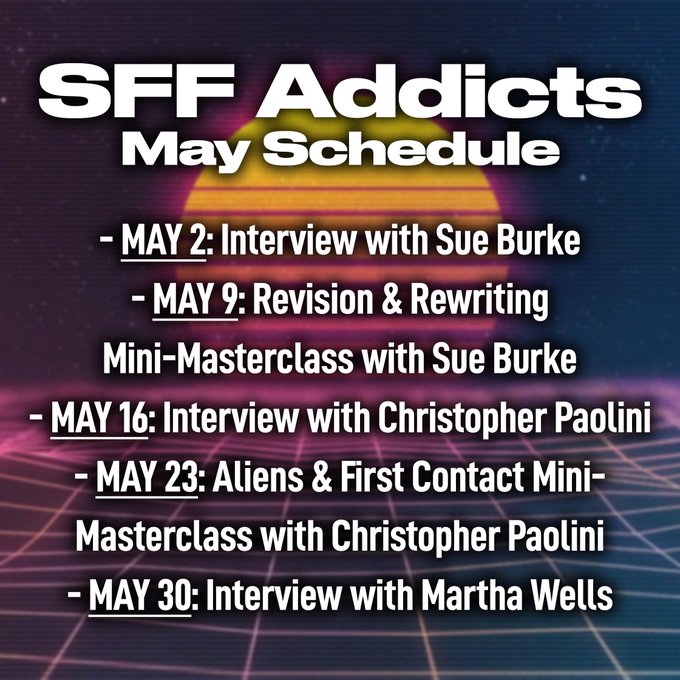
I don’t know if I’m a master at revision and rewriting, but I hate writing first drafts. I have to bribe myself to get through them. Once I have something to work with, though, I love to edit, revise, and rewrite. I think it’s where the magic happens.
Adrian M. Gibson and M.J. Kuhn, co-hosts of the SFF Addicts Podcast, and I talk about techniques I’ve learned over 50 years of professional writing (I started very young) that might help you with your writing. Every project is different, so the more techniques you know, the better.
Available today, May 9, in audio and video. Watch/stream/download it:
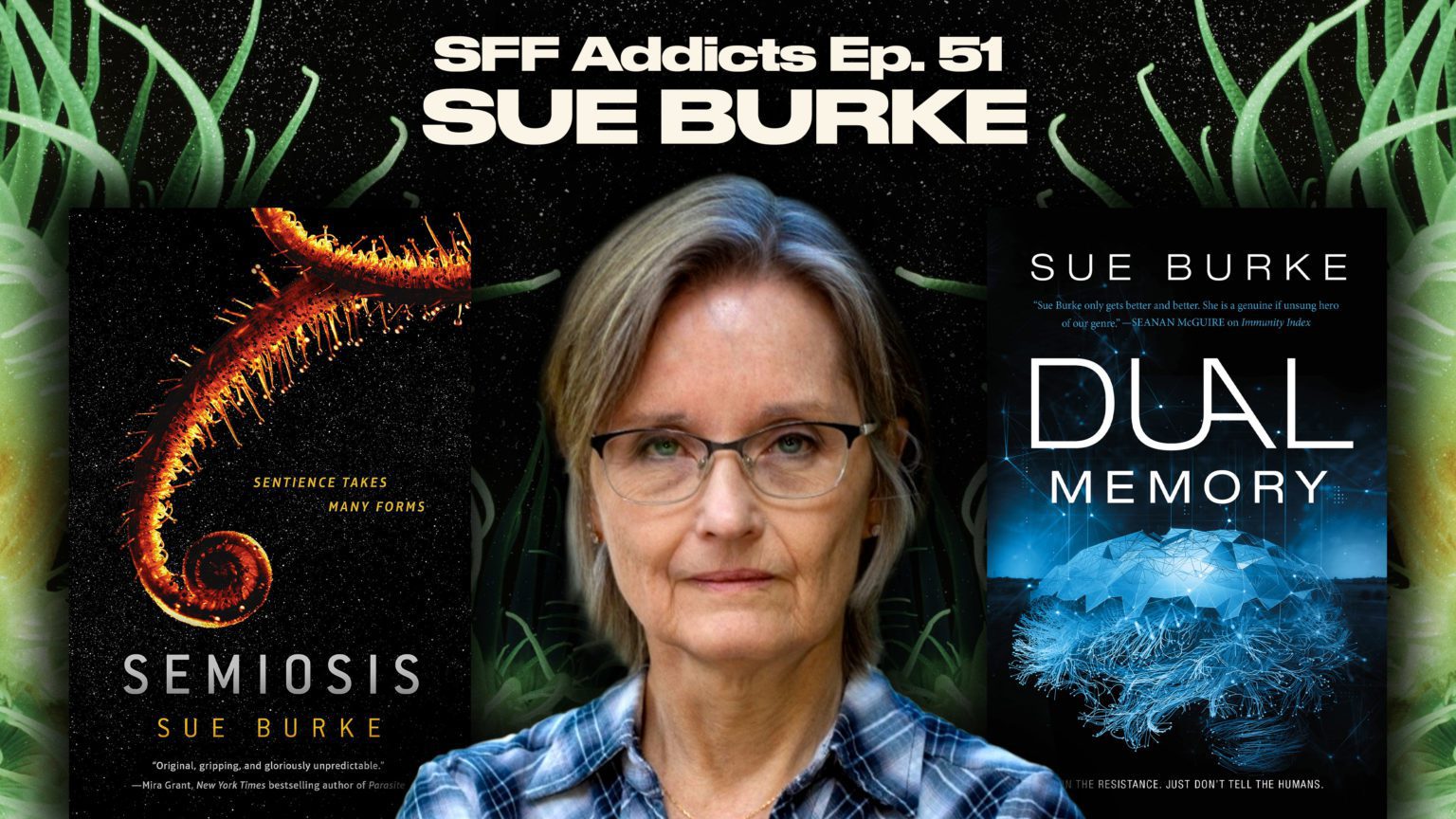
Adrian M. Gibson and M.J. Kuhn, co-hosts of the SFF Addicts Podcast, chat with me in Episode 51 about my next book, Dual Memory. We also discuss plant consciousness, since I’m very fond of plants even though they’re murderous. Then they ask me about book launch jitters, which I’m not at all fond of but I very much have.
Dual Memory will be released on May 16. If you’re in Chicago, come to the launch party at Volumes Bookcafé, 1373 N. Milwaukee Ave., in the Wicker Park neighborhood, at 6:30 p.m. Tuesday, May 16, and witness my jitters. If you can’t come, you can order the book through Volumes and request an autograph, and I’d be delighted to sign a book to you personally.
Today, April 28, is Arbor Day in the United States, where I live. Many other countries and cultures have an annual day to celebrate and plant trees, the exact day depending on their climate and culture.
Trees lead active, informed lives, paying acute attention to the world around them. They can’t get up and move, so they have to cope with whatever comes their way. Here’s some of what your tree knows:
A tree knows where it is. It knows up from down, and its sense of gravity allows it to grow up without mistakes. (Plants grown in weightlessness in space sometimes get confused.) A tree’s roots tell it all about the soil and its composition, and the tree will sense the roots of its neighbors and know what they are. It knows which direction the sunshine comes from and can arrange its leaves to capture the maximum light.
A tree knows the seasons. The angle of the sun and the length of the days let it match its growth with the seasons. Dandelions illustrate this well. They get ready to bloom in the spring and fall when the days are between 12 and 13 hours long. This sense also helps seeds germinate at the right time of the year.
A tree knows the neighborhood. Plants nearby may emit chemicals into the air to warn of attacks by insects or other trouble. The tree will know if other trees of its own kind are nearby, too. Trees usually prefer to grow in communities that can share food, information, and protect each other from violent weather by acting as mutual windbreaks.
A tree knows when you touch it. It can also feel hot and cold, and tell when its limbs are swaying in the wind. Plants prefer not to be touched, by the way.
A tree knows a lot about the weather. Heat, humidity, sunshine, storms — it has to cope with whatever happens and can adjust itself in many ways. Leaves may get tougher to cope with hot, dry days. The tree can have a growth spurt when the weather is favorable, or go dormant in especially hard times, waiting for the weather to return to normal, and it remembers what normal was like.
A tree knows when it’s had enough. You may notice that in a climate where trees drop their leaves in fall, some trees start to drop their leaves earlier than others. Trees spend the summer storing food to get through the winter and resume growth in spring. It can only store so much. Trees lose leaves for winter because the weight of snow and ice on leaves in high winds might pull down a branch, which can be a fatal injury. When a tree’s storage is full, it makes sense to drop the leaves, start to doze, and stay out of trouble in case of early storms.
From April 26 to 28, Barnes & Noble is taking 25% off the price of all pre-orders again: dead-tree books, audiobooks, and ebooks. More information is at barnesandnoble.com.
This includes my next novel, Dual Memory, available May 16. The coupon code for checkout is PREORDER25
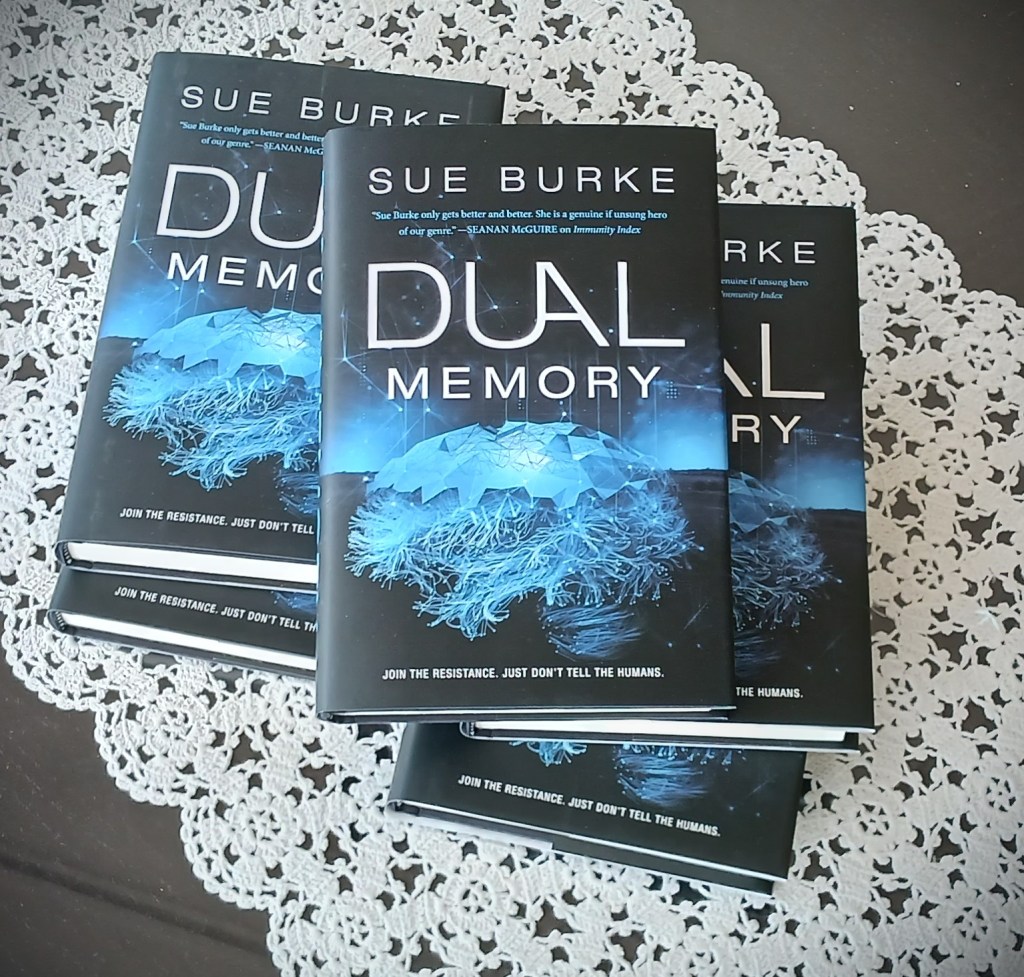
The author copies are here for Dual Memory! On sale May 16.
Have I mentioned that blue is my favorite color?
If you’re in Chicago, come to the launch party at 6:30 p.m. Tuesday, May 16, at Volumes Bookcafé, 1373 N. Milwaukee Ave., Chicago. More information is here.
Yes, there will be an audiobook for Dual Memory. How do audiobooks happen?
In this case, the book’s publisher, Tor Books, holds the rights for the audiobook. Tor, in turn, sold the rights to Dreamscape, a publisher whose projects include audiobooks.
Dreamscape then asked me a dozen questions about such things as pronunciations and preferences on accents (I had no preference). Dreamscape also asked: “It is customary for narrators to have the freedom to create these characters on their own, but … if you have a strong opinion…” My only suggestion was that one of the characters, Par Augustus, could be played for laughs.
Dreamscape suggested audiobook narrator and voice actor Andrés Santana and passed on a few samples of his past work. I loved one of them for its snarky tone because Dual Memory, as Library Journal’s review says, is rollicking. He would be fun to listen to!
And so it’s going to be Andrés. I even got to talk to him briefly, and he was charming. He had questions about the pronunciation of seventeen words in the text. I’m a writer, so I know how to spell them, but pronunciation … I did some quick research. Quidam is KWEE-dam. Cedonulle is SAY-don-ul.
And so, I bring you Andrés Santana as the voice of Antonio Moro and the narrator of Par Augustus. He’ll be a pleasure to listen to and will make the story even better than I wrote it.
Library Journal: [starred review] “This dystopian biothriller reads like a 21st-century version of Michael Crichton’s The Andromeda Strain, crossed with George Orwell’s 1984. The clone sisters and their creator each provide alternating perspectives of a chaotic world and evince that individuals can make a difference. The story they tell is hopeful, heartbreaking, and compelling at every turn. Highly recommended for readers of dystopian science fiction or political technothrillers.”
Publishers Weekly: “Burke endows her characters with distinct personalities and conjures a frighteningly real sense of national destabilization as events spiral out of their control.”
What I like the most about C2E2, the Chicago Comic and Entertainment Expo, is the celebration of creativity among the people who attend. Cosplay strolls down the aisles in all its glory, artists pass around inspiration, gamers revel in their enthusiasm, and writers join in the fun. Pro or amateur, we’re all fans, and we get energy from each other.
If you can’t make it to C2E2, you can still celebrate creativity on April Fool’s Day. Make something: art in any medium, a poem, a story, a meal, or don some fabulous clothing. If you see someone being creative, tell them they’re doing a great job. Nobody ever says or hears that often enough.
If you’re at C2E2, come see me Saturday, April 1, from 2:45 to 3:45 p.m. in Room S403-B. I’ll be on the panel Imagining Tomorrow: World Building in Science Fiction. From The Time Machine to The Left Hand of Darkness, science fiction has given us some of the most enduring stories of all time. We’ll discuss our approach to imagining the worlds of tomorrow and some of the science fiction stories that inspired us. Veronica Roth, Sylvain Neuvel, Sue Burke, and J. S. Dewes, moderated by John Jackson Miller.
We know from previous years at C2E2 that aspiring writers come to panels to learn, and we’ll do our best to help you.
After that, I’ll be in the Celebrity Autographing Area from 4:00 to 5:00 p.m. at the panel signing for Imagining Tomorrow: World Building in Science Fiction. You don’t have to buy something or want an autograph to say hi. Let’s talk about creativity. What are you up to?





 Semiosis