Categories
Uncategorized

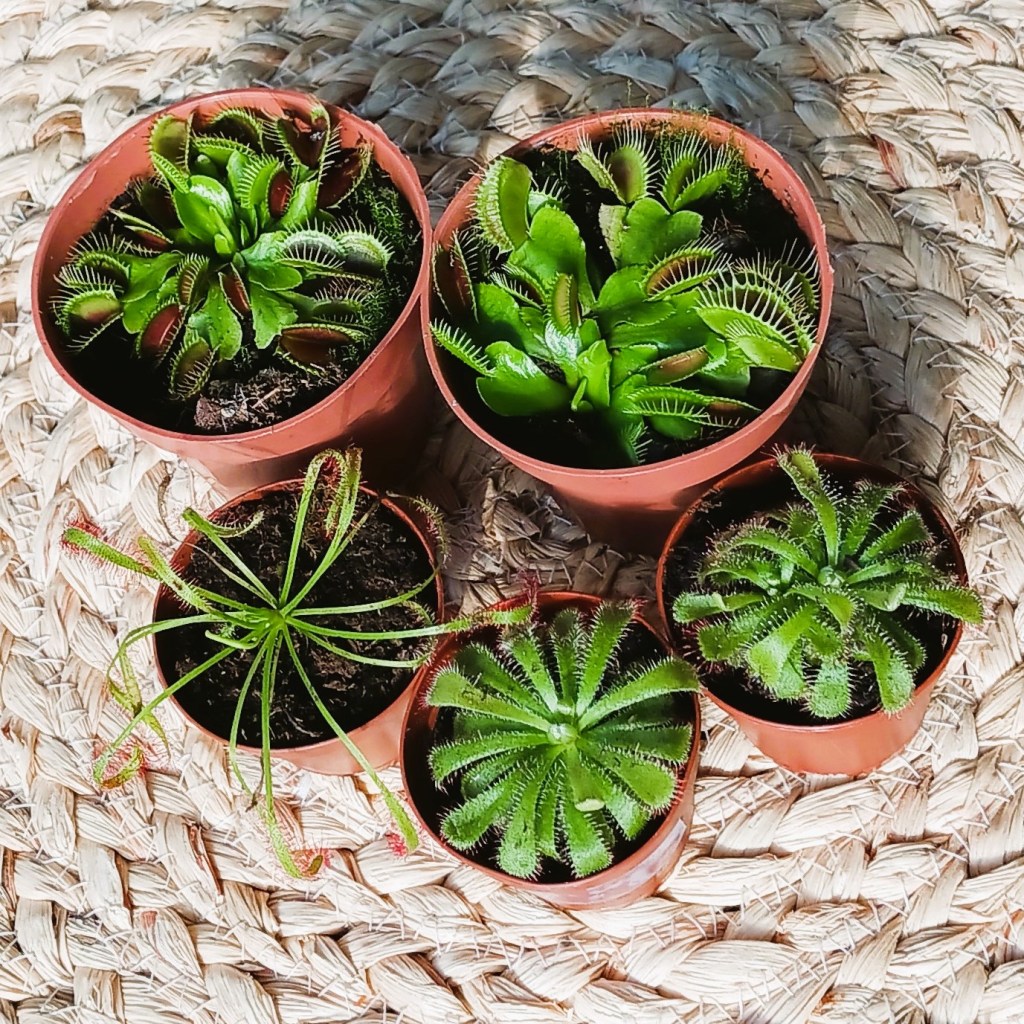
My new houseplants are hungry

You may have noticed that the covers of Semiosis and Usurpation depict actual Earth plants. The tentacle on Semiosis belongs to a sundew, probably a Drosera filiformis. The leafy traps of a Venus fly trap, Dionaea muscipula, hang menacingly on the cover of Usurpation.

The art inspired me.

Since I love growing plants, I headed to my local garden center, one of Chicago’s best, and got several carnivores from its impressive selection to grace my home. These plants need plenty of sunshine, which I can easily provide.

They also need to eat, and my home doesn’t have bugs, so I visited a pet store. The reptile and fish section astounded me with the enormous variety of food insects, dead and alive. I bought some freeze-dried bloodworms, recommended for carnivorous plants. I’m also cultivating fruit flies from grocery-store bananas. Venus fly traps prefer food that moves.

I can’t decide if I feel murderous or nurturing.

Carnivory is not the worst thing a plant can do, according to the rainbow bamboo in Usurpation — but carnivory lets me actively participate in the doings of my plants.

Categories
Uncategorized

‘Sentience will prevail’

This is the cover of Usurpation, the third book in the Semiosis trilogy. Notice the tagline: “Sentience will prevail.” There were taglines for the first two books: “Sentience takes many forms.” (Semiosis) “Sentience craves sovereignty.” (Interference) It seemed logical for the third book to have a tagline along the same lines, too.

My editor at Tor, Jen Gunnels, said she wasn’t sold on that particular tagline, though — “Sentience will prevail” — and invited me to suggest a better one if I could.

So I got to work and enlisted the help of my chief technobabble consultant, my husband. Here are some of our ideas:

Sentience seeks purpose

Sentience demands meaning

Sentience finds a way (Nice, but Jeff Goldblum got there first.

Sentience defends and endures

Sentience hungers for freedom

Sentience seeks peace

Sentience demands control

Sentience needs compassion

In the end, I decided “Sentience will prevail” is as good as anything we came up with. Can you think of something better? It’s too late to change the cover, but there are many other uses for a good tagline, so please share your ideas.

Categories
Uncategorized

Goodreads review: ‘Borne’ by Jeff Vandermeer

Borne (Borne, #1)

Borne by Jeff VanderMeer
My rating: 5 of 5 stars

In a dystopian world, every good thing, no matter how small, is precious, but anything can become a monster. That’s the underlying premise of this novel: how to stay human, how to maintain love, and how not to become a monster in the midst of surroundings that keep growing more hostile.

(You can read the blurb if you want to find out more about the plot. I think that reviewers tend to recount what happens in a book, sometimes in extensive detail, because in their grade school days they were required to retell the story to prove to their teacher that they had indeed read the book. I think my job here is to help you decide if you might like the book. I enjoyed it, but be warned: it’s heavy on dystopia.)

VanderMeer delivers a ecological disaster with rich prose and an inventive, twisting story. It’s not quite a horror story despite horrible moments – and there are a lot of very horrible moments. I think that modern horror is essentially classical tragedy, and in tragedies end in grief and downfall. Even in the wrecked world of this novel, humanity in the end is tested but not defeated.

View all my reviews

Categories
Uncategorized

‘Dual Memory’ is an Audie Award Finalist

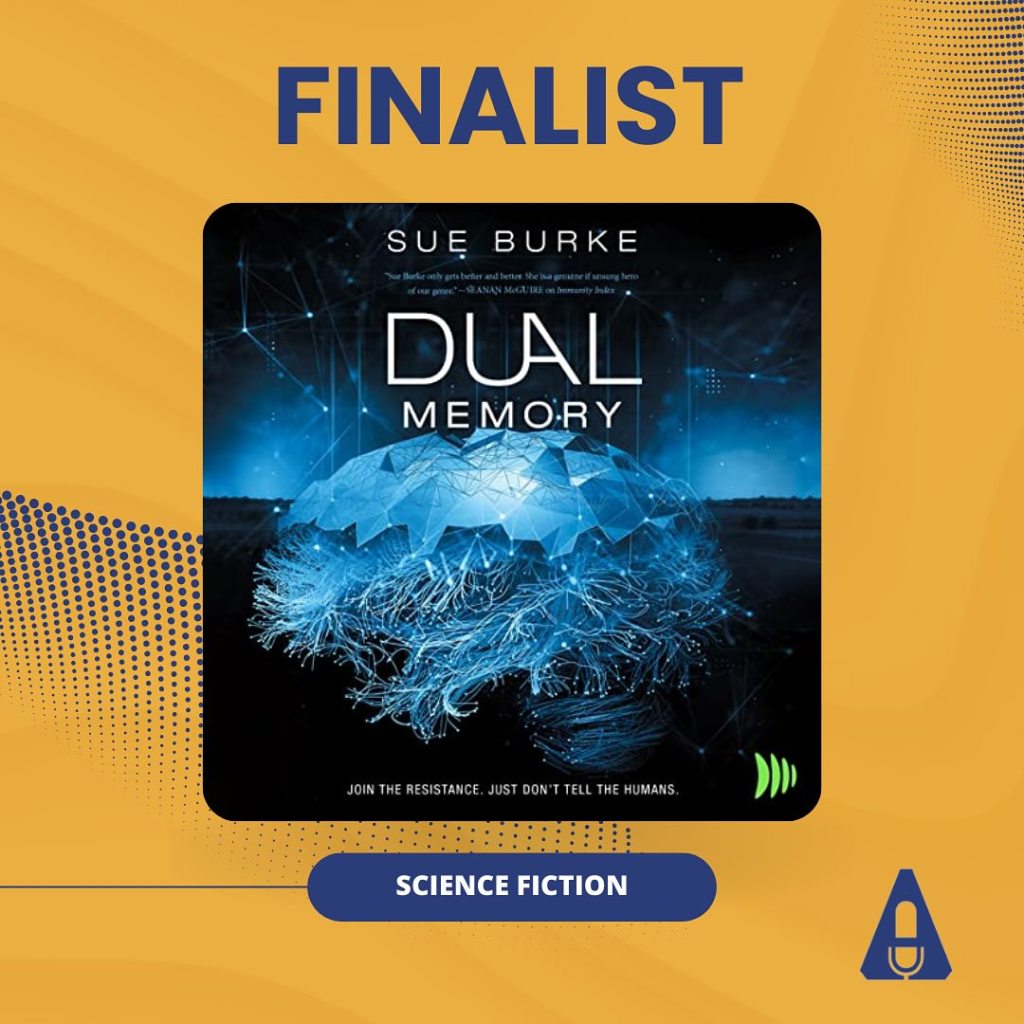
Dual Memory is a finalist for the Audio Publishers Association’s 2024 Audie Awards in the Science Fiction category. Thank you for the narration, André Santana! The winners will be announced March 4.

You can listen to Chapter 1 here: https://soundcloud.com/dreamscape-media/dual-memory-by-sue-burke-chapter-1

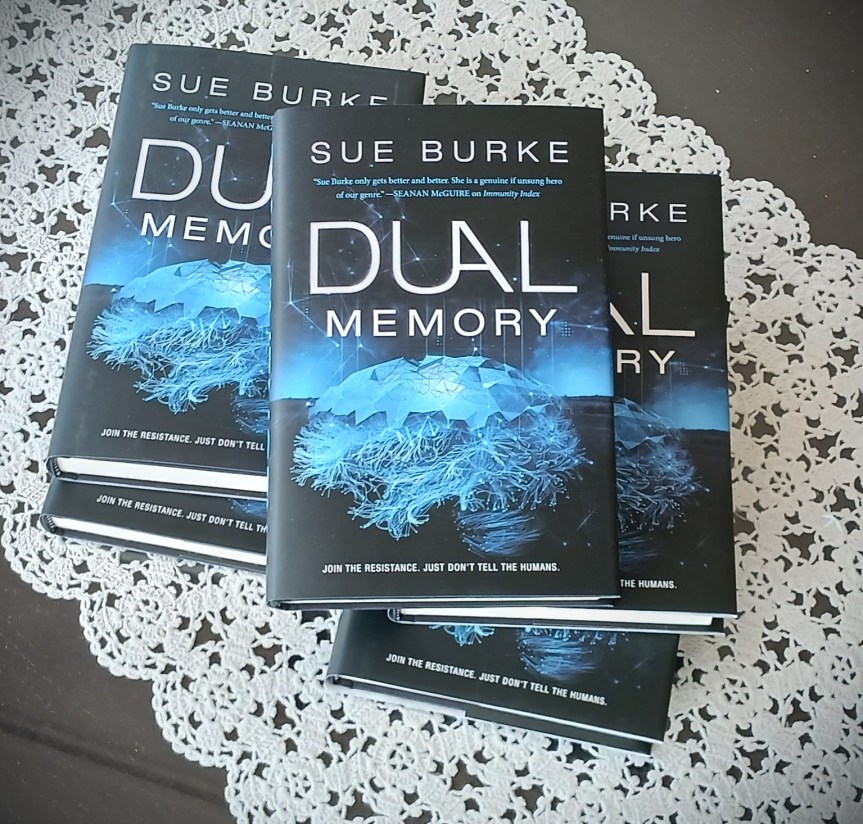
You can buy the audiobook wherever fine audiobooks are sold — and the novel is available in hardcover and ebook, too.

Categories
Uncategorized

‘Usurpation’ cover art!

Isn’t it beautiful? This is the cover of Usurpation, the third novel in the Semiosis trilogy. It will be published on October 29 (and you can pre-order it now from your favorite bookseller).

You might be thinking that the picture looks a lot like a Venus flytrap. Yes, it does. That small plant originated in the eastern wetlands of North and South Carolina, and it grows in poor, wet soil. It kills and eats ants, spiders, and other small animals to get necessary nutrients. The toothy “jaws” on the ends of its leaves are waiting to close around prey.

But you’ll learn when you read the novel that carnivory is not the worst thing a plant can do.

Categories
Uncategorized

Pre-order sale for B&N Rewards and Premium members

B&N.com will have a pre-order promotion from January 24 to 26 for its Rewards and Premium members. Rewards and Premium Rewards members will get 25% off pre-orders, including ebook and audio, while Premium members get an additional 10%.

During that promotion, you can pre-order the trade paperback edition of Dual Memory, coming April 16, and the hardcover edition of Usurpation, coming October 29. Usurpation is the third book in the Semiosis trilogy.

If you’re not a B&N special member, you can still pre-order those books at your favorite bookseller, although probably not at promotional prices. As I learn of any sales, I’ll announce them here.

Categories
Uncategorized

Fippokats in space!

Kill your darlings, they say. That means you should cut the parts from your book that don’t move the plot forward, even if you love them. So, on the wise advice from my editor, I killed the final section of the novel Interference about some fippokats (well, they were going to die anyway) and write a different ending that was much more dire.

Here’s the original ending for your enjoyment: the alternate epilogue to Interference.

EPILOGUE—KELLY—LATER THAT DAY—IN ORBIT

Oh, this is the strangest place and the most wonderful. It frightened me at first, yes, although the Big Ones are happy, so we are happy, Moss and Emerald and Lime and I am Kelly. We have our sleeping box and we drink water from a tiny pipe next to strange food dishes and it is a game just to eat because the food floats. It all floats, the Big Ones and the food and the toys and us and everything.

But we do more than float, Moss and Emerald and Lime and I. We jump and hop and chase each other, leaping from wall to wall, from floor to ceiling, anyplace to anyplace, and look at this somersault, three in a row! We can fly!

We hop and we glide along the walls and ceilings and floors and tabletops, and it is easy, a twitch of the toes and now a somersault again. Here I come at a Big One, and I spread my legs to steer and slow, and the Big One catches me and says Kelly Kelly Kelly and pets me and we float to the window to look outside, but it is night, so I will stay where it is bright and warm and full of fun.

The Big One helps me spin, whee! and I come to a wall and jump off because Lime is down the hall and we can chase each other through the air. Lime sees me and launches herself at me and we meet in the air and bat at each other’s back feet and we connect and here we go! Back and forth and up and down, wall to floor to ceiling. It is the best game ever.

We can fly! We can fly!

Categories
Uncategorized

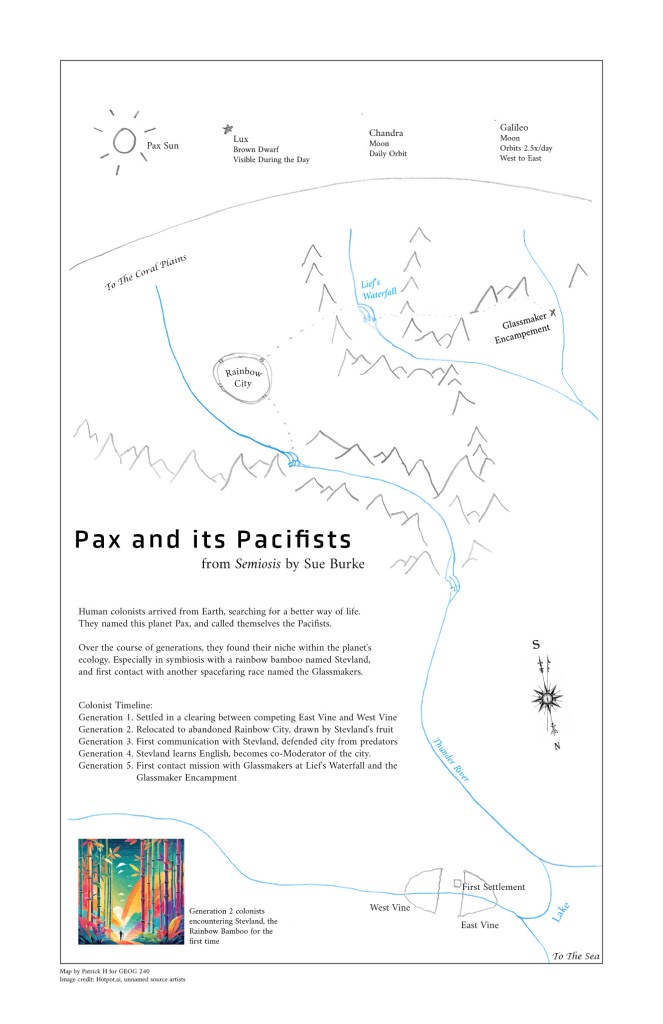
A fan-made map of Pax

I wish I’d had this map when I was writing the novel Semiosis. I made a couple of my own maps, but this one is better.

It was made by Patrick Hixenbaugh, who got in touch with me:

“I’d like to share a map I made of the colonists’ journeys on Pax during the first novel, which I made for an assignment on literary maps for a college cartography course. We learned about maps for fictitious places, like Treasure Island and Narnia, and I thought of Pax right away. I thought you might like to have it, and see how accurately (or not!) it matches your vision of Pax.”

You got Pax exactly right, Patrick, and thank you for sharing it. Authors often rely on maps from real-life or imagination to orient the characters in their environments. For example, when characters travel to the mountains, they need to turn left at the bridge every time. This sounds easy, but when you’re writing a novel, every kind of mistake can creep in.

Patrick described his process for making the map:

***

What went into making my map? Well the first time I read Semiosis, the details like East and West Vine with the river flowing through it made it feel like a real place, especially when the colonists themselves talked about seeing the landscape from the sky and from satellite images. I had the mental picture of the river flowing up the mountains to Glassmaker City for a long time.

The course was an Introduction to Cartography for the geography/environmental science program at my college — I’m working towards a certificate in Geographic Information Systems (GIS). We studied some literary maps like what you’d find in Treasure Island and Tolkien, and were assigned to create a map in the same “literary” style — letting the map tell the story. I thought pretty quickly how much I’d love to see the map of Pax I’d been imagining.

I reread it once again just for fun and to get a general impression of the landscape, which reminded me of the lake, which eventually flows to a distant sea, and of the “Lief’s waterfall” area, where it turns out a lot of things happened! I thought a lot about the gates of the city, the bridge that Higgins destroyed in the eagle attack, but ended up not putting the bridge on the map since I wasn’t positive where it went.

I reread it a second time, really looking for the geographic details, and I loved picking up on everything that made Pax feel like an alien world — the strange moons with weird orbits and the sun’s brown dwarf companion star that rises and sets ahead of the sun. I realized they really ought to make it onto the map, so I drew them above the planet, in space. And I had to make a sizeable change to my mental map — I originally had thought the river that flowed through the colonists’ first area had led directly to the Rainbow City. But when I reread it, I found the place name “Thunder River” and got the impression that the pieces of bamboo and glass they recovered after the hurricane had not flowed directly past them, but had washed up on the shores of the lake instead. So I made Thunder River into a separate river that also flowed into the lake.

I had a lot of fun reading the trek from the parents’ colony to Rainbow City and sketching out where I thought the mountains and waterfalls were. I also picked up on a detail, that the city sat on a bluff above the river, which was really nice imagery I hadn’t picked up on before.

I also had a lot of fun with Nye’s first contact mission to the nomadic Glassmakers. The first time I read the novel I read it at the level of just feeling how arduous and dangerous their trek was. This time, reading through it and working out how their journey could map out into a plausible landscape was really interesting, and I got a lot out of that.

I finished the project this fall and went on to other things, but for winter break I read Interference again, and I noticed how the Coral Plains were always “south” of rainbow city, where I had always imagined them as “further up.” And that the Earthlings orbiting Pax found the colony in the Southern Hemisphere. That was a really cool discovery, and so I changed the North Arrow on the map to a South Arrow and had fun imagining life in the Southern Hemisphere, and thought about the rotation of solar systems and galaxies, and magnetic fields and how you would define north and south on an alien planet.

That does mean that east and west are reversed on my map! Just realized that now! Whoops! Was Rainbow City “north” of the parents’ settlement, or just upstream? Maybe the Pax colonists and the Earthlings used different references for north and south? I guess now I can reread Semiosis again and find out 🙂
Categories
Uncategorized

My 2023 houseplant Christmas tree

Every year, I coerce one of my houseplants into impersonating a Christmas tree, but this year, the Pilea peperomioides enthusiastically volunteered. The little plant wasn’t what I had in mind — I intended to conscript the bigger and more cone-shaped crown of thorns — but Pilea insisted:

“I’ll be perfect! My leaves are already just like those round glass ornaments!”

I answered that its species is sometimes called a money plant because its leaves are flat and round like coins, but Christmas ornaments are actually spherical.

“Christmas cookies are flat! And I’m Christmas green! An actual evergreen!”

Yes, I told it, it is green year-round, but that doesn’t mean it’s a conifer, and besides, it’s kind of small for the job.

“Presents will look bigger under me! If I can’t do this, I’ll drop all my leaves and be the Festivus Pole!”

So, I backed down. Here’s my tree. Merry Christmas.

Categories
Uncategorized

Podcast with Tasshin

I had a delightful two-hour podcast conversation this week with Tasshin, who describes himself as “an extremely online pilgrim wandering this precious world for the benefit of all beings.”

We came to know each other when he reviewed my novels Semiosis and Interference, examining  ethical themes raised by the books, the world of Pax, and the character of Stevland. His review is long and deeply thoughtful, and I think it captures what I was trying to do.

You can watch our conversation here on YouTube, where there are also links to an audio version and a transcript. I hope you enjoy it as much as we did.

***

In other matters, the first short story I ever published, “Poet for Hire,” is available here. The background to the story is here.

In Tor.com’s Reviewers’ Choice: The Best Books of 2023, Matt Keeley calls Dual Memory “a satisfying thriller about art, climate, conspicuous consumption, and artificial intelligence. Burke remains one of our foremost science fiction writers.” Thanks, Matt!