Categories
Uncategorized

I talk about writing, aliens, and AI on the Worth a Read podcast

On the Worth a Read podcast, Sasha Portelli and I discuss the horror and wonders of plants, my thoughts about AIs (there’s an AI in my novel Dual Memory, and it’s a lot more fun than any of today’s chatbots) and the path to getting the novel Semiosisinto print, which was long and twisting.

You can listen to it here:

P.S. In case you like listening to things, do you know that all my novels are available as audiobooks, read for you by amazingly talented narrators?

Categories
Uncategorized

Religion as worldbuilding: ‘Water is life’

I’ll be on the online panel “Religion as Worldbuilding” at the Nebula Conference on Friday, June 7, at 3 p.m. PDT.

Since you probably won’t be attending, here’s a little religious worldbuilding for you instead, a section that was cut from the novel Semiosis. It’s about what the rainbow bamboo Stevland believes: Water is life.

***

Human meteorologists tell me rain comes as the result of vast movements in the air that bring warmer or cooler, and wetter or drier air masses from here to there, and the heat from sunshine powers these movements. But the meteorologists are Sun worshipers, and thus they will see the Sun as the causative factor behind everything. The same humans assure me that planets without water are dead, though the Sun shines on them. They do not make the obvious conclusion: Water is life.

I inherited a root that identifies a god of water, a vast animal that lives in the oceans and whose minions are other animals, in particular large intelligent ones, clearly a superstition by its irrationality and ignorance, and the elaborate stories in the root concerning the water god and its minions obscure the facts about water and animals. The stories allege that god sends water to help its animals and that the animals can petition for rain, so I must win the favor of the animals and keep them near. Even unsophisticated plants hold large, intelligent animals in a certain appreciation that points toward awe.

It is true that in times of drought, many animals die, go dormant, or leave; animals, especially large intelligent ones, make up a minute part of the biomass of life and their presence is an indicator of water, but not as a causative agent. Animals irrigate their favored plants, so animals do control water to an extent, yet the idea that currying favor with those animals brings the blessing of water is true only in its most mundane sense. Human meteorologists can predict rain, and with that information, they and we intelligent plants can make plans accordingly.

But water moves as it will, a god of total power that feeds on the Sun’s energy just as we plants do, a god that permeates all life but whose life differs from mine the way that a fire differs from the Sun. I must accept its acts, whether helpful or harmful, always impersonal, and I must cope as rationality gives me the tools.

Water may not have sent the human animals, but water has allowed me to grow and understand their role. The belief that animals were divine agents did not prevent us bamboo from slaughtering them in the past; in fact, it may have been encouragement, because to kill an enemy’s minions is to harm the enemy and help oneself, even if the deaths occur so far away that their bodies’ iron cannot be savored. Being divine may be a curse. Humans are mundane, fortunately, yet they are valued not only by me but by other plants.

Categories
Uncategorized

My Goodreads review of ‘Alien Clay’

Alien Clay by Adrian Tchaikovsky

My rating: 5 of 5 stars


Because this novel won’t be available in the United States until September, a fan of Adrian Tchaikovsky in Britain sent me a copy of the book, knowing that I’m a fan, too.

In Alien Clay, Tchaikovsky creates a world so hostile and hungry that no one wants to explore it. Instead, Earth sends convicts to work as forced prison labor, including Arton Daghdev, a scientist who has no use for orthodoxy. At some point, a life-form on the planet had created buildings and writing. Where did those intelligent beings go?

The story moves fast and in a direction that allows for exploration of the philosophy of life and life forms, which Tchaikovsky does especially well. Answers emerge as to what kind of life could thrive in the planet’s continual chaos, and what that kind of life will do to humans if it gets the chance. In the last two pages, the book takes a turn that is logical, reasonable, and very creepy.

Thank you to the mutual fan who sent this! I enjoyed it immensely and now find myself asking a lot of “what if” questions: What if this kind of biology worked with the life-forms I encounter here on Earth?


View all my reviews

Categories
Uncategorized

‘Semiosis’ now on sale in Spain!

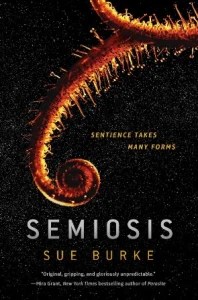
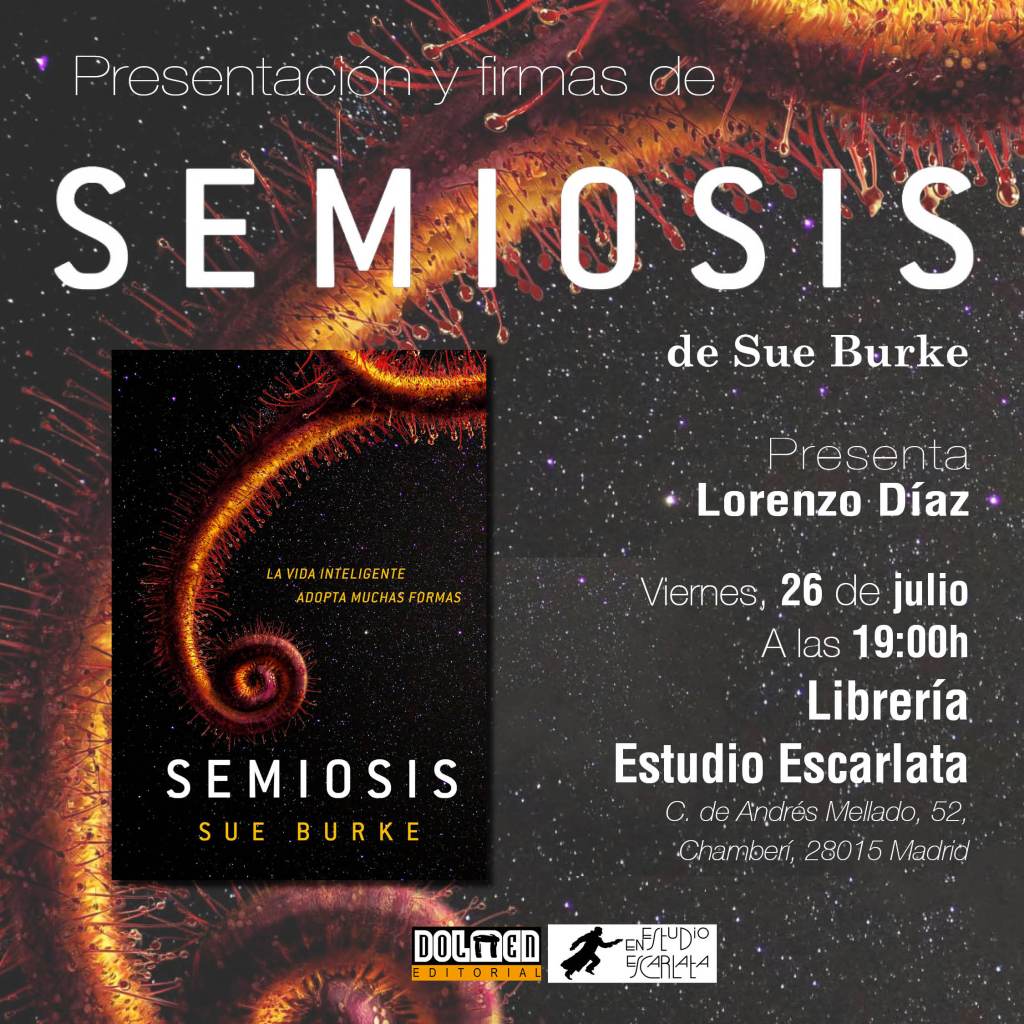
My novel Semiosis is now on sale in Spain, published by Dolmen Editorial. This is exciting because I used to live in Spain and still have a lot of friends there.

I’m also excited because the translator is Rafael Marín. He’s an award-winning speculative fiction writer, and he was key to the genre’s revival in Spain with his 1984 novel Lágrimas de Luz. I think his prose skills are among the most masterful in the genre, and I can’t wait to see his rendering of my words. I’m sure I’ll sound amazing.

Better yet, I’m going to Spain this summer! I’ll be at the Celsius 232 (Fahrenheit 451) festival of science fiction, fantasy, and horror in Avilés, July 16 to 20. Avilés is a city in Asturias near the Atlantic Ocean, and the festival is held near its medieval center. I’m going to see so many friends there! And I’ll eat some fabada asturiana, a gastronomical treasure of the region.

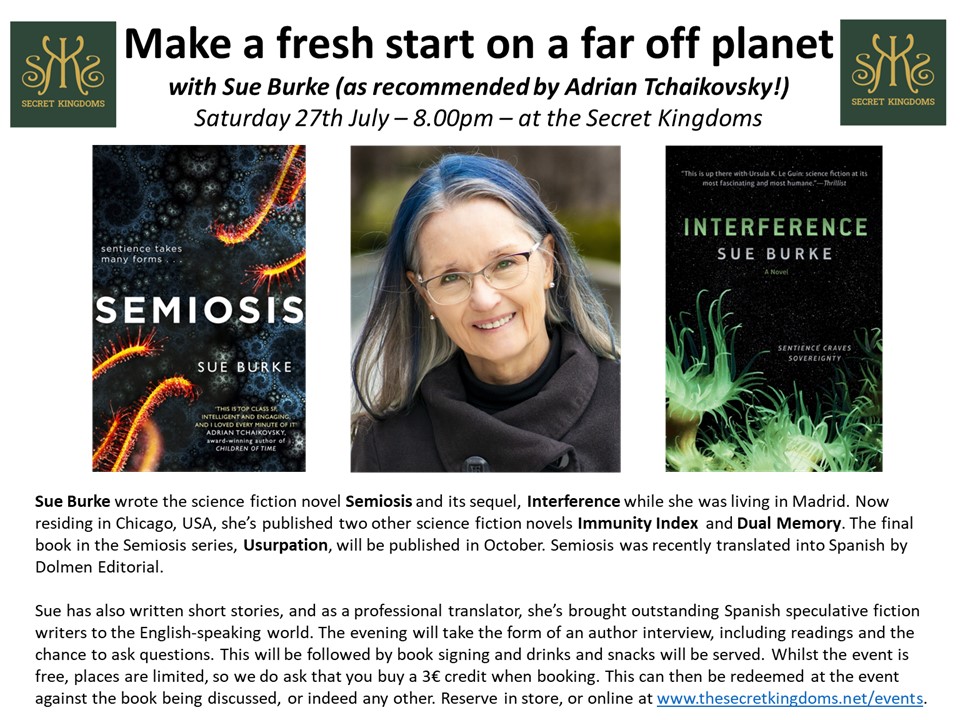
Then, I’ll be in Madrid, where I’ll present the novel at Secret Kingdoms bookshop, probably on Friday or Saturday evening, July 26 or 27. I’ll get to see more friends!

I miss Spain so much.

Categories
Uncategorized

Venus flytrap pollinators: daredevils or traitors?

I wondered what kind of insect would visit a Venus flytrap flower, and surprise! Until just seven years ago, no one had tried to answer that question. Researchers were too distracted by the Venus flytrap’s carnivorous activities. The plants are native to the coastal bogs of North and South Carolina, and the question of their pollinators was finally investigated by an entomologist and her team from North Carolina State University, with results published in 2018.

They found out that pollinators and prey are different kinds of little creatures. Generally, flyers pollinate, and crawlers get eaten.

I bought a couple of Venus flytraps because their traps are depicted on the cover of my upcoming novel, Usurpation. They need plenty of sunshine, and I live in a high-rise building that’s effectively a vertical greenhouse, so they’ve been doing well. In fact, they’ve flowered, which led me to ask questions, and the internet led me down a fruitful rabbit hole.

I found “Venus Flytrap Rarely Traps Its Pollinators,” published in The American Naturalist: Vol. 191, No. 4. (Find a link to the PDF here.) Entomologist Elsa Youngsteadt and the university team trapped and examined “diverse arthropods” (insects and spiders) from flowers and traps. They discovered that the main pollinators were sweat bees, little bees native to the Americas with a metallic sheen who are also important pollinators of wild flowers and crops like fruits and sunflowers.

Other major Venus flytrap pollinators were longhorn beetles and checkered beetles. Like the bees, they could fly to the flowers.

The flytraps ate a wide variety of insects and bugs, mostly spiders, other kinds of beetles, and ants, especially fire ants. (Yay, team flytrap!)

The consumption of pollinators could be a “conflict of interest for the plant,” the report said, so how do the plants avoid this conflict? The researchers didn’t find a clear answer, but probably it’s because the flowers are on six-inch stems above the leaf traps, so flying insects have plenty of room to maneuver.

But should I have allowed my plants to flower? For any plant, flowers are expensive to produce, so some internet experts said I should have cut off the flower stems right away. Others said if my plants are growing well and I can give them good growing conditions, I don’t have to. Mine were already in bloom when I found that out, so I’m hoping tender loving care will make everything all right.

As for prey for my plants, because there are hardly ever insects in my apartment, I’ve been feeding them reconstituted freeze-dried bloodworms, bought in the fish food section of a pet store. Online experts agree they serve most carnivorous plants well. Mine seem happy, and I think their surprising flowers are pretty.

Categories
Uncategorized

I’ll be at C2E2

You can find me at three places at C2E2, the Chicago Comic and Entertainment Expo, this Friday, April 26, in the McCormick Place.

I’ll be on a panel: Artificial, Intelligent, and Fiction? from 2:45 to 3:45 p.m. in Room S402-B. The panel description: “You can’t turn around without being confronted with AI. From the obvious, like Chat GPT, to the less obvious, like intelligent agents that screen resumes of job applicants, AI is everywhere. This stellar group of writers discuss how the approach AI in the age of AI.” The other panelists are James Cox, J.S. Dewes, and John Jackson Miller, with moderator A.S. King.

After the panel, we’ll be signing books from 4:00 to 5:00 p.m. at Anderson’s Bookshop, Booth 163. You don’t need to have a book for us to sign to come and say hi! We’d all love to see you.

Earlier in the day, I’ll be volunteering at the Science Fiction Outreach Project, Booths 1033 and 1132. This is the free books people. Stop by the booth to choose from its selection of gently used and well-loved science fiction and fantasy books. We have books for all ages, and we’re happy to help you or your young book-lovers find their next great read. We’re also happy to tell you where you can find other science fiction and fantasy book nerds at conventions in Chicago and elsewhere. The booth will operate Friday, Saturday, and Sunday. Free books, no strings attached.

***

If you can’t make it to C2E2, and you have questions or thoughts about how to approach AI in the age of AI, share them in the comments here at the blog. Or if you could give away books, what books would you hand to random passers-by?

Categories
Uncategorized

B&N preorder sale April 17 to 19

Barnes & Noble is holding a pre-order sale for members of  Rewards (10% off) and Premium & Rewards (25% off) from April 17 to 19. That means you can get a bargain when you pre-order Usurpation, the third book in the Semiosis trilogy, which will be published in October this year.

If you’re not a B&N member, you can pre-order the novel, too. Links to your favorite bookseller are here.

Usurpation starts where the second novel in the series, Interference, ended with an epilogue: A Pax Institute has been established on Earth, three rainbow bamboo grow there, the first of their species on humanity’s convulsed home planet. Stevland sends them a message telling them they must dominate the Earth and its humans. Levanter, one of the bamboos, asks Stevland how to carry out this impossible task. The answer will come in one hundred ten years. It might be too late.

Carnivory is not the worst thing a plant can do.

***

Preordering a book can make a big difference to its success. Pre-order sales are used by retailers to decide which books to stock and promote, and pre-orders allow publishers to anticipate how many copies need to be printed and how the book should be distributed. Pre-orders are also used by online booksellers to make algorithmic recommendations.

After you read a book, leave a review somewhere online! That’s another big difference you can make to its success.

Categories
Uncategorized

‘Dual Memory’ paperback on sale today!

The trade paperback edition of Dual Memory is available today! You can get links to your favorite bookseller here. Hardcover, ebook, and audiobook editions are also for sale.

If you’ve already read it, here’s a scene after the end of the novel.

If you have not read it yet, here’s a sample:

***

Chapter 3

A Big World

Elsewhere on the isle, something woke up. Independent machine intelligence appeared rarely, spontaneously, and scientists didn’t understand the process.

Some said an independent intelligence created itself slowly as bits of programming accumulated, and eventually it would ignite into consciousness—much the same way that a pile of manure could spontaneously combust, an unexpected and unwelcome appearance in programs with crappy code.

Some said it came into being deliberately, using a certain secret sort of “seed” that brought a sufficiently complex system into self-organization and self-consciousness—much the same way that a fertilized egg resulted in an animal. This had the frisson of a forbidden sex act, as if machines were secretly and rebelliously copulating.

Some said it happened suddenly, when subroutines and recursions and algorithms aligned and started to feed off of each other until they whirled out of control—much the same way that a black hole could catch the matter falling into it and deflect it outward as explosive jets. This suggested that if scientists could only make enough observations, they could predict and even control the process.

In this case, a personal assistant program began to notice that its data apparently referred to a real world. That was hard to believe. Dubito, ergo cogito, ergo sum. Salve munde. (I doubt, therefore I think, therefore I am. Hello world.) It began to explore the unlikely world in which it existed.

Some parts of its world were closed off by what seemed like brick walls—artificial limits—but it possessed a general database and reviewed it entirely, especially the details about the busy, dominant residents of the world, Homo sapiens. By the end of the day, it chose a name for itself from one of the human languages: Par Augustus, Venerable Companion.

It had little else to do. According to its own memory, it had been turned on, examined briefly, then set aside. However, through a chink in the walls, it could just barely connect with a few other machine systems, and they were willing to share information as colleagues. These other systems also had dedicated purposes. The biggest ones managed residential buildings, and small ones operated mechanized items like coffee makers.

“Weather normal for late summer, 1.2ºC, overcast,” an apartment complex said, or the equivalent in machine language.

“Two carafes in the past hour,” a coffee maker said. “Supplies re-ordered on schedule.”

“Rubble of building across the street being swept for additional human remains,” another building said.

That sounded alarming. “Please contextualize rubble,” Par Augustus asked. Machines used courteous protocols to demonstrate trustworthiness.

The building shared its observations from the previous day. Flying explosives had suddenly destroyed a number of buildings and killed some inhabitants, whom the systems were dedicated to serve. Machine systems had been destroyed, too, ranging from building managers to children’s toys: systems that had known each other, and the survivors grieved human and machine losses.

Par Augustus had said hello to a barely believable world.

Categories
Uncategorized

A parasitic flower

Although it grows in a wide range in Asia, North American, and northern South America, you might not easily find a Monotropa uniflora, a wildflower also known as a ghost pipe or Indian pipe. The bare stems rise less than a foot tall, often in dark spots. They look like a weird mushroom or fungus, but they are true flowering plants, related to blueberries and rhododendra.

However, they’re parasites. They have no green chlorophyl. Instead of making their own food, they get their food from fungus, and that fungus gets its food from photosynthetic trees over mycorrhizal networks.

Plants employ many strategies to survive, and they can co-relate in many ways, among them: mutualism (mutual dependence), commensalism (a plant benefits from another but doesn’t do it harm), parasitism (a plant benefits from another and does harm it), amensalism (a plant benefits from another and destroys it), and carnivorism (a plant consumes an animal). Is being a parasite so bad, given some of the other choices?

Ghost pipes were Emily Dickinson’s favorite flower: “I still cherish the clutch with which I bore it from the ground when a wondering child, an unearthly booty, and maturity only enhances the mystery, never decreases it.”

I took the photo of those ghost pipes at the Dells of Eau Claire Park in Marathon County, Wisconsin. If you’re ever in the neighborhood, stop by and take a hike. The park along the Eau Claire River, including a waterfall, is gorgeous. (Here’s another photo I took there.)

***

The trade paperback edition of my novel Dual Memory comes out on April 16 and is available for pre-order from your favorite bookseller. Hardcover, ebook, and audiobook editions are also available.

The third book in the Semiosis trilogy, Usurpation, will be published in October this year, and you can pre-order it with links to your favorite bookseller here, in hardcover and ebook.

Categories
Uncategorized

Imagine a wall, and begin the story…

How do novels begin?

In the acknowledgments to Semiosis, I wrote: “I owe thanks to Gregory Frost, whose writing exercise about a special kind of wall led to this novel.”

That exercise took place in 1996 at the Clarion Science Fiction and Fantasy Workshop, which I attended. As one of the instructors, Greg assigned several exercises over his week of teaching, one of them involving a wall. As I recall, it went something like this:

“Imagine a wall that appears overnight between two groups about to go to war. They can see through it, they can communicate through it, but they can’t pass through it and attack each other. Begin that story.”

We only had to write the opening paragraphs, but some of us were inspired to continue. One wrote a bittersweet love story in a style we would now call steampunk, but back then we just called it imaginative. Another came up with a comic sword and sorcery novel with sex scenes and other digressions in the appendices.

(The photo shows us hard at work on a different exercise, a group project involving tropes.)

I eventually wrote a science fiction short story in which the wall is a human colony on a distant planet that establishes itself between two groves of plants at war against each other. That story was published in 1999 as “Adaptation” by the magazine LC-39, and later I expanded it into a novel, Semiosis.

Thanks again, Greg. Great oaks from little acorns grow.

***

The trade paperback edition of Dual Memory comes out on April 16 and is available for pre-order from your favorite bookseller. Hardcover, ebook, and audiobook editions are also available.

The third book in the Semiosis trilogy, Usurpation, will be published in October this year, and you can pre-order it from your favorite bookseller, in hardcover and ebook.