
I’ll be reading at the Last Fridays Poetry open mic on Friday, May 29, 8 p.m., at Esquinaevent space, 4602 N. Western Ave., Chicago. It’s a supportive environment, and all are welcome. This time, I won’t be reading poetry, I’ll be talking about poetry, specifically about translating poetry. Here’s what I plan to say:
***
Today, I won’t be reading poetry, I’ll be talking about poetry, specifically about translating poetry. I’ve lived in Spain and the United States, and sometimes I write poetry in English and Spanish, and there can be problems with translation.
For example, the Spanish language doesn’t have a verb equivalent to “finesse.” You can express the idea, of course. “She finessed her way into the party,” can be said in Spanish: Se las ingenió para entrar en la fiesta. “She used ingenuity on things to get into the party.” Not quite the same, but close.
That technique, using “ingenuity” to approximate “finesse,” is called compensation. Here’s another example. My English-language haiku:
nodding heads —
lavender flowers
weighted by bees
My translation into Spanish:
abejas
meciendo las flores
de lavanda
In Spanish, you nod by asentir con la cabeza or “to agree with the head.” A literal translation would not work. The closest word, mecer, means “to rock,” as in “the hand that rocks the cradle.” So I wrote a Spanish version that means, literally, “bees / rocking the flowers / of lavender.” It supplies the same physical picture, but the implied meaning is different.
You can also paraphrase, which may or may not get you what you need. In Spain, the famous festival in July in Pamplona, known for its running of the bulls, honors St. Fermin, so the fiesta and by extension the run are known as los sanfermines. The Spanish haiku:
sanfermines
el semáforo parpadea
amarillo
Literal translation:
the running of the bulls in Pamplona
a stoplight blinking
yellow
It still needs a little work.
Another problem is cultural, which can be solved with adaptations. In Europe, the bird called a blackbird is the Turdus merula, basically an all-black version of the American robin, Turdus migratorius. (The European robin is a flycatcher, Erithacus rubecula. New World blackbirds don’t exist in Europe. Yes, it’s confusing.) For both these Turdus birds, their beautiful song is a harbinger of spring, so if I’m writing for an American audience, I might adapt the name of the bird to avoid confusion.
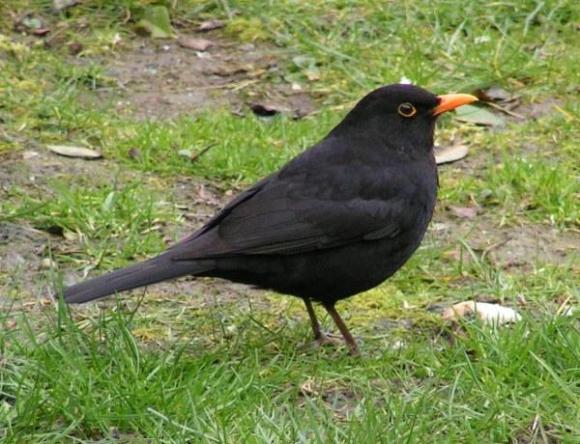
But the following haiku has another problem that also requires a compensation. In Spanish, the adverb ya emphasizes the time of the event. What time? Now, then, soon, already, immediately, finally, never … you know from the context, and there’s no exact English equivalent. Consider this haiku:
el mirlo canta
cigüeñas rumbo al norte
¿ya? ¿cómo que ya?
The Spanish version, translated over-literally, is “the blackbird sings / storks in direction to the north / ~time? how that ~time?
My translation:
the robin sings
storks headed north
now? so soon?
A particular problem is wordplay and puns. In this example, Spanish words often distinguish gender, although English words can’t. The translation of this poem is exact, but the humor doesn’t quite come through.
lectores – lectoras
los servicios de
la Feria del Libro
In English:
male readers – female readers
the rest rooms
at the Book Fair
Of course, poems can also employ rhyme, rhythm, assonance, figures of speech, and all the other resources that form the art of language. They tend to resist translation, but these exacting challenges are what makes translating poetry as much fun as writing it.


