Since it’s Halloween, let me tell you a true story about a ghost. I don’t believe in ghosts, but I want to believe in this one. It happened quite a few years back when I was living in Milwaukee and I went to visit a friend’s house in the Bay View neighborhood.
I didn’t know the house was haunted. I simply said the big, colorful framed poster hanging at the top of the stairs looked lovely, especially in that spot.
“Do you want to know why it’s there?” My friend was eager to tell me. She and her family had moved into the house not long ago, and they had decided that the space at the top of the stairs seemed like a natural place for art, which it was.
So they hung up a picture. It fell down. They put it up again. It fell down the stairs and broke. They tried another picture, carefully securing it to the wall, and it, too, fell down the stairs and broke. They couldn’t figure out what the problem was.
Then one day they were talking with the elderly neighbor who had lived next door all his life. He listened to their story and sighed sadly. Decades earlier, the family in that house had a teenage son who was gay, which in those days was a terrible taboo, so he had committed suicide by throwing himself down the stairs. Ever since then, things fell down the stairs for no reason — or perhaps because the boy was still there in spirit.
My friend and her family decided to try an experiment. They bought the most beautiful gay rights poster they could find, put it in a nice frame, and hung it at the top of the stairs, hoping the boy might understand that things had changed.
“And it’s still there!” she said. “I’m not sure I believe in ghosts, but maybe we helped his spirit rest in peace.”
Now, I knew the neighborhood. The street in front of that house was built over an underground stream, Deer Creek. Maybe, when heavy trucks went past, they made the ground shake and the movement somehow focused on that stairway.
Or maybe there was a troubled spirit in that house, a forlorn teenage boy who had lived there many years ago. And possibly, if he had been born decades later, he could have lived at peace with himself and still be alive.
Bust of Aristotle. Marble, Roman copy after a Greek bronze original by Lysippos from 330 BC; the alabaster mantle is a modern addition.
“Here is Oedipus, here is the reason why I will call no mortal creature happy.” — from Oedipus Rex, a play written by Sophocles in about 430 B.C.
Oedipus believes he is an orphan. He unknowingly kills his father and marries his mother, a queen. They live happily ever after and raise a fine family, until one day a messenger arrives…
Ancient Greeks invented dramatic tragedy in about 600 B.C. and spent several centuries refining it. Despite the limited theatrical techniques of the time, the emotions portrayed were at once subtle and intense: honor, ethics, self-knowledge, conscience, pride, insolence, responsibility, and courage.
But how do you tell a story? In about 320 B.C., Aristotle examined what makes a good tragedy, and his lecture has survived as the book Poetics— which Shakespeare studied and put to good use. Here are Aristotle’s rules:
1. Show don’t tell.
2. Try to keep the time frame short, perhaps “a single circuit of the sun” for a stage play or short story. Otherwise, you might have an epic, which has its own rules.
3. Be serious. This isn’t a satire. Try to express yourself well, with lively language full of images.
4. Make characters lifelike, and make them do things, not ponder things. “All human happiness or misery takes the form of action,” Aristotle writes. “Character gives us qualities, but it is in our actions, in what we do, that we are happy or the reverse.”
5. Plot is paramount. Try to make the plot powerful. It should have a beginning, middle, and end. It should be long enough to allow for a sequence of necessary or probable events that will bring about a change from good fortune to calamity, but not so long that we can’t remember it all easily.
6. Unity of plot means you leave out as much as you can, “for a thing whose presence or absence makes no visible difference is not an organic part of the whole.”
7. Tragedy inspires fear or pity. The events should surprise us, but they must follow cause and effect, because logic is more amazing than convenient coincidences.
8. The best plots are complex. A complex plot has either a reversal of the situation, or a recognition, or both. These reversals or recognitions should be a necessary or probable result of what went before.
Reversal is a change of a situation into its opposite. For example, in Oedipus Rex, a messenger brings good news to Oedipus: the mystery of his parentage has been solved … and it turns out to be disastrous news.
Recognition is a change from ignorance to knowledge, and makes people change their feelings about each other. “The best form of recognition is coincident with a reversal of the situation, as in Oedipus,” says Aristotle. But it can also come from something like a trivial object that provides crucial information that results in knowledge, particularly knowledge about other people that provokes fear or pity in the audience.
9. The end result is suffering, “such as a death on the stage, bodily agony, wounds, and the like,” Aristotle says. If you like gore, you’ll like Oedipus Rex and other ancient Greek plays. Modern horror is often like classic tragedy; modern readers outside of the horror genre tend to prefer emotional pain to of buckets of blood, although there’s nothing quite as fearsome as ripping your own eyeballs to ribbons the way Oedipus does to show his shame, is there?
10. A perfect tragedy does not involve a virtuous person brought to ruin, for this moves neither pity or fear; it merely shocks us. Nor a bad man passing from adversity to prosperity, obviously; nor a villain brought to ruin. You want a good and just protagonist whose purposes are noble but who brings misfortune on himself not by vice or depravity, but by an error or frailty, usually some sort of immoderation — an excess of justice, truth, vengeance, self-sacrifice, love, pride, egotism, constancy, stubbornness, or anger. An unhappy ending is the right ending.
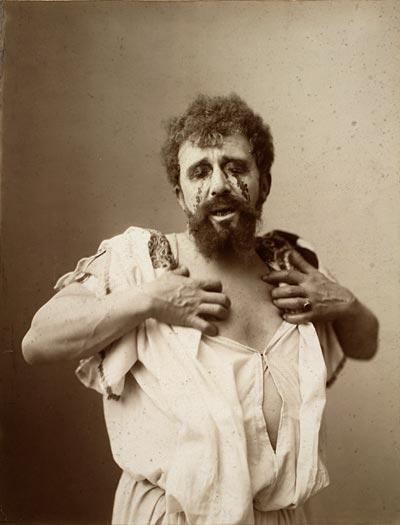
Louis Bouwmeester as Oedipus in a Dutch production of Oedipus Rex, c. 1896.
Short stories are one of my favorite art forms, but some readers don’t seem to like them. Perhaps, in school, all the short stories they read were old, depressing, pedantic, and hard to parse. (But new, uplifting, entertaining, unperplexing short stories are written all the time.) Or perhaps, some readers don’t like them because unlike novels, short stories are too fast, too intense, and send readers back into the world a little breathless. (Is that a bad thing?) Or perhaps, readers just don’t hear about them as much as novels. Now hear this: New Year, New You: A Speculative Anthology of Reinvention is a great way to start your 2025 reading. It offers two dozen science fiction and fantasy short stories united by the idea of personal change. Themes include time travel, Greek myth, fairy tales, foreseen death, odd dystopias, programmed memory loss, and manufactured life. Many are quite short, and the tone varies from playful to horrific. I enjoyed them all, like eating a box of chocolates or bento box, and was sometimes left a little breathless. The anthology was published by the Viable Paradise writing workshop 2023 cohort as a Kickstarter that was funded in less than 12 hours.
Not every mind is human, which is a challenge for authors. It’s hard enough to write from a different human point of view: we’re a varied species, each one of us with our own experiences and quirks, but at least we can talk to each other. Non-humans … well, they never have long conversations with us, alas.
Yet, if we’re going to write speculative fiction, we can’t let that stop us. For my Semiosis novel series, I wanted to write from the point of view of a plant — an alien plant, of course, not an Earthly one. All right, where to start?
Obviously, we know some things about Earth plants, so I began researching them. What is their experience of life? For one thing, they’re under a lot of stress. Growing seasons are short, and weather is uncertain.
Spring ephemerals, such as trilliums and snowdrops, illustrate this anxiety. They grow and flower as early as possible in spring, sometimes even through snow, dangerous though that must be. They catch the sunlight before trees put out leaves and cast shade. They offer nectar to the first bees that wake up after winter, monopolizing their attention. Then these plants go dormant until next spring: That’s the extreme step they have to take to get their day in the sun. They leap upward at the first hint of springtime.
Plants compete for sunlight and actively fight over it. A common houseplant called the asparagus fern (Asparagus setaceus) has pretty, lacy leaves – and thorns it can anchor into other plants and climb over them. Its aggression has earned it the status of noxious weed in some parts of Australia. Roses have thorns for the same reason. If they happen to starve other plants by blocking out the sunshine, that’s just survival of the fittest.
Vines climb up trees to get sunshine without the cost of growing a sturdy trunk. Other plants may grow large leaves quickly to cast shadows on their neighbors, or poison the ground to keep out competition.
So, plants lead lives of quiet desperation, in constant combat using a variety of weapons.
The book What a Plant Knows: A Field Guide to the Senses by Daniel Chamovitz documents what his fellow botanists have long known. A plant can see, smell, feel, hear, know where it is, and remember. “Plants are acutely aware of the world around them,” he writes.
Trees, like us humans, have social lives. InThe Hidden Life of Trees: What They Feel, How They Communicate, German forester Peter Wohlleben describes how trees of the same species in forests create communities that help each other, enjoying much longer, healthier lives than isolated city trees. Trees also make decisions, such as when to drop their leaves, which can be a life-or-death gamble on the coming weather.
Plants are alert to their surroundings and can recall the past and plan for the future. They’re gregarious, and being isolated hurts them.
As we would expect from highly aware, social creatures, they relate to other species including animals. They grow flowers to attract pollinators, they grow fruit to encourage animals to spread their seeds, and they enter into symbiotic relationships with animals to further their needs. If nutrients are especially scarce, plants turn carnivorous. (The leaves depicted on the cover of Semiosis are of a sundew. The drops are glue to catch insects.)
Through photosynthesis, plants create their own energy. We can’t know how that feels, although we can observe how sap courses up and down stems and through leaves, and how carefully plants arrange their leaves in a “leaf mosaic” to capture light efficiently. Plants that store food for winter know how much they have because they stop and shed their leaves when they think they have enough. They have body awareness.
Plants differ from us in one essential way: They have no set body type. Humans have two arms, two legs, and a standard-sized brain. A tree has as many branches and roots as it can support. A single tree can be huge, spreading out from its roots to create its own grove, and some can live for centuries, even millennia.
A possible personality has begun to emerge: anxious, active, aggressive, alert to its surroundings, impatient, reflective, forward-looking, physically singular, self-aware, long-lived, manipulative of animals, and painfully lonely if it has no companions of its own species. Add intelligence and we have a point of view:
“Growth cells divide and extend, fill with sap, and mature, thus another leaf opens. Hundreds today, young leaves, tender in the Sun. With the burn of light comes glucose to create starch, cellulose, lipids, proteins, anything I want. Any quantity I need. In joy I grow leaves, branches, culms, stems, shoots, and roots of all types. … Intelligence wastes itself on animals and their trammeled, repetitive lives. They mature, reproduce, and die faster than pines, each animal equivalent to its forebearer, never smarter, never different, always reprising their ancestors, never unique.”
“If and when aliens make first contact, who should answer? Maybe humankind should turn to people like me, translators of science fiction. We’ve already thought through this kind of problem.”
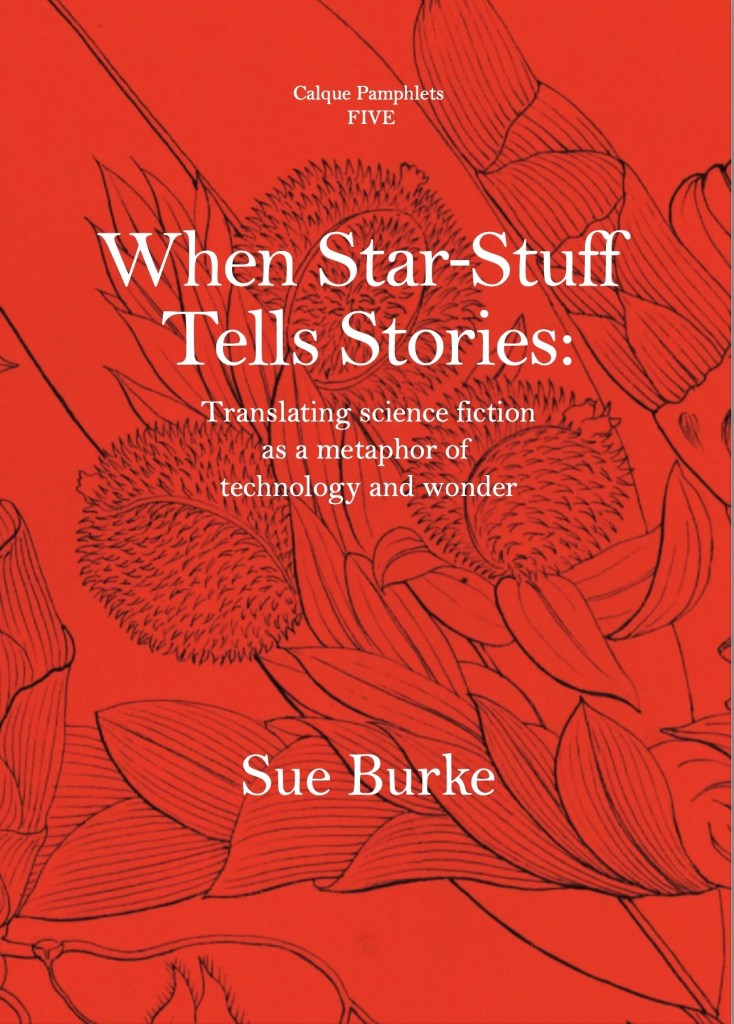
That’s the opening sentences of my essay When Star-Stuff Tells Stories: Translating science fiction as a metaphor of technology and wonder. Calque Press has just published a limited edition of it as a 24-page pamphlet, and you can learn more and buy it here.
It’s one of a series of essays and other short works published by Calque. They’re meant to provide an opportunity for writers to think aloud about their own experiences and knowledge — and they are beautifully printed on high-quality paper. The publisher is fussy about the look and feel.
Here’s Calque’s description of When Star-Stuff Tells Stories:
Starting from the very earliest forms of human communication, the ways in which language developed into languages, and created the role of the translator, Sue Burke offers an invaluable guide to the importance and difficulties of translation on Earth, and gives us fascinating speculation about what might happen if we ever do come into contact with extraterrestrial intelligence. This pamphlet addresses questions of what communication is, and how the translator is uniquely positioned to work at escaping the bounds of the medium and bringing pure meaning into an intelligible form.