Categories
Uncategorized

Your Name in Landsat   

NASA/USGS’s Landsat program has compiled the longest continuous space-based record of Earth’s land in existence. The data is used to make informed decisions about Earth’s resources and environment.

Just for fun, Landsat created a tool by which you can enter your name — or any other word — and see it spelled out in images of Earth. Hovering over the picture tells you where in the world the picture is from with a link to more information.

I made it spell out Stevland: S is Rio Chapare, Bolivia; T is Lena River Delta, Russia; E is Breiðamerkurjökull Glacier, Iceland; V is Padma River, Bangladesh; L is Regina, Saskatchewan, Canada; A is Lake Guakhmaz, Azerbaijan; N is Yapacani, Bolivia; D is Lake Tandou, Australia.

***

If you’re looking for a rock-hard science fiction novel, The Mary Sue has ten suggestions. One of them is Semiosis:

“Do you ever feel like your houseplants could be watching you? That maybe they’re more aware of their surroundings than their innocent, leafy, seemingly helpless without you watering them bodies would have you believe? Sue Burke’s Semiosis will justify all of your paranoid plant musings, turning them into scientific reality! The novel concerns a group of crash-landed astronauts, who begin to believe that the plants on their new alien planet home have more to them than meets the eye. The novel is a deep down dig into the roots of botanical science, and is chloro-filled with all the real life ways that plants are evil psychopaths. Seriously, Earth’s plants are murdery enough, but sentient planet-ruling plants from beyond the stars? Diabolical.”

***

Dragonfly.eco calls itself “an exploration of eco-fiction, blowing your mind with wild words and worlds.” It just interviewed Cristina Jurado about her novella ChloroPhilia, which I translated from Spanish into English. Cristina currently lives in Dubai, United Arab Emirates, and she explains how living there with its “insidious, powerful” sandstorms and hostile heat helped her create the story’s setting.
Categories
Uncategorized

Usurpation: Love will be ferocious

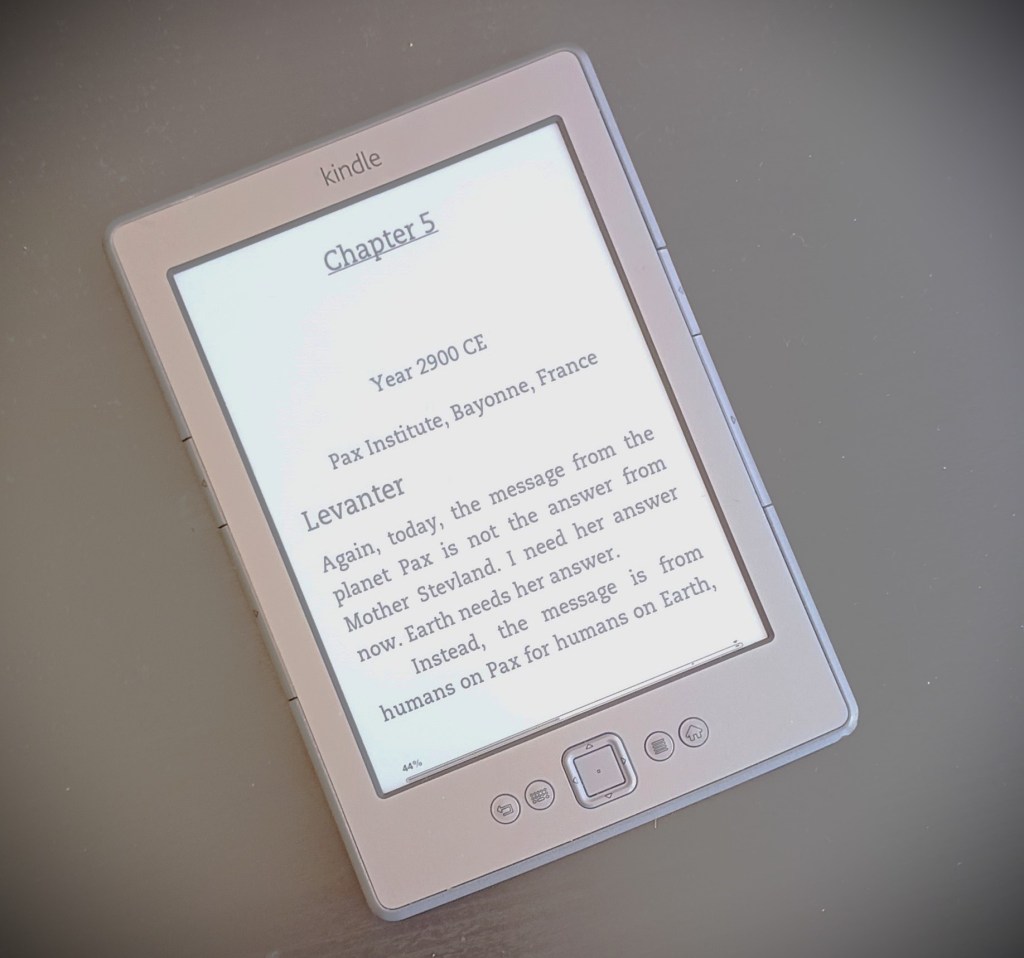
The novel Usurpation is the third in the Semiosis trilogy. The first book, Semiosis, takes place on a distant planet called Pax where the dominant species is an intelligent plant, rainbow bamboo. Stevland is the reigning bamboo. At the end of the second book, Interference, Stevland has sent his seeds to Earth, where the rainbow bamboo are flourishing, but no one knows they’re intelligent.

Then, at the end of Interference, Stevland sends a message to the bamboo on Earth: “…I must share a secret about humans. They are ours to protect and dominate.”

A bamboo named Levanter asks, “Tell us how.”

Stevland’s response finally arrives in Usurpation: “…Compassion will give you courage. Love will be ferocious.”

That’s all I can say without spoilers. In fact, I’ve probably spoiled enough already.

Usurpation will be released on October 29. I’ll be celebrating at 6:30 p.m. Wednesday, October 30, at Volumes Bookcafé, 1373 N. Milwaukee Ave., in Chicago, with Alex Kingsley, whose first novel, Empress of Dust, has just been released. You’re invited!It’s the day before Halloween, so you’re encouraged to cosplay.

You can see me at a Speculative Literature Foundation event read the opening of Chapter 3 of Usurpation in this 3-minute video. (All the novels in the trilogy are available as audiobooks, narrated by Caitlin Davies and Daniel Thomas May, who do a much better job than me.)

You can read a few reviews of Usurpation at NetGalley, and a recent review of Semiosis at Space Cat Press. Semiosis was named one of the 75 best science fiction books of all time by Esquire Magazine.

If you want an autographed copy of my next novel and you can’t come to the launch party, you can order it through Volumes Books here.

Categories
Uncategorized

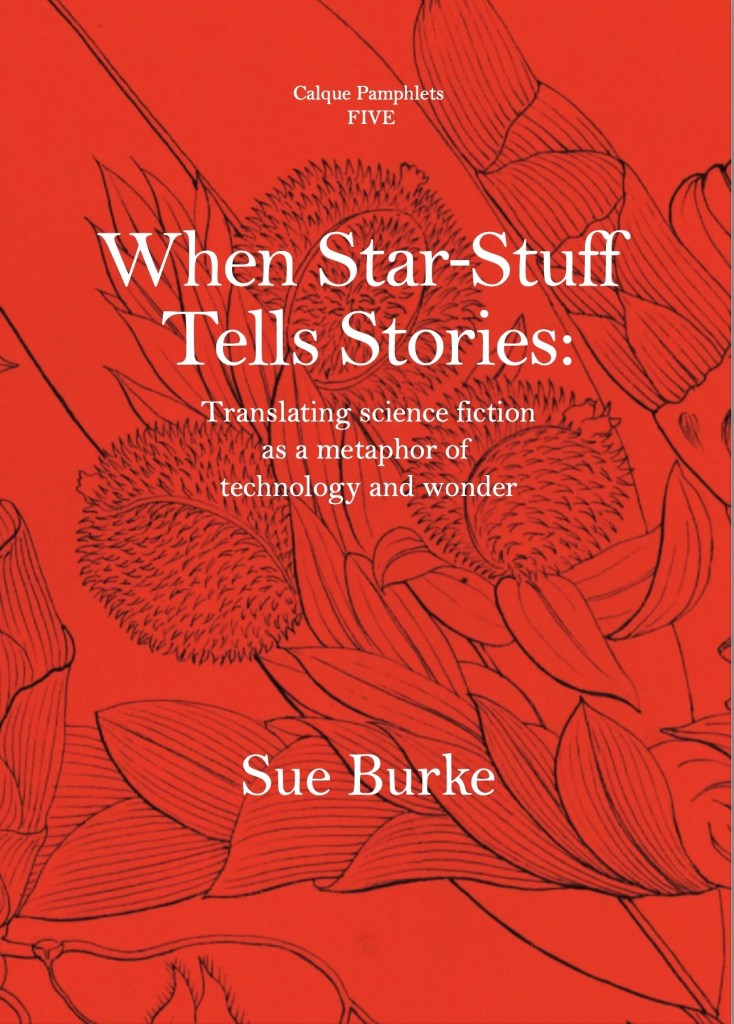
“When Star-Stuff Tells Stories” – now on sale

“If and when aliens make first contact, who should answer? Maybe humankind should turn to people like me, translators of science fiction. We’ve already thought through this kind of problem.”

That’s the opening sentences of my essay When Star-Stuff Tells Stories: Translating science fiction as a metaphor of technology and wonder. Calque Press has just published a limited edition of it as a 24-page pamphlet, and you can learn more and buy it here.

It’s one of a series of essays and other short works published by Calque. They’re meant to provide an opportunity for writers to think aloud about their own experiences and knowledge — and they are beautifully printed on high-quality paper. The publisher is fussy about the look and feel.

Here’s Calque’s description of When Star-Stuff Tells Stories:

Starting from the very earliest forms of human communication, the ways in which language developed into languages, and created the role of the translator, Sue Burke offers an invaluable guide to the importance and difficulties of translation on Earth, and gives us fascinating speculation about what might happen if we ever do come into contact with extraterrestrial intelligence. This pamphlet addresses questions of what communication is, and how the translator is uniquely positioned to work at escaping the bounds of the medium and bringing pure meaning into an intelligible form.

Categories
Uncategorized

My Goodreads review of ‘Alien Clay’

Alien Clay by Adrian Tchaikovsky

My rating: 5 of 5 stars


Because this novel won’t be available in the United States until September, a fan of Adrian Tchaikovsky in Britain sent me a copy of the book, knowing that I’m a fan, too.

In Alien Clay, Tchaikovsky creates a world so hostile and hungry that no one wants to explore it. Instead, Earth sends convicts to work as forced prison labor, including Arton Daghdev, a scientist who has no use for orthodoxy. At some point, a life-form on the planet had created buildings and writing. Where did those intelligent beings go?

The story moves fast and in a direction that allows for exploration of the philosophy of life and life forms, which Tchaikovsky does especially well. Answers emerge as to what kind of life could thrive in the planet’s continual chaos, and what that kind of life will do to humans if it gets the chance. In the last two pages, the book takes a turn that is logical, reasonable, and very creepy.

Thank you to the mutual fan who sent this! I enjoyed it immensely and now find myself asking a lot of “what if” questions: What if this kind of biology worked with the life-forms I encounter here on Earth?


View all my reviews