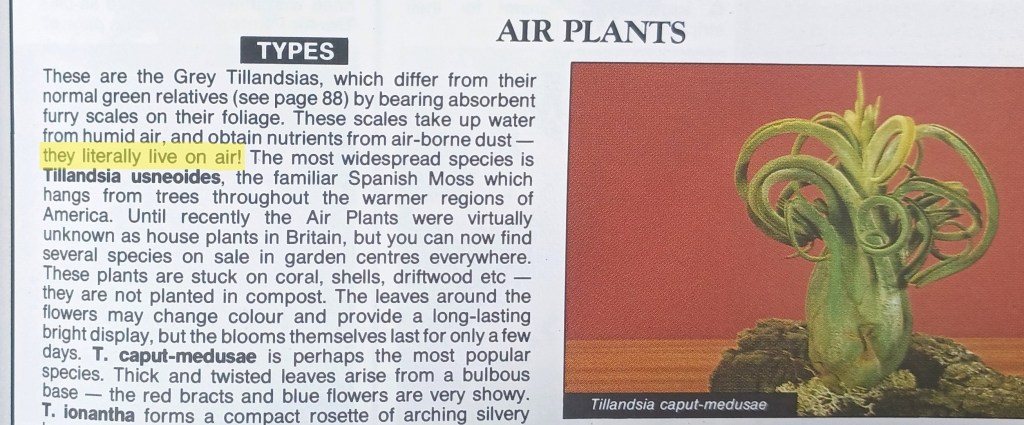
You may have heard that air plants (Tillandsia species) live on air. This is untrue. They live in air, usually clinging to trees, rocks, telephone wires, or roofs. They do not have roots. They get their water and nutrients from the air.
You may have also been told the plant magically subsists on air alone. So you set your air plant somewhere and ignore it. Eventually your plant dies
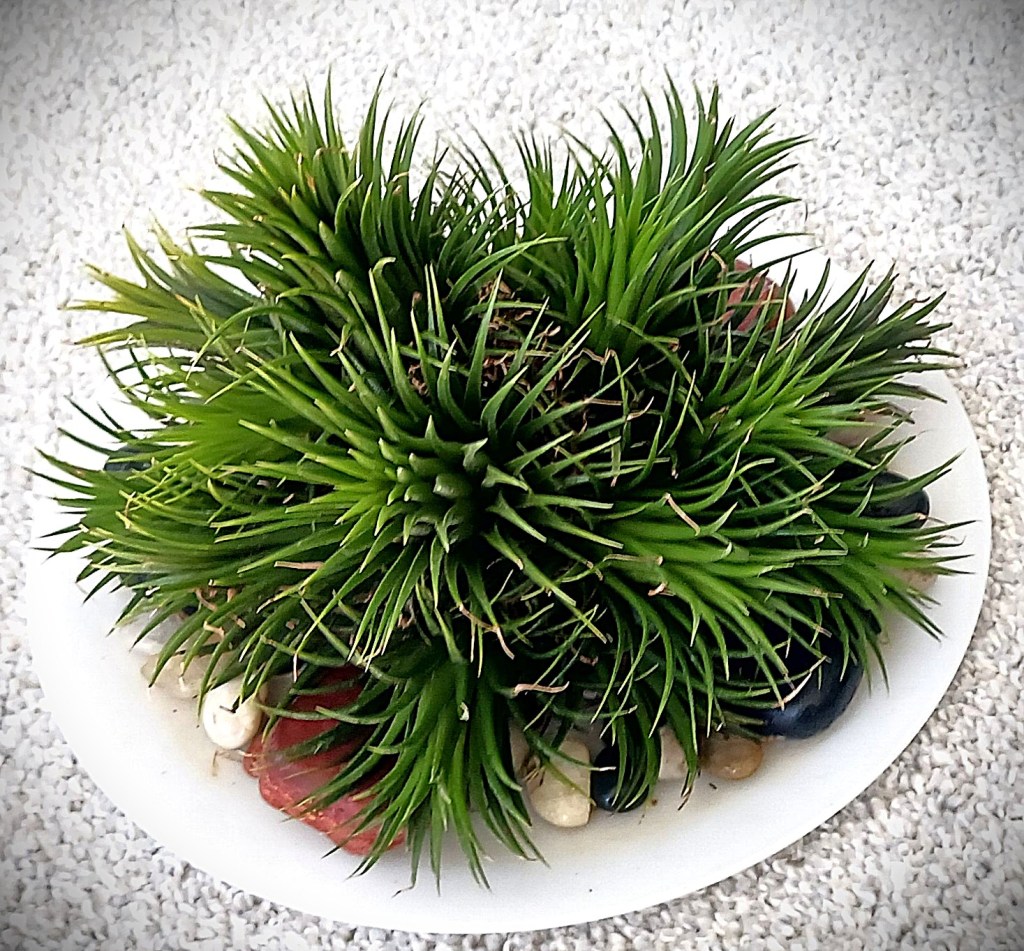
The photo is of my Tillandsia ionantha on a dinner plate. I’ve had it for ten years, and it keeps getting bigger. Here’s the secret to success:
I’ve visited the Yucatan in Mexico where it comes from, and I saw it growing on tree branches. While I was there, I couldn’t help noticing that it rains a lot in the Yucatan in the summer. Like every day. Air plants don’t live on air, they live on thunderstorms.
The Yucatan also suffers droughts. The plant can survive a drought, but it doesn’t like them. An unending drought will kill it.
Since it doesn’t rain in my living room, I regularly spray it or dunk it in water. It has little cups in the leaves that collect water. It shouldn’t be left to sit in water, though. It lives in the air, not in a swamp.
It also lives in sunny places. An air plant belongs on a windowsill, not in a dark corner.
Tillandsia are great little house plants, and your service to it as a emotional support animal will be rewarded. Just don’t believe everything you’re told, especially if it sounds too good to be true. That’s one of an air plant’s gifts to you: healthy skepticism.
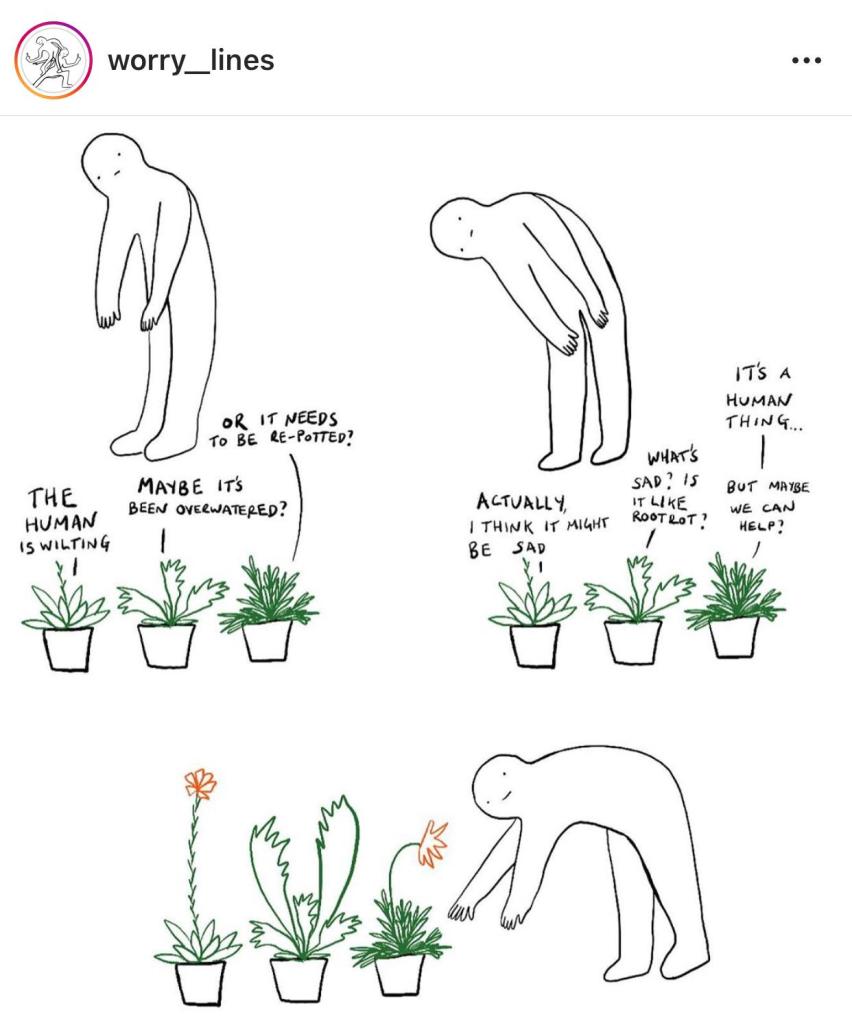
As you know, an emotional support animal is a companion that provides support to human individuals for a mental, psychiatric, or emotional disorder. These are often typical pet animals like dogs and cats, although other creatures — including plants — can improve your mental health.
Plants require a role reversal, though.
Animal companions for humans rarely get training, but you must train yourself to provide effective emotional support for plants. First, you must overcome plant blindness and see them as living beings. Then decide if you plan on supporting outdoor or indoor plants: gardening, rewilding your lawn, or sustaining indoor plants in pots?
If you already have plants, what kind do you have? Apps like Picture This and its website,Pl@ntNet, or guided observation and keys can help. Find out what that particular plant needs for warmth, light, and watering, and consider what you can offer.
Common houseplants are often jungle undergrowth plants, and your living room probably resembles a jungle floor in light and warmth — but check. Every plant has a niche, and it will suffer stress outside that niche. A cactus leads a very different life than a pothos, and small plants need more frequent care, sometimes daily, than big plants. Your first emotional support duty is to gauge your ability to minimize the plant’s stress.
“Moist” is a universally challenging concept when it involves soil, yet you must master it.
When you care for your plant, you will benefit both the plant and yourself. As you provide regular, attentive care, you may improve your own self-care. After all, you get by giving, and you learn responsibility by being responsible.
As the support animal, you will be rewarded by beauty and quiet companionship, and you will have created a supportive environment for the plant — and very possibly for yourself. Are you ready to change your life?
“Its actual name is ‘sheep catcher,’” she explained. “It would typically entangle wildlife around it and then hold on to it and unfortunately if they perish it would then give nutrients to the plant.”
“Plant-pollinator coevolution has been studied primarily by assessing the production and perception of visual and olfactory cues, even though there is growing evidence that both insects and plants can sense and produce, or transmit, vibroacoustic signals,” said Francesca Barbero, a professor of zoology at the University of Turin in Italy.
As magma moves upward through the Earth’s crust, it releases gases like carbon dioxide. Trees absorb this carbon dioxide, and in response, their leaves often grow more vibrant and healthy-looking. Using powerful tools like NASA’s Landsat 8 satellite, along with airborne instruments flown as part of the Airborne Validation Unified Experiment: Land to Ocean (AVUELO), scientists are now able to detect these subtle signs from above.
Dive into the wild world of weird plants! In this episode, the crew explores plant biology, carnivorous plants, zombie survival gardens, and Molly’s journey from forest explorer to plant store owner. Our goal is to have fun learning science through the lens of science fiction, fantasy, and pop-culture … and you’ll learn a few facts you can use to impress your friends at a party or use as a conversation starter to go down your own rabbit holes.
The construction industry faces pressure to be more sustainable. And the demand for greener buildings has led to a fresh look at wood construction. Wood is one of the oldest building materials used by mankind, but it does not have the strength needed to be used the load-bearing material in structures larger than houses and cabins.
A subjective plant map of 40 indoor plants based on plant impressions was prepared. The physical shapes of leaves were measured that could represent a subjective map. Both experts and people reported relaxation and liveliness on seeing plants. Plants with small leaves induced a sense of relaxation. Leaf shape classification may assist in selecting plants for indoor landscapes.
Often referred to as “broken tulips,” the striped variations of the popular flower were coveted in the 17th century for their beautiful markings. It’s been known since 1928 that the pattern is caused by a viral infection known as the tulip breaking virus, but exactly how the signature stripes are formed remained an unsolved mystery until now.
Artificial intelligence
I’m a member of the American Translators Association. The translation field is coping with neural machine translation (such as Google Translate) and AI translation:
The latest wave of artificial intelligence (AI), powered by large language models (LLM), is reshaping numerous professions, including the translation and interpreting industry. However, a growing reliance on AI highlights—not diminishes—the necessity of expert human linguists who possess the specialized skills to address translation and interpreting challenges that arise in this new context.… One of the greatest dangers of AI-generated translations and interpretations is that they may appear accurate to the general observer, making errors harder to detect for those without linguistic expertise.
On one hand, AI tools promise efficiency, personalization, and access. On the other, they provoke a deep discomfort. If students can simulate fluency and polish with a few prompts, what becomes of the messy, vulnerable, and transformative act of writing? What becomes of the human voice?
They describe trying to grade “hybrid essays half written by students and half written by robots,” trying to teach Spanish to kids who don’t know the meaning of the words they’re trying to teach them in English, and students who use AI in the middle of conversation. They describe spending hours grading papers that took their students seconds to generate: “I’ve been thinking more and more about how much time I am almost certainly spending grading and writing feedback for papers that were not even written by the student,” one teacher told me. “That sure feels like bullshit.”
It’ll be hard to talk about the whole Semiosis trilogy without some spoilers for the first two books, though I think I can communicate at least some of it in broad enough strokes. The overarching theme is sentience, and each book has its own tagline: “Sentience takes many forms.” “Sentience craves sovereignty.” “Sentience will prevail.”
Then I realized – or believe to have realized – that, while this book plays in an even more distant future than its precursors, its content, how it feels to me, is even closer to what is happening currently on planet Earth, and suddenly all disappointment disappeared, first to be replaced by some horror, as the book progressed, and then … by hope.
Not every mind is human, which is a challenge for authors. It’s hard enough to write from a different human point of view: we’re a varied species, each one of us with our own experiences and quirks, but at least we can talk to each other. Non-humans … well, they never have long conversations with us, alas.
Yet, if we’re going to write speculative fiction, we can’t let that stop us. For my Semiosis novel series, I wanted to write from the point of view of a plant — an alien plant, of course, not an Earthly one. All right, where to start?
Obviously, we know some things about Earth plants, so I began researching them. What is their experience of life? For one thing, they’re under a lot of stress. Growing seasons are short, and weather is uncertain.
Spring ephemerals, such as trilliums and snowdrops, illustrate this anxiety. They grow and flower as early as possible in spring, sometimes even through snow, dangerous though that must be. They catch the sunlight before trees put out leaves and cast shade. They offer nectar to the first bees that wake up after winter, monopolizing their attention. Then these plants go dormant until next spring: That’s the extreme step they have to take to get their day in the sun. They leap upward at the first hint of springtime.
Plants compete for sunlight and actively fight over it. A common houseplant called the asparagus fern (Asparagus setaceus) has pretty, lacy leaves – and thorns it can anchor into other plants and climb over them. Its aggression has earned it the status of noxious weed in some parts of Australia. Roses have thorns for the same reason. If they happen to starve other plants by blocking out the sunshine, that’s just survival of the fittest.
Vines climb up trees to get sunshine without the cost of growing a sturdy trunk. Other plants may grow large leaves quickly to cast shadows on their neighbors, or poison the ground to keep out competition.
So, plants lead lives of quiet desperation, in constant combat using a variety of weapons.
The book What a Plant Knows: A Field Guide to the Senses by Daniel Chamovitz documents what his fellow botanists have long known. A plant can see, smell, feel, hear, know where it is, and remember. “Plants are acutely aware of the world around them,” he writes.
Trees, like us humans, have social lives. InThe Hidden Life of Trees: What They Feel, How They Communicate, German forester Peter Wohlleben describes how trees of the same species in forests create communities that help each other, enjoying much longer, healthier lives than isolated city trees. Trees also make decisions, such as when to drop their leaves, which can be a life-or-death gamble on the coming weather.
Plants are alert to their surroundings and can recall the past and plan for the future. They’re gregarious, and being isolated hurts them.
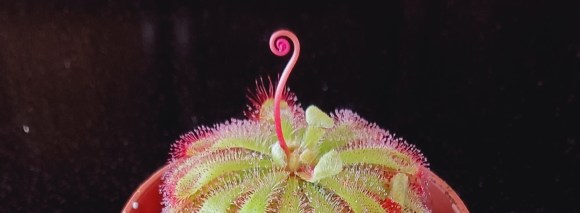
As we would expect from highly aware, social creatures, they relate to other species including animals. They grow flowers to attract pollinators, they grow fruit to encourage animals to spread their seeds, and they enter into symbiotic relationships with animals to further their needs. If nutrients are especially scarce, plants turn carnivorous. (The leaves depicted on the cover of Semiosis are of a sundew. The drops are glue to catch insects.)
Through photosynthesis, plants create their own energy. We can’t know how that feels, although we can observe how sap courses up and down stems and through leaves, and how carefully plants arrange their leaves in a “leaf mosaic” to capture light efficiently. Plants that store food for winter know how much they have because they stop and shed their leaves when they think they have enough. They have body awareness.
Plants differ from us in one essential way: They have no set body type. Humans have two arms, two legs, and a standard-sized brain. A tree has as many branches and roots as it can support. A single tree can be huge, spreading out from its roots to create its own grove, and some can live for centuries, even millennia.
A possible personality has begun to emerge: anxious, active, aggressive, alert to its surroundings, impatient, reflective, forward-looking, physically singular, self-aware, long-lived, manipulative of animals, and painfully lonely if it has no companions of its own species. Add intelligence and we have a point of view:
“Growth cells divide and extend, fill with sap, and mature, thus another leaf opens. Hundreds today, young leaves, tender in the Sun. With the burn of light comes glucose to create starch, cellulose, lipids, proteins, anything I want. Any quantity I need. In joy I grow leaves, branches, culms, stems, shoots, and roots of all types. … Intelligence wastes itself on animals and their trammeled, repetitive lives. They mature, reproduce, and die faster than pines, each animal equivalent to its forebearer, never smarter, never different, always reprising their ancestors, never unique.”
Some plants are conspicuous killers. Are they murderous or are they carnivorous — including proto-carnivorous, semi-carnivorous, para-carnivorous, or sub-carnivorous? So much carnivory!
An article at the International Carnivorous Plant Society website discusses the ways that taxonomists, ecologists, and evolutionary biologists differ in their approaches. The article also describes the “rather horrid plants that everyone needs to grow once to fully appreciate life.” This article is food for thought. Read it here: Murderous Plants.
In another matter, I was recently interviewed on Bull Falls Radio, WXCO in Wausau, Wisconsin. Host Bob Look started the hour-long show talking with Jane Graham Jennings of the Women’s Community. Then he and I had a fun chat. I happen to have been a high school classmate of Bob’s, and he and I have both fulfilled our youthful goals. He’s on the radio (and he sounds slick!), and I’m writing science fiction novels.
I’ve been growing houseplants for a half-century, and before that, I lived in a house filled with my mother’s plants. She also kept a garden. I’ve always liked plants.
Now, I don’t just like them — or even love them. I respect them. And I have opinions.
According to a work attributed to Aristotle but is probably by Nicolaus of Damascus, On Plants, “the plant is not a living creature, because there is no feeling in it.” That kind of thought has permeated Western philosophy since ancient times: Plants rank one step up from rocks, capable of reproduction and growth, but not movement or sensation.
A lot of people still think that way, and to them, plants are valuable only insofar as they provide some benefit to us such as food and medicine, or habitat for a charismatic animal like monarch butterflies, or inspire easy awe like giant sequoias. If not, that particular plant species has no interest or value.
Plants, of course, make our lives possible on Earth. They produce the oxygen and food we need from sunlight. But thinking that way can still fall into the trap of anthropocentrism.
After all these years of living alongside plants at home and after all the research needed for the novel series, for me every plant has become a miracle. Shepherd’spurse, a common weed growing in vacant lots and cracks in sidewalks, has seed pods that explode! In the soil, the seeds exude mucilage to capture and digest nematodes and insects to provide nutrients for the seedling — the seeds are protocarnivorous!
Plants have so much drama in their lives, and we walk right past as if these “weeds” were little more than rocks. (As if rocks weren’t also awesome.)
Every plant is fighting for its life, and they are all remarkably equipped to win the fight under ordinary circumstances. But we live in extraordinary circumstances, and many species can’t adapt fast enough to the loss of habitat, invasive species, poaching, the rapid spread of disease and pests using human transport, over-foraging, and climate change.
Plants need friends. I hope I’m a good friend, and I hope I’ve convinced you to care about plants, too. They’re not here to serve us. We are all in this together, and our task is to share this good green Earth.
***
The official launch of the novel Usurpation, the third book in the Semiosis trilogy, will be at 6:30 p.m. Wednesday, October 30, at Volumes Bookcafe, 1373 N. Milwaukee Ave., Chicago. Everyone’s invited! More details here.
Although it grows in a wide range in Asia, North American, and northern South America, you might not easily find a Monotropa uniflora, a wildflower also known as a ghost pipe or Indian pipe. The bare stems rise less than a foot tall, often in dark spots. They look like a weird mushroom or fungus, but they are true flowering plants, related to blueberries and rhododendra.
However, they’re parasites. They have no green chlorophyl. Instead of making their own food, they get their food from fungus, and that fungus gets its food from photosynthetic trees over mycorrhizal networks.
Plants employ many strategies to survive, and they can co-relate in many ways, among them: mutualism (mutual dependence), commensalism (a plant benefits from another but doesn’t do it harm), parasitism (a plant benefits from another and does harm it), amensalism (a plant benefits from another and destroys it), and carnivorism (a plant consumes an animal). Is being a parasite so bad, given some of the other choices?
Ghost pipes were Emily Dickinson’s favorite flower: “I still cherish the clutch with which I bore it from the ground when a wondering child, an unearthly booty, and maturity only enhances the mystery, never decreases it.”
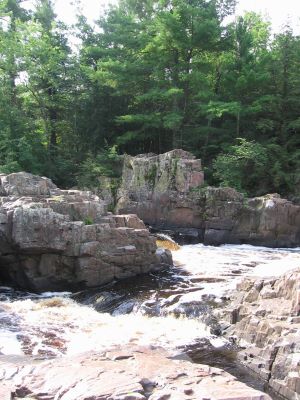
I took the photo of those ghost pipes at the Dells of Eau Claire Park in Marathon County, Wisconsin. If you’re ever in the neighborhood, stop by and take a hike. The park along the Eau Claire River, including a waterfall, is gorgeous. (Here’s another photo I took there.)
The third book in the Semiosis trilogy, Usurpation, will be published in October this year, and you can pre-order it with links to your favorite bookseller here, in hardcover and ebook.



 Semiosis