Categories
Uncategorized

Why you have a future

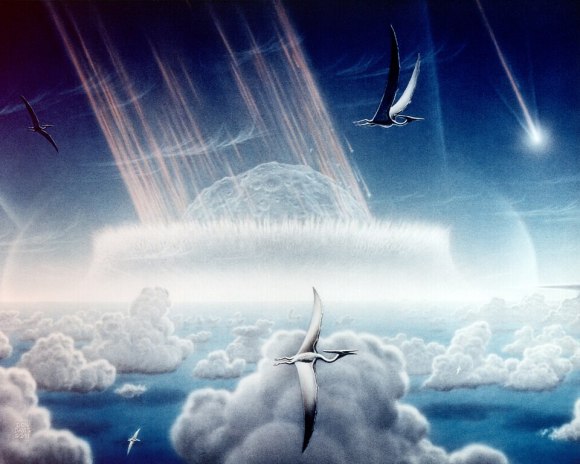
This painting for NASA by Donald E. Davis depicts an asteroid slamming into the Yucatan Peninsula as pterodactyls glide above low tropical clouds.
Knowledge is power, but perfect knowledge is impossible.

Suppose you knew when and how you were going to die. Could you avoid crossing the street in front of a speeding taxi? Get a mammogram in time? Stop smoking right now?

You might have to learn to face certain death with aplomb.

Possibly, everything in space and time already exists, just like a museum diorama, unchangeable as the evolution and disappearance of the dinosaurs. Their story began two hundred thirty million years ago, when Thecodonts began to walk upright. It ended 65 million years ago when the eight-ton Tyrannosaurus rex got squashed by a giant asteroid.

Perhaps God has already thought things through. Or perhaps, in an atheistic universe, space-time exists such that all its event-lines are locked in place from beginning to end. For the dinosaurs, it was a fatal surprise when an immense rock from space the size of Halley’s Comet smashed into Mexico’s Yucatan Peninsula and blasted out a crater 175 kilometers across.

But it was fate, kismet. The moving finger wrote, and it had to happen. Orbits had intersected, and God, or anyone with a telescope, could have seen it coming.

Philosophers and physicists have propounded for and against this idea of a pre-determined universe. Despite its logical consistency, Western minds can’t quite get around the fatalism. It means that no matter what we do now, we can’t change anything. We are as fierce, beloved, and doomed as T-rex. Our big brains make no difference.

So, you have no free will. You were pre-destined to read this essay, in fact. You can’t change a thing, can you?

Ah, but you have. One small example: Do you remember your school teacher when you were seven years old, Mrs. Sobel? In reality you were nine years old when she was your teacher. Yet you go on blithely making decisions thinking that you live in the seven-year-old-with-Sobel universe.

Mentally, we rearrange events to happen the way we think they should have happened. Then we interact with other people, every one of us with deluded memories, and we change our evolution and redesign our fates en masse.

Worse yet, without monumental research into every moment of your past, you can’t even know what you’ve misremembered. You may have forgotten major events, or made up others out of thin air. You may be planning a vacation to the Yucatan. You hope to swim at the white sand beaches, play a little golf, and take a day trip to the Maya ruins of Uxmal. Or have you already gone? Can you be sure? Was Mrs. Sobel there? Did you see any dinosaurs?

That’s why, in the Yucatan, the ancient Maya wrote down their history. They needed to remember everything that happened because they believed time moved like a wheel, which is why their calendars revolved in circles. Dates would repeat. When time turned around again, if they knew what had happened on the same date the last time, they could be prepared. Their records indicated that huge floods usually destroy the world on a certain date, 13 Baktun 0 Katun 0 Uinal 0 Kin. Fortunately this date doesn’t recur often, most recently on December 23, 2012, by our Gregorian calendar. But was the Earth destroyed? No, because we were prepared!

Knowledge is power. But you have to have accurate information.

And you don’t. You’ve already forgotten who knows what, and so have I.

What’s going to happen next? Somewhere, someone might have known, but we’ve ruined it for them. You may wish to quit smoking, get a mammogram, or look both ways before crossing anyway. We still need all the aplomb we can get, because we will all die, we just can’t know when.

***

This essay appeared in Issue 2, Summer 2002, of Full Unit Hookup magazine. Illustration: This painting for NASA by Donald E. Davis depicts an asteroid slamming into the Yucatan Peninsula as pterodactyls glide above low tropical clouds.

Categories
Uncategorized

Links about plants, AI use, and reviews

Botany may be entering a golden age as improved scientific tools allow for new insights and new uses for plants. Here’s some recent news.

‘Sheep eating’ tropical plant flowers in Hampshire after 10 years | BBC

“Its actual name is ‘sheep catcher,’” she explained. “It would typically entangle wildlife around it and then hold on to it and unfortunately if they perish it would then give nutrients to the plant.”

Plants can hear tiny wing flaps of pollinators | Popular Science

“Plant-pollinator coevolution has been studied primarily by assessing the production and perception of visual and olfactory cues, even though there is growing evidence that both insects and plants can sense and produce, or transmit, vibroacoustic signals,” said Francesca Barbero, a professor of zoology at the University of Turin in Italy.

Volcanoes Send Secret Signals Through Trees And NASA Satellites Can See Them | SciTechDaily

As magma moves upward through the Earth’s crust, it releases gases like carbon dioxide. Trees absorb this carbon dioxide, and in response, their leaves often grow more vibrant and healthy-looking. Using powerful tools like NASA’s Landsat 8 satellite, along with airborne instruments flown as part of the Airborne Validation Unified Experiment: Land to Ocean (AVUELO), scientists are now able to detect these subtle signs from above.

The Rabbit Hole of Research EP 35: Weird Plants | podcast

Dive into the wild world of weird plants! In this episode, the crew explores plant biology, carnivorous plants, zombie survival gardens, and Molly’s journey from forest explorer to plant store owner. Our goal is to have fun learning science through the lens of science fiction, fantasy, and pop-culture … and you’ll learn a few facts you can use to impress your friends at a party or use as a conversation starter to go down your own rabbit holes.

Next big thing in sustainable building: Iron-fortified wood | Anthropocene

The construction industry faces pressure to be more sustainable. And the demand for greener buildings has led to a fresh look at wood construction. Wood is one of the oldest building materials used by mankind, but it does not have the strength needed to be used the load-bearing material in structures larger than houses and cabins.

Subjective mapping of indoor plants based on leaf shape measurements to select suitable plants for indoor landscapes | ScienceDirect

A subjective plant map of 40 indoor plants based on plant impressions was prepared. The physical shapes of leaves were measured that could represent a subjective map. Both experts and people reported relaxation and liveliness on seeing plants. Plants with small leaves induced a sense of relaxation. Leaf shape classification may assist in selecting plants for indoor landscapes.

Mathematicians solve centuries-old mystery of how ‘broken’ tulips get their stripes | The Global Plant Council

Often referred to as “broken tulips,” the striped variations of the popular flower were coveted in the 17th century for their beautiful markings. It’s been known since 1928 that the pattern is caused by a viral infection known as the tulip breaking virus, but exactly how the signature stripes are formed remained an unsolved mystery until now.

Artificial intelligence

I’m a member of the American Translators Association. The translation field is coping with neural machine translation (such as Google Translate) and AI translation:

ATA Statement on Artificial Intelligence | ATAnet

The latest wave of artificial intelligence (AI), powered by large language models (LLM), is reshaping numerous professions, including the translation and interpreting industry. However, a growing reliance on AI highlights—not diminishes—the necessity of expert human linguists who possess the specialized skills to address translation and interpreting challenges that arise in this new context.One of the greatest dangers of AI-generated translations and interpretations is that they may appear accurate to the general observer, making errors harder to detect for those without linguistic expertise.

A philosophic look at AI in writing:

Listening for the Human Voice: Reflections on AI, Authenticity, and Education | Queer Translation Collective

On one hand, AI tools promise efficiency, personalization, and access. On the other, they provoke a deep discomfort. If students can simulate fluency and polish with a few prompts, what becomes of the messy, vulnerable, and transformative act of writing? What becomes of the human voice?

The view from the trenches:

Teachers Are Not OK | 404 Media

They describe trying to grade “hybrid essays half written by students and half written by robots,” trying to teach Spanish to kids who don’t know the meaning of the words they’re trying to teach them in English, and students who use AI in the middle of conversation. They describe spending hours grading papers that took their students seconds to generate: “I’ve been thinking more and more about how much time I am almost certainly spending grading and writing feedback for papers that were not even written by the student,” one teacher told me. “That sure feels like bullshit.”

Reviews of my novels

Stack Overflow: Alien Intelligence | GeekDad

It’ll be hard to talk about the whole Semiosis trilogy without some spoilers for the first two books, though I think I can communicate at least some of it in broad enough strokes. The overarching theme is sentience, and each book has its own tagline: “Sentience takes many forms.” “Sentience craves sovereignty.” “Sentience will prevail.”

Tom (Germany)’s review of Usurpation | Goodreads

Then I realized – or believe to have realized – that, while this book plays in an even more distant future than its precursors, its content, how it feels to me, is even closer to what is happening currently on planet Earth, and suddenly all disappointment disappeared, first to be replaced by some horror, as the book progressed, and then … by hope.