Categories
Uncategorized

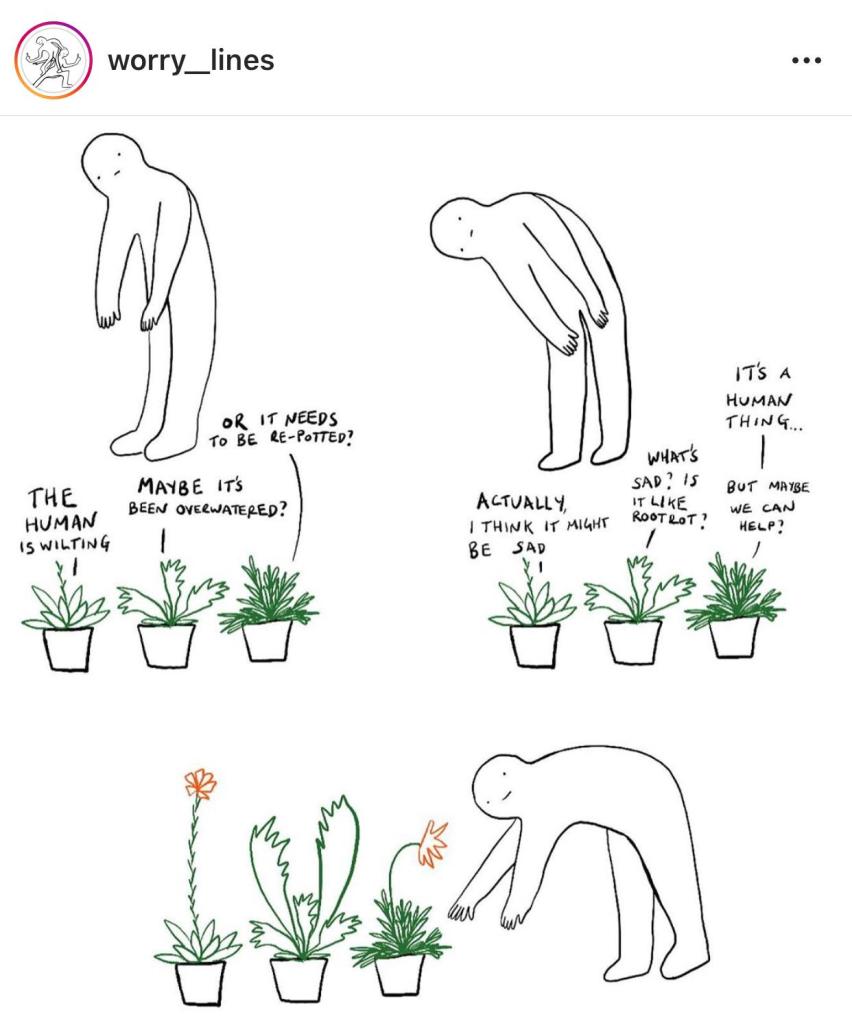
You can be an emotional support animal

As you know, an emotional support animal is a companion that provides support to human individuals for a mental, psychiatric, or emotional disorder. These are often typical pet animals like dogs and cats, although other creaturesincluding plants — can improve your mental health.

Plants require a role reversal, though.

Animal companions for humans rarely get training, but you must train yourself to provide effective emotional support for plants. First, you must overcome plant blindness and see them as living beings. Then decide if you plan on supporting outdoor or indoor plants: gardening, rewilding your lawn, or sustaining indoor plants in pots?

If you already have plants, what kind do you have? Apps like Picture This and its website, Pl@ntNet, or guided observation and keys can help. Find out what that particular plant needs for warmth, light, and watering, and consider what you can offer.

Common houseplants are often jungle undergrowth plants, and your living room probably resembles a jungle floor in light and warmth — but check. Every plant has a niche, and it will suffer stress outside that niche. A cactus leads a very different life than a pothos, and small plants need more frequent care, sometimes daily, than big plants. Your first emotional support duty is to gauge your ability to minimize the plant’s stress.

“Moist” is a universally challenging concept when it involves soil, yet you must master it.

When you care for your plant, you will benefit both the plant and yourself. As you provide regular, attentive care, you may improve your own self-care. After all, you get by giving, and you learn responsibility by being responsible.

As the support animal, you will be rewarded by beauty and quiet companionship, and you will have created a supportive environment for the plant — and very possibly for yourself. Are you ready to change your life?

Categories
Uncategorized

How has the Semiosis series changed me?

Shepherd’s purse, Capsella bursa-pastoris.

I’ve been growing houseplants for a half-century, and before that, I lived in a house filled with my mother’s plants. She also kept a garden. I’ve always liked plants.

Now, I don’t just like them — or even love them. I respect them. And I have opinions.

According to a work attributed to Aristotle but is probably by Nicolaus of Damascus, On Plants, “the plant is not a living creature, because there is no feeling in it.” That kind of thought has permeated Western philosophy since ancient times: Plants rank one step up from rocks, capable of reproduction and growth, but not movement or sensation.

A lot of people still think that way, and to them, plants are valuable only insofar as they provide some benefit to us such as food and medicine, or habitat for a charismatic animal like monarch butterflies, or inspire easy awe like giant sequoias. If not, that particular plant species has no interest or value.

Plants, of course, make our lives possible on Earth. They produce the oxygen and food we need from sunlight. But thinking that way can still fall into the trap of anthropocentrism.

After all these years of living alongside plants at home and after all the research needed for the novel series, for me every plant has become a miracle. Shepherd’s purse, a common weed growing in vacant lots and cracks in sidewalks, has seed pods that explode! In the soil, the seeds exude mucilage to capture and digest nematodes and insects to provide nutrients for the seedling — the seeds are protocarnivorous!

Plants have so much drama in their lives, and we walk right past as if these “weeds” were little more than rocks. (As if rocks weren’t also awesome.)

Every plant is fighting for its life, and they are all remarkably equipped to win the fight under ordinary circumstances. But we live in extraordinary circumstances, and many species can’t adapt fast enough to the loss of habitat, invasive species, poaching, the rapid spread of disease and pests using human transport, over-foraging, and climate change.

Plants need friends. I hope I’m a good friend, and I hope I’ve convinced you to care about plants, too. They’re not here to serve us. We are all in this together, and our task is to share this good green Earth.

***

The official launch of the novel Usurpation, the third book in the Semiosis trilogy, will be at 6:30 p.m. Wednesday, October 30, at Volumes Bookcafe, 1373 N. Milwaukee Ave., Chicago. Everyone’s invited! More details here.