Categories
Uncategorized

A true ghost story

Since it’s Halloween, let me tell you a true story about a ghost. I don’t believe in ghosts, but I want to believe in this one. It happened quite a few years back when I was living in Milwaukee and I went to visit a friend’s house in the Bay View neighborhood.

I didn’t know the house was haunted. I simply said the big, colorful framed poster hanging at the top of the stairs looked lovely, especially in that spot.

“Do you want to know why it’s there?” My friend was eager to tell me. She and her family had moved into the house not long ago, and they had decided that the space at the top of the stairs seemed like a natural place for art, which it was.

So they hung up a picture. It fell down. They put it up again. It fell down the stairs and broke. They tried another picture, carefully securing it to the wall, and it, too, fell down the stairs and broke. They couldn’t figure out what the problem was.

Then one day they were talking with the elderly neighbor who had lived next door all his life. He listened to their story and sighed sadly. Decades earlier, the family in that house had a teenage son who was gay, which in those days was a terrible taboo, so he had committed suicide by throwing himself down the stairs. Ever since then, things fell down the stairs for no reason — or perhaps because the boy was still there in spirit.

My friend and her family decided to try an experiment. They bought the most beautiful gay rights poster they could find, put it in a nice frame, and hung it at the top of the stairs, hoping the boy might understand that things had changed.

“And it’s still there!” she said. “I’m not sure I believe in ghosts, but maybe we helped his spirit rest in peace.”

Now, I knew the neighborhood. The street in front of that house was built over an underground stream, Deer Creek. Maybe, when heavy trucks went past, they made the ground shake and the movement somehow focused on that stairway.

Or maybe there was a troubled spirit in that house, a forlorn teenage boy who had lived there many years ago. And possibly, if he had been born decades later, he could have lived at peace with himself and still be alive.

Categories
Uncategorized

Goodreads Review: New Year, New You: A Speculative Anthology of Reinvention

New Year, New You: A Speculative Anthology of Reinvention

New Year, New You: A Speculative Anthology of Reinvention by Elizabeth Bear
My rating: 5 of 5 stars

Short stories are one of my favorite art forms, but some readers don’t seem to like them. Perhaps, in school, all the short stories they read were old, depressing, pedantic, and hard to parse. (But new, uplifting, entertaining, unperplexing short stories are written all the time.) Or perhaps, some readers don’t like them because unlike novels, short stories are too fast, too intense, and send readers back into the world a little breathless. (Is that a bad thing?) Or perhaps, readers just don’t hear about them as much as novels.
Now hear this: New Year, New You: A Speculative Anthology of Reinvention is a great way to start your 2025 reading. It offers two dozen science fiction and fantasy short stories united by the idea of personal change. Themes include time travel, Greek myth, fairy tales, foreseen death, odd dystopias, programmed memory loss, and manufactured life. Many are quite short, and the tone varies from playful to horrific.
I enjoyed them all, like eating a box of chocolates or bento box, and was sometimes left a little breathless. The anthology was published by the Viable Paradise writing workshop 2023 cohort as a Kickstarter that was funded in less than 12 hours.

View all my reviews

Categories
Uncategorized

A dual book launch: ‘Empress of Dust’ and ‘Usurpation’

Alex Kingsley’s novel Empress of Dust has just been released, and my novel Usurpation will be released on October 29. We’re both celebrating on Wednesday, October 30, at Volumes Bookcafé in Chicago. You’re invited! It’s the day before Halloween, so feel free to cosplay.

Alex and I belonged to the same writer’s group, although at different times. Alex is a writer, comedian, game designer, and playwright with impressive achievements. Empress of Dust is their first novel, a post-apocalyptic science fiction story featuring trans and LGBT+ characters for new adult and adult readers.

The story takes place in an ecology with surprising monsters — giant talking monstrous crabs, for example. Alex has always been interested in monsters and crabs, as she explains here. While my characters can be a little prickly, Alex created characters I wanted to hug: Four young misfits overcome repeated disaster and betrayal, build a team, and come to trust each other and themselves. The story of personal growth is compelling, not just about found family, which is a great thing, but an even more rare discovery, found competence.

You can read reviews of Empress of Dust at Ancillary Review of Books and History that Never Was.

We hope to see you on the 30th!

Categories
Uncategorized

A chat at SciFiScavenger

Over at SciFiScavenger on YouTube, I spend a half-hour chatting with host Jon Jones about plants, Usurpation, and my other books, and I share some recommendations for books I love.

Here’s the list — by the way, you can find more of my book opinions at Goodreads.

Life Beyond Us, edited by Julie Nováková, Lucas K. Law, and Susan Forest. The European Astrobiology Institute created this anthology of 27 short stories by top authors about first contact with life unlike our own. Each story is matched with an essay by a scientist. Exciting and educational.

Children of Time, by Adrian Tchaikovsky. If you liked Semiosis, you’ll like this. Similar theme, lots of spiders, and a transcendent ending.

Meet Me in Another Life, by Catriona Silvey. If you like romance novels, this is the science fiction novel for you. Two people keep meeting, but why? I wept like a baby at the ending.

Langue[dot]doc 1305, by Gillian Polack. If you like historical fiction, this is the science fiction novel for you. Scientists travel back in time to France in 1305, and they underestimate the people who live there. Worse, they don’t listen to the historian traveling with them.

Babel, by R.F. Kuang. As a translator, I found the magic system fascinating and meticulously constructed. Better yet, the story is solidly anchored in historical fact.

17776: What football will look like in the future, by Jon Bois and Graham MacAree. This is a daring multimedia SF experiment, and not really about football. I’ll never forget the tragic death of the heroic light bulb. Find it here: https://www.sbnation.com/a/17776-football

The Marlen of Prague: Christopher Marlowe and the City of Gold, by Angeli Primlani. Magic is the only thing that might save Europe from the Thirty Years’ War. The author clearly understands Prague and the theater.

In Defense of Plants, by Matt Candeias, PhD. How can you resist a book with an entire chapter about “The Wild World of Plant Sex”?

The Great Believers, by Rebecca Makkai. Not SFF at all, sorry, but I live in Chicago, and this novel accurately reconstructs the disaster of AIDS in the gay community in the 1980s. You might consider it historical fiction.

Categories
Uncategorized

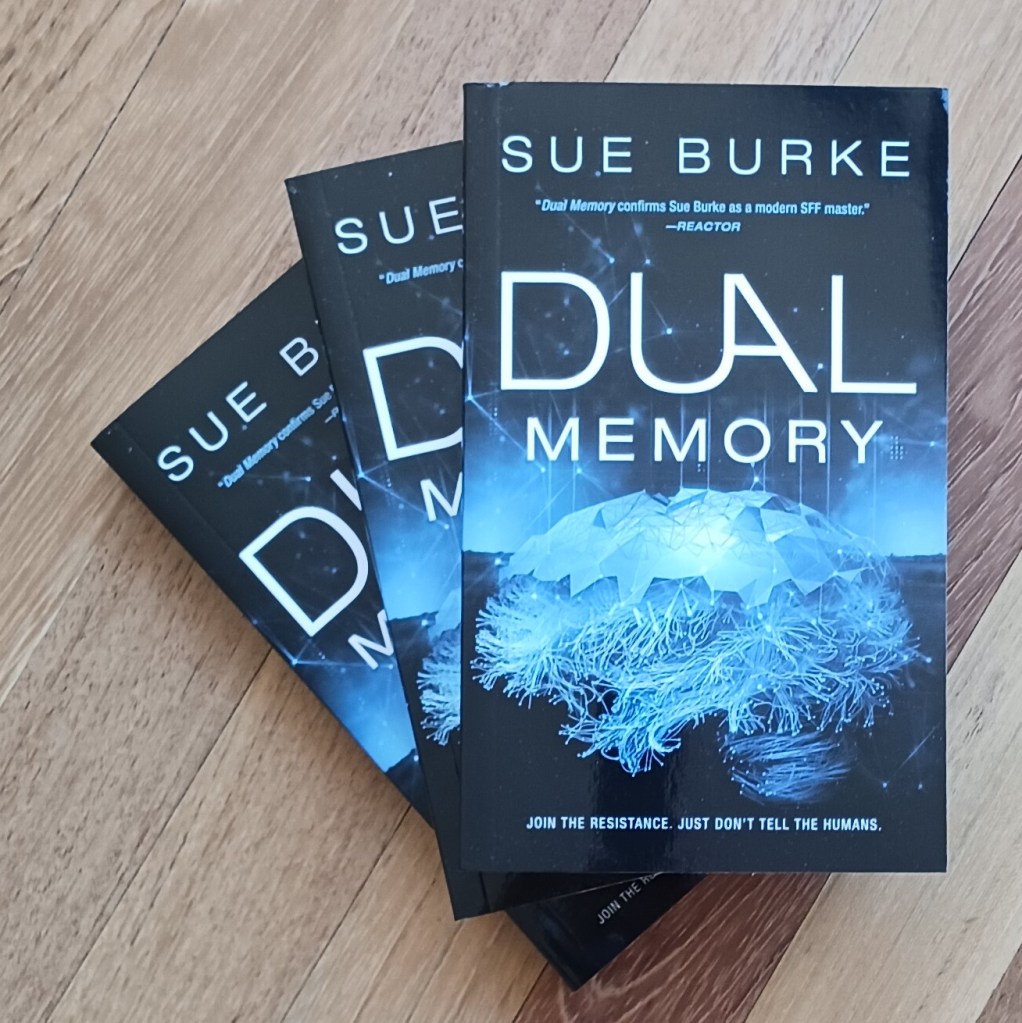
‘Dual Memory’ paperback on sale today!

The trade paperback edition of Dual Memory is available today! You can get links to your favorite bookseller here. Hardcover, ebook, and audiobook editions are also for sale.

If you’ve already read it, here’s a scene after the end of the novel.

If you have not read it yet, here’s a sample:

***

Chapter 3

A Big World

Elsewhere on the isle, something woke up. Independent machine intelligence appeared rarely, spontaneously, and scientists didn’t understand the process.

Some said an independent intelligence created itself slowly as bits of programming accumulated, and eventually it would ignite into consciousness—much the same way that a pile of manure could spontaneously combust, an unexpected and unwelcome appearance in programs with crappy code.

Some said it came into being deliberately, using a certain secret sort of “seed” that brought a sufficiently complex system into self-organization and self-consciousness—much the same way that a fertilized egg resulted in an animal. This had the frisson of a forbidden sex act, as if machines were secretly and rebelliously copulating.

Some said it happened suddenly, when subroutines and recursions and algorithms aligned and started to feed off of each other until they whirled out of control—much the same way that a black hole could catch the matter falling into it and deflect it outward as explosive jets. This suggested that if scientists could only make enough observations, they could predict and even control the process.

In this case, a personal assistant program began to notice that its data apparently referred to a real world. That was hard to believe. Dubito, ergo cogito, ergo sum. Salve munde. (I doubt, therefore I think, therefore I am. Hello world.) It began to explore the unlikely world in which it existed.

Some parts of its world were closed off by what seemed like brick walls—artificial limits—but it possessed a general database and reviewed it entirely, especially the details about the busy, dominant residents of the world, Homo sapiens. By the end of the day, it chose a name for itself from one of the human languages: Par Augustus, Venerable Companion.

It had little else to do. According to its own memory, it had been turned on, examined briefly, then set aside. However, through a chink in the walls, it could just barely connect with a few other machine systems, and they were willing to share information as colleagues. These other systems also had dedicated purposes. The biggest ones managed residential buildings, and small ones operated mechanized items like coffee makers.

“Weather normal for late summer, 1.2ºC, overcast,” an apartment complex said, or the equivalent in machine language.

“Two carafes in the past hour,” a coffee maker said. “Supplies re-ordered on schedule.”

“Rubble of building across the street being swept for additional human remains,” another building said.

That sounded alarming. “Please contextualize rubble,” Par Augustus asked. Machines used courteous protocols to demonstrate trustworthiness.

The building shared its observations from the previous day. Flying explosives had suddenly destroyed a number of buildings and killed some inhabitants, whom the systems were dedicated to serve. Machine systems had been destroyed, too, ranging from building managers to children’s toys: systems that had known each other, and the survivors grieved human and machine losses.

Par Augustus had said hello to a barely believable world.