Categories
Uncategorized

Deep Dish reading on Thursday

You’re invited to the Deep Dish speculative fiction reading on Thursday, October 3, at 6:30 p.m. at Volumes Bookcafe, 1373 N. Milwaukee Ave., Chicago, sponsored by the Speculative Literature Foundation. I’ll be one of the rapid-fire readers.

***

The launch of my novel Usurpation will be at 6:30 p.m. Wednesday, October 30, at Volumes Bookcafe. Everyone’s invited! More details here.

***

At Goodreads, I reviewed The Word, by JL George, a science fiction novel that shows how the power of compassion can fuel a rebellion in a dehumanized near-future Britain.

Categories
Uncategorized

Why is the Pax Institute in Bayonne?

In the novels Interference and Usurpation, the Pax Institute is located in Bayonne, France. Someone asked me why.

Well, basically, because I’ve been there (the photo is of me and my husband), so I knew Bayonne had a good climate for growing rainbow bamboo — which is the most important detail, of course.

Beyond that, I got a bit of a feel for the location, just enough to be able to imagine it a few centuries in the future: What’s the general layout of the city? Where are the hills? How far away is the ocean?

If you’re considering a visit to Bayonne, I recommend it. The historic heart of the city has beauty and charms that date back to before the Middle Ages. Nearby are wide beaches and forested parks, and not far to the south are the gorgeous foothills of the Pyrenees. The city hosts a variety of festivals — and, of course, there’s French and Basque food to enjoy.

In the novels, I hope I’ve respected Bayonne’s traditions and heritage, but I feel I should apologize for the damage I inflicted on the future city and its people. Je m’excuse pour le dérangement.

***

Reminder: The ebook of the first novel in the Semiosis trilogy is on sale during September at Amazon for only $2.99. It includes an excerpt from the third book in the trilogy, Usurpation, which will be released on October 29.

Categories
Uncategorized

Autographed copies of “Usurpation”

If you want an autographed copy of my next novel, Usurpation, and you won’t see me in person, you can order it through Volumes Books, a locally owned Chicago bookstore. The book comes out on October 29. International shipping can be arranged individually.

Find it at this link:

https://volumesbooks.com/book/9781250809162

Categories
Uncategorized

Telling a story from a nonhuman point of view

Not every mind is human, and that’s a challenge for science fiction authors. It’s hard enough to write from a different human point of view: We’re a varied species, each one of us with our own experiences and quirks, but at least we can talk to each other. Non-humans … well, they never have long conversations with us, alas.

Yet, if we’re going to write science fiction, we can’t let that stop us. For my novel Semiosis, I needed to write from the point of view of a plant — an alien plant, of course, not an Earthly one. All right, where to start?

Obviously, we know some things about Earth plants, so I began researching them. What is their experience of life? For one thing, they’re under a lot of stress. Growing seasons are short, and weather is uncertain.

Spring ephemerals, such as trilliums and snowdrops, illustrate this anxiety. They grow and flower as early as possible in spring, sometimes right through snow, dangerous though that must be. They catch the sunlight before trees put out leaves and cast shade. They offer nectar to the first bees that wake up after winter, monopolizing their attention. Then these plants go dormant until next spring: That’s the extreme step they must take to get their day in the sun. They leap upward at the first hint of springtime.

Plants compete for sunlight and actively fight over it. A common houseplant called the asparagus fern (Asparagus setaceus) has pretty, lacy leaves – and thorns it can anchor into other plants and climb over them. Its aggression has earned it the status of noxious weed in some parts of Australia. Roses have thorns for the same reason. If they happen to starve other plants by blocking out the sunshine, that’s just survival of the fittest.

Vines climb up trees to get sunshine without the cost of growing a sturdy trunk. Other plants may grow large leaves quickly to cast shadows on their neighbors, or poison the ground to keep out competition.

So, plants lead lives of quiet desperation — in constant combat and relying on an arsenal of weapons.

The book What a Plant Knows: A Field Guide to the Senses by Daniel Chamovitz documents what his fellow botanists have long known. A plant can see, smell, feel, hear, know where it is, and remember. “Plants are acutely aware of the world around them,” he writes.

Trees, like us humans, have social lives. InThe Hidden Life of Trees: What They Feel, How They Communicate, German forester Peter Wohlleben describes how trees of the same species in forests create communities that help each other, enjoying much longer, healthier lives than isolated city trees. Trees also make decisions, such as when to drop their leaves, which can be a life-or-death gamble on the coming weather.

Plants are alert to their surroundings, and they can recall the past and plan for the future. They’re gregarious, and being isolated hurts them.

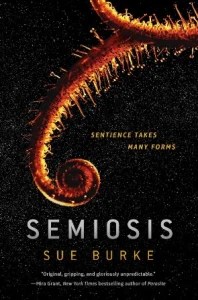
As we would expect from highly aware, social creatures, they relate to other species including animals. They grow flowers to attract pollinators, they grow fruit to encourage animals to spread their seeds, and they enter into symbiotic relationships with animals to further their needs. If nutrients are especially scarce, plants turn carnivorous. (The leaves depicted on the cover of Semiosis and the plant in the photo are sundews. The drops are glue to catch insects.)

Through photosynthesis, plants create their own energy. We can’t know how that feels, although we can observe how sap courses up and down stems and through leaves, and how carefully plants arrange their leaves to capture light efficiently. Plants that store food for winter know how much food they have because they stop and shed their leaves when they think they have enough: They have body awareness.

Plants differ from us in one essential way: They have no set body type. Humans have two arms, two legs, and a standard-sized brain. A tree has as many branches and roots as it can support. A single tree can be huge, spreading out from its roots to create its own grove, and some can live for centuries, even millennia.

A possible personality for a plant has begun to emerge: anxious, active, aggressive, alert to its surroundings, impatient, reflective, and forward-looking, physically singular, self-aware, long-lived, manipulative of animals, and painfully lonely if it has no companions of its own species. Add intelligence and we have a point of view:

“Growth cells divide and extend, fill with sap, and mature, thus another leaf opens. Hundreds today, young leaves, tender in the Sun. With the burn of light comes glucose to create starch, cellulose, lipids, proteins, anything I want. Any quantity I need. In joy I grow leaves, branches, culms, stems, shoots, and roots of all types. … Intelligence wastes itself on animals and their trammeled, repetitive lives. They mature, reproduce, and die faster than pines, each animal equivalent to its forebearer, never smarter, never different, always reprising their ancestors, never unique.”

Categories
Uncategorized

Books on sale!

If you or someone you know and love hasn’t read the novel Semiosis yet, the ebook will be on sale throughout the month of September for only $2.99 for Kindle. This promotion will include an excerpt from the third book in the Semiosis trilogy, Usurpation, which will be released on October 29.

Besides that, from September 4 to 6, Barnes & Noble is dropping the preorder price for Usurpation, as well as other preorders. B&N Members get 25% off, and Premium members get an additional 10% off. This is good for print, ebook, and audiobook editions.

Meanwhile, I’ll be at Chicago’s Printers Row Lit Fest on Saturday morning, September 7, at the Speculative Literature Foundation table. Come say hi!

Categories
Uncategorized

If there was grass…

This is an excerpt from Chapter 1 of Semiosis. Octavo, the botanist, explains what plants tell us about the overall ecology:

But the presence of the wheat worried me. The wheat was a lot like Earth grass, and if there was grass, then there were grazers, maybe animals like gazelle, moose, or elephant. And if there were grazers, then something hunted them. So far we had seen only small browsers and predators like little land crabs with trilateral symmetry, but we had found bits of big crab shells — and of big stone-shelled land corals with stinging tentacles. None of us went barefoot anywhere.”

Categories
Uncategorized

Daniel Thomas May and Caitlin Davies are back!

Usurpation will have an audiobook, and Daniel Thomas May and Caitlin Davies will be narrating it. They narrated the first two novels in the trilogy, Semiosis and Interference — and they did a fabulous job! I’m delighted to have them back.

The audiobook is now in production, and the novel Usurpation will be released as hardcover, ebook, and audiobook on October 29.

Categories
Uncategorized

I’ll be at bookstores in Madrid on Friday and Saturday

If you happen to be in Madrid, Spain, this week, so am I!

If you speak Spanish, come to Estudio Escarlata at 7 p.m. Friday, July 26, at calle Andrés Mellado 52. As you may know, Semiosis is now available in Spanish — with a wonderful translation by Rafael Marín.

If you prefer English, come to the Secret Kingdoms bookstore at 8 p.m. Saturday, July 27, at calle Moratín 7. I’ll be talking about my books, naturally — followed by drinks and snacks.

As you may know, I lived in Madrid from 2000 to 2016. I’m excited to be back among friends in the city I love!

Categories
Uncategorized

An excerpt from ‘Usurpation’

Here’s an excerpt from the novel Usurpation, which will be published in October in hardback, ebook, and audiobook (in preparation). You can preorder your copy now.

CHAPTER 3 – Year 2885 CE – Pax Institute, Bayonne, France – LEVANTER

She has arrived, the new director of the Pax Institute, and I will be destroyed. She confirms her credentials with the building and walks through the front door.

She is going to take my place. She will find out that I, Levanter, am not a human being. Foolishly, I used my real name to declare myself director, the name Mirlo gave me three centuries ago. He planted seeds he brought from the planet Pax, and I and my two sisters now grow here at the institute’s garden. My name is in the record’s big clumsy library in too many places to erase before she accesses the system. It is even on a sign in the garden in front of my main stalks. She will discover that Levanter is a rainbow bamboo.

No one knows we are intelligent. No one can know. Bamboo grow all over the Earth, and humans would kill us all if they knew. Not all humans are killers, but some are, and they have proven themselves efficient.

Categories
Uncategorized

“When Star-Stuff Tells Stories” – now on sale

“If and when aliens make first contact, who should answer? Maybe humankind should turn to people like me, translators of science fiction. We’ve already thought through this kind of problem.”

That’s the opening sentences of my essay When Star-Stuff Tells Stories: Translating science fiction as a metaphor of technology and wonder. Calque Press has just published a limited edition of it as a 24-page pamphlet, and you can learn more and buy it here.

It’s one of a series of essays and other short works published by Calque. They’re meant to provide an opportunity for writers to think aloud about their own experiences and knowledge — and they are beautifully printed on high-quality paper. The publisher is fussy about the look and feel.

Here’s Calque’s description of When Star-Stuff Tells Stories:

Starting from the very earliest forms of human communication, the ways in which language developed into languages, and created the role of the translator, Sue Burke offers an invaluable guide to the importance and difficulties of translation on Earth, and gives us fascinating speculation about what might happen if we ever do come into contact with extraterrestrial intelligence. This pamphlet addresses questions of what communication is, and how the translator is uniquely positioned to work at escaping the bounds of the medium and bringing pure meaning into an intelligible form.