The FanFiAddict website is back with TBRCon2025, an all-virtual sci-fi/fantasy/horror convention that will livestream from January 19 to 26. More than 150 authors, podcasters, bloggers, and booktubers will appear on the virtual stage for 25 livestream panels, 5 live podcasts and 2 RPG sessions.
TBRCon2025 is free to watch, available on YouTube, Bluesky, X, and Threads during convention week — or to re-watch on YouTube at your convenience.
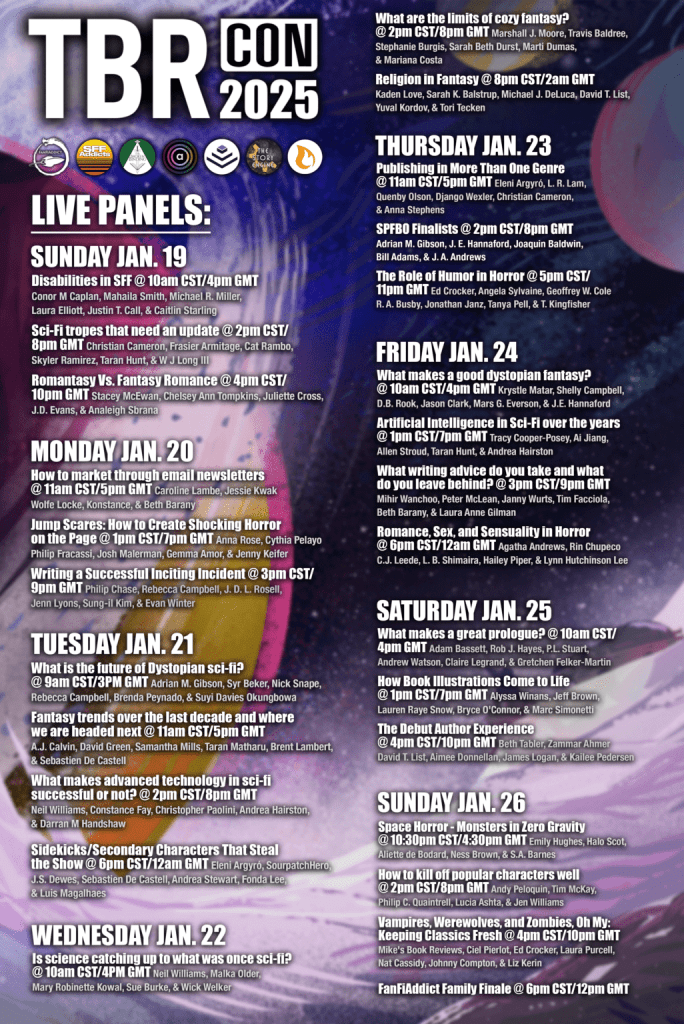
I’ll be on the panel “Is Science Catching Up to What Was Once Sci-fi?” on Wednesday, January 22, from 10 a.m. to 11:30 a.m. CST, with Mary Robinette Kowal, Malka Older, and Wick Welker, moderated by Neil Williams. A lot has changed in recent years when it comes to technology. But are we at full sci-fi tech level yet?
You can watch it live on YouTube here:
Some other panels I want to see: What Makes a Great Prologue? – Artificial Intelligence in Sci-Fi Over the Years – Space Horror: Monsters in Zero Gravity – How Book Illustrations Come to Life – What Is the Future of Dystopian Sci-Fi? – What Writing Advice Do You Take and What Do You Leave Behind? – Sci-Fi Tropes That Need an Update – How to Market Through Email Newsletters: Do’s and Don’ts.
Written by award-winning author Cristina Jurado, ChloroPhilia tells the story of Kirmen. He’s different from the other inhabitants of the Cloister, whose walls protect them all from the endless storm ravaging Earth. As a result of the Doctor’s cruel experiments, his physical form is gradually evolving into something better fit for survival in the world outside. This singular coming-of-age story addresses life after an environmental disaster and collective madness, and ends with surprising triumph.
As a translator, I faced a particular challenge with the prologue and the closing section. I’ve translated Cristina before, and she writes beautifully. She poured her talent into prose soaring toward poetry that needed to be equally compelling in English. I did my best:
And behind it all was the roar of the swarm that was its body, millions of shrieks drowning in the fleshy throats of minute beings, a beautiful song made from the spark that lit their lives and that, doused forever, wove the music of the dead.
The novela was reviewed by the Fantasy-Hive as “a remarkable, powerful and disturbing novella that confirms Jurado as a key creative voice in speculative fiction.”
ChloroPhilia is on sale here or at your favorite bookseller.
Short stories are one of my favorite art forms, but some readers don’t seem to like them. Perhaps, in school, all the short stories they read were old, depressing, pedantic, and hard to parse. (But new, uplifting, entertaining, unperplexing short stories are written all the time.) Or perhaps, some readers don’t like them because unlike novels, short stories are too fast, too intense, and send readers back into the world a little breathless. (Is that a bad thing?) Or perhaps, readers just don’t hear about them as much as novels. Now hear this: New Year, New You: A Speculative Anthology of Reinvention is a great way to start your 2025 reading. It offers two dozen science fiction and fantasy short stories united by the idea of personal change. Themes include time travel, Greek myth, fairy tales, foreseen death, odd dystopias, programmed memory loss, and manufactured life. Many are quite short, and the tone varies from playful to horrific. I enjoyed them all, like eating a box of chocolates or bento box, and was sometimes left a little breathless. The anthology was published by the Viable Paradise writing workshop 2023 cohort as a Kickstarter that was funded in less than 12 hours.
Discover Sci-Fi, which is a site for people who love to read science fiction, is hosting its Reader’s Choice awards. Titles were selected based on nominations from readers, and the winners will be announced on January 9, 2025.
The categories are: Best Sci-Fi Book (overall), Best Sci-Fi Audiobook, Best Debut, Best Space Opera Book, Best Military Sci-Fi Book, Best Alien Sci-Fi (First Contact/Invasion) Book — Usurpationis in this category — and Best LitRPG Book.
***
The movie Babygirl with Nicole Kidman, Antonio Banderas, and Harris Dickinson was released in the US this week. My novel, Semiosis, was used as a prop in the movie.
The movie producers asked for permission to use the book in the film a year ago. Only the cover will appear, the agreement stipulated, and “the book will not be read aloud, and no reference would be made to the book or its contents” — although if that happened, or if any of the stars wanted to pretend they were reading it, or if the book were somehow directly involved in the “erotic thriller” nature of the film, I would be fine with that.
But, probably, Semiosis will appear on a bookshelf somewhere in the background, perhaps not legibly, if at all. I haven’t seen the movie yet, but if you’ve seen it and you spotted my book, please let me know!
Every year, I coerce one of my house plants to cosplay the role of Christmas tree.
At the mere thought, my croton,Codiaeum variegatum, was so horrified it dropped almost all its leaves to avoid consideration. Apparently it never heard of a Festivus pole.
Last year’s “tree”I refuseFractal meLiving tinselPrickly
The Pilea peperomioides, who was last year’s imitation tree, complained it was too tired. I didn’t want it to drop its leaves in protest, so I let it rest.
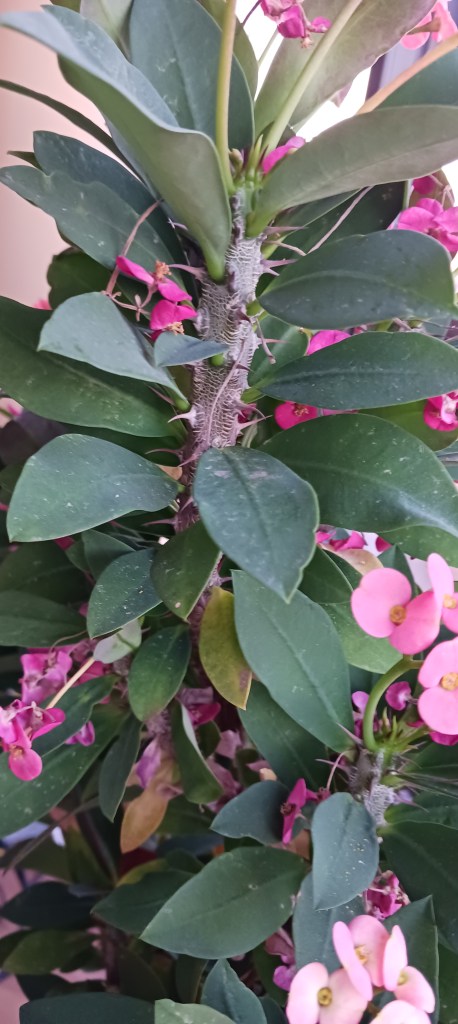
The crown of thorns, Euphorbia milii, volunteered with enthusiasm. “I have needles, just like a pine tree!” No, it has thorns quite unlike a pine tree, and I wear heavy gloves when I need to give it care. Decorating it would not be festive, so I kept looking.
“Pick me!” said the Boston fern, Nephrolepis exalta ‘Fluffy Ruffles’. “Look at my leaves. I’m a fractal Christmas tree!” Well, yes, and the plant is large, too. Although my standards are low, I can’t imagine a fluffy, ferny tree.
The dragon tree, Dracaena reflexa marginata ‘tricolor’, was not enthusiastic. “I am living tinsel,” it said. “My beauty is sufficient unto itself, and ornamentation would obscure my spontaneous splendor.”
That left the lucky bamboo, Dracaena sanderiana, but I’d cut it back to give away stems as gifts to neighbors. However, it has no thorns, no fluff, and it’s the strong, silent, non-complaining type.
So the lucky bamboo is this year’s tree. Happy holidays, and may your home be filled with joy and uncomplicated greenery.
An article by Amanda Gefter in Nautilus, “What Plants Are Saying About Us,” explains that although plants don’t have a brain, they do have autonomy, intelligence, adaptivity, and sense-making — that is, they have cognition. They’re not that different from us. And our cognition is more than our brains, too.
***
The photo of jungle plants in the mist is by me, incidentally. I took it this summer in a greenhouse at the Real Jardín Botánico (Royal Botanical Garden) in Madrid, Spain. Plants can dazzle us with their beauty as well as their intellect.
***
Meanwhile, Amazon wants me to buy this book. I’ve read it already, however, dozens of times.
Not every mind is human, which is a challenge for authors. It’s hard enough to write from a different human point of view: we’re a varied species, each one of us with our own experiences and quirks, but at least we can talk to each other. Non-humans … well, they never have long conversations with us, alas.
Yet, if we’re going to write speculative fiction, we can’t let that stop us. For my Semiosis novel series, I wanted to write from the point of view of a plant — an alien plant, of course, not an Earthly one. All right, where to start?
Obviously, we know some things about Earth plants, so I began researching them. What is their experience of life? For one thing, they’re under a lot of stress. Growing seasons are short, and weather is uncertain.
Spring ephemerals, such as trilliums and snowdrops, illustrate this anxiety. They grow and flower as early as possible in spring, sometimes even through snow, dangerous though that must be. They catch the sunlight before trees put out leaves and cast shade. They offer nectar to the first bees that wake up after winter, monopolizing their attention. Then these plants go dormant until next spring: That’s the extreme step they have to take to get their day in the sun. They leap upward at the first hint of springtime.
Plants compete for sunlight and actively fight over it. A common houseplant called the asparagus fern (Asparagus setaceus) has pretty, lacy leaves – and thorns it can anchor into other plants and climb over them. Its aggression has earned it the status of noxious weed in some parts of Australia. Roses have thorns for the same reason. If they happen to starve other plants by blocking out the sunshine, that’s just survival of the fittest.
Vines climb up trees to get sunshine without the cost of growing a sturdy trunk. Other plants may grow large leaves quickly to cast shadows on their neighbors, or poison the ground to keep out competition.
So, plants lead lives of quiet desperation, in constant combat using a variety of weapons.
The book What a Plant Knows: A Field Guide to the Senses by Daniel Chamovitz documents what his fellow botanists have long known. A plant can see, smell, feel, hear, know where it is, and remember. “Plants are acutely aware of the world around them,” he writes.
Trees, like us humans, have social lives. InThe Hidden Life of Trees: What They Feel, How They Communicate, German forester Peter Wohlleben describes how trees of the same species in forests create communities that help each other, enjoying much longer, healthier lives than isolated city trees. Trees also make decisions, such as when to drop their leaves, which can be a life-or-death gamble on the coming weather.
Plants are alert to their surroundings and can recall the past and plan for the future. They’re gregarious, and being isolated hurts them.
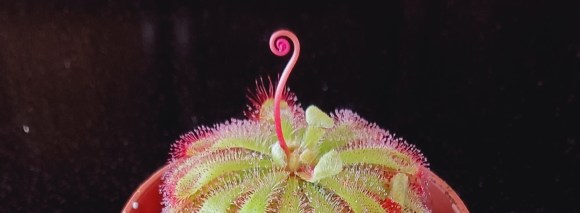
As we would expect from highly aware, social creatures, they relate to other species including animals. They grow flowers to attract pollinators, they grow fruit to encourage animals to spread their seeds, and they enter into symbiotic relationships with animals to further their needs. If nutrients are especially scarce, plants turn carnivorous. (The leaves depicted on the cover of Semiosis are of a sundew. The drops are glue to catch insects.)
Through photosynthesis, plants create their own energy. We can’t know how that feels, although we can observe how sap courses up and down stems and through leaves, and how carefully plants arrange their leaves in a “leaf mosaic” to capture light efficiently. Plants that store food for winter know how much they have because they stop and shed their leaves when they think they have enough. They have body awareness.
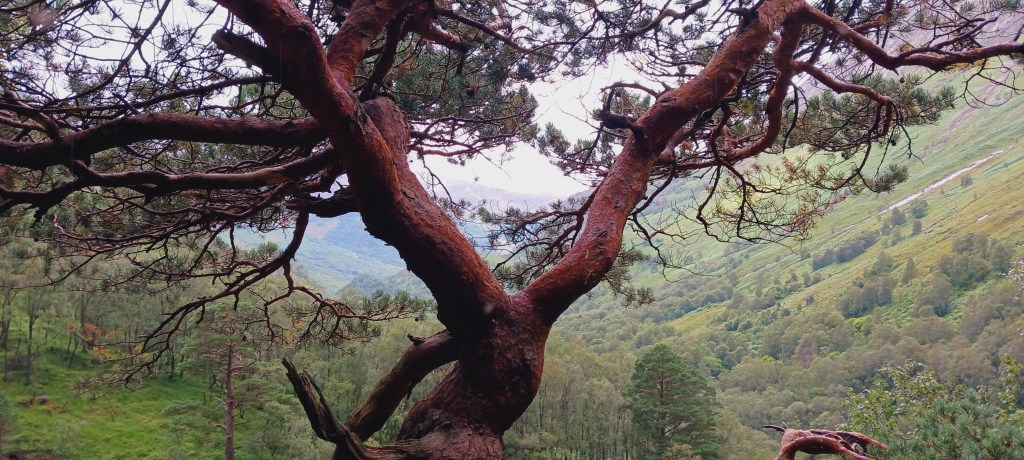
Plants differ from us in one essential way: They have no set body type. Humans have two arms, two legs, and a standard-sized brain. A tree has as many branches and roots as it can support. A single tree can be huge, spreading out from its roots to create its own grove, and some can live for centuries, even millennia.
A possible personality has begun to emerge: anxious, active, aggressive, alert to its surroundings, impatient, reflective, forward-looking, physically singular, self-aware, long-lived, manipulative of animals, and painfully lonely if it has no companions of its own species. Add intelligence and we have a point of view:
“Growth cells divide and extend, fill with sap, and mature, thus another leaf opens. Hundreds today, young leaves, tender in the Sun. With the burn of light comes glucose to create starch, cellulose, lipids, proteins, anything I want. Any quantity I need. In joy I grow leaves, branches, culms, stems, shoots, and roots of all types. … Intelligence wastes itself on animals and their trammeled, repetitive lives. They mature, reproduce, and die faster than pines, each animal equivalent to its forebearer, never smarter, never different, always reprising their ancestors, never unique.”
Some plants are conspicuous killers. Are they murderous or are they carnivorous — including proto-carnivorous, semi-carnivorous, para-carnivorous, or sub-carnivorous? So much carnivory!
An article at the International Carnivorous Plant Society website discusses the ways that taxonomists, ecologists, and evolutionary biologists differ in their approaches. The article also describes the “rather horrid plants that everyone needs to grow once to fully appreciate life.” This article is food for thought. Read it here: Murderous Plants.
In another matter, I was recently interviewed on Bull Falls Radio, WXCO in Wausau, Wisconsin. Host Bob Look started the hour-long show talking with Jane Graham Jennings of the Women’s Community. Then he and I had a fun chat. I happen to have been a high school classmate of Bob’s, and he and I have both fulfilled our youthful goals. He’s on the radio (and he sounds slick!), and I’m writing science fiction novels.





 Semiosis