Categories
Uncategorized

Is the poop plant real? Yes

Photo by Sue Burke

A “poop plant” is mentioned a couple of times in Semiosis:

The poop plant has proven possibilities for mischief. It looks like a pile of brown plump stems. –  Chapter 3.

The carved lid to a child’s chamber pot made me laugh out loud, but no one was in a mood to laugh, so no one looked pleased. “It’s the pattern,” I explained. It looked at first like the intricate pattern of lines on a Glassmaker tile mural. Subtle differences in the height of certain parts of the pattern revealed a small, low plant. “It’s a poop plant,” I said. – Chapter 5.

Where did the idea for the poop plant come from? From Earth. Specifically, the Euphorbia decaryi from Madagascar. The succulent grows there in dry forests and shrubland, and like many other native species, it’s endangered due to loss of habitat and collection. For some ambitious gardeners, it makes an interesting and rewarding houseplant.

I used to live in Milwaukee, Wisconsin, and I first encountered the plant at the Mitchell Park Conservatory, also known as The Domes for its three domed greenhouses. The Desert Dome has a special Madagascar collection, including many kinds of Euphorbia. One day, during a visit, I saw what looked like a big pile of dry, weathered turds on the ground. But no, it was the Euphorbia decaryi, with its lumpy grayish-brown stems bearing just a few leaves too tiny to notice. It didn’t look like something good to eat, which might serve as protection against predators.

The existence of a plant camouflaged as animal feces was a detail I knew I’d have to use in my writing – somehow. Eventually, I had the opportunity to have a little fun with it in Semiosis.

Our home planet, Earth, is an amazing place. It has poop plants.

Categories
Uncategorized

Review: “Recognize Fascism” an anthology edited by Crystal M. Huff

Recognize Fascism: A Science Fiction and Fantasy AnthologyRecognize Fascism: A Science Fiction and Fantasy Anthology by Crystal M. Huff
My rating: 5 of 5 stars

Full disclosure: I backed the Kickstarter campaign to fund this anthology. The book sounded exciting. It turned out to be excellent and, despite the grim-sounding subject matter, a pleasure to read.

Besides quality, what fuels this anthology is variety. The authors bring viewpoints from different countries and different kinds of narrators, including a turnip (really). While you might expect stories about fascism to be grim and angry, and some of them are, others are fun and funny, even absurdist. One is a romantic meet-cute. Another is brief and poetic. Some of the voices soar.

The kinds of fascism also vary, including a bullying schoolgirl, a shattered armistice in a war over magicians, a waitress whose job becomes increasingly oppressive, lovers separated by space and politics, a magical object carrying memories of slavery, and the arbitrary replacement of clocks.

How do you recognize fascism? You might have known it all along, or you might see the world unravel as your freedoms shrink. How can you fight fascism? You might use music, a network of allies, a pissed-off artificial intelligence, or a sudden glimpse of your own power. You might have choices.

View all my reviews
Categories
Uncategorized

When Plants Kill (the article that gave birth to “Semiosis”)

This article appeared in the Spring 1997 issue of Terra Incognita magazine. It was inspired by my own houseplants, which had attacked each other in my living room. Plants cooperate, but they compete, too, viciously. Plants are active, not passive. As I researched the article, I realized that we live in the midst of a photosynthetic war. And I began to wonder: What if

***

Imagine alien beings totally dependent on light for nourishment. Could such beings live peaceably together? No. Sooner or later, they would compete mercilessly for light. They would kill for light — starving, maiming, poisoning, strangling, crushing, and burning any rival.

Here on Earth, we call these vicious beings “plants.”

In 1820, botanist and taxonomy pioneer Augustine Pyrame de Candolle said, “All plants of a given place are in a state of war with respect to each other.” If we humans moved slower, we’d notice the carnage in our ecosystem’s green kingdom — and we’d be in peril ourselves.

It’s a jungle out there, so let’s visit one. In a tropical rain forest, the darkness may surprise you, so let your eyes adjust a moment. Now look up. You can see a green ceiling, the forest canopy. That’s why it’s so dark. The leaves up there hog all the sunlight.

Look down. On the forest floor, you can see a few ferns, struggling saplings, gaunt seedlings, some moss, and a lot of roots. Nothing else.

Look around. The space between the floor and canopy is filled with sapling stalks, tree trunks covered by clambering vines, and 60‑foot-long roots lunging from the canopy so taut we can pluck them like guitar strings — in all, an impenetrable tangle between the floor and the canopy. But few leaves grow beneath the canopy. It’s too dark. Everything aims for the canopy to grab the sunlight.

Trees use brute force, investing in thick trunks to carry their branches upward. Saplings stand here and there in the jungle, but young trees flourish only after an old tree crashes down, ripping a hole in the ceiling. Light pours onto a waiting sapling that will rise like a titan.

Trees joust with each other. Softwood trees grow faster and outrace the hardwoods to reach the top first for their day in the sun. Hardwoods follow, slowly sawing their way up: hardwood branches, stirred by winds, grind against softwood branches and carve through, amputating softwood branches one by one.

On many trees you can see thick, woody vine-like stems, called lianas, climbing up the trunk. Climbing pays off, Charles Darwin said in 1893, because climbers can reach the sun “with wonderfully little expenditure of organized matter, in comparison with trees, which have to support a load of heavy branches with a massive trunk.” A climber three inches in diameter may have as many leaves as a tree with a trunk two feet across.

Lianas weigh down trees and spread their leaves over their hosts, stealing the light. Trees starve. Saplings snap under the sheer weight.

But trees fight back. They try to grow faster than lianas, or shed bark to make them fall, or grow large shady leaves to starve them, or sway in the wind to knock off their attackers.

Lianas and vines continue up, twining around stems, impaling trunks with thorns and hooks, pushing roots and twigs into cracks, even gluing roots onto smooth bark. If a liana falls, or when the poor tree finally dies and collapses, the liana just starts climbing again.

One huge vine with yard-wide leaves is an ordinary philodendron, like the one you might have in your living room, but mature. Even the baby in your own home could attack another plant — a would-be murderer might be perched on your bookcase. Watch out.

In the jungle, watch out for the rattan, a palm used in wicker furniture. It climbs, and to do that, it grows spines on long, whiplike extensions of its leaf stalks: claws to stab into anything that can offer support. The spines hang like in the jungle loose barbed wire and can slash through your skin. Roses have thorns to climb the same way.

Many climbers send out tendrils to grasp for handholds. Darwin wrote, “It has often been vaguely asserted that plants are distinguished from animals by not having the power of movement. It should rather be said that plants acquire and display this power only when it is of some advantage to them.”

A passionflower has its tendrils ready for action, poised, according to Darwin, “as a polypus places its tentacula.” Slowly across the days, the tendrils will revolve like the feeler of a monster, searching for a victim.

Touching something, in 30 seconds the tendril will start to coil around it. Within hours, the tentacle will firmly clutch its new brace in a life-or-death race to the forest top.

One member of the Pea family can grow a vine with a two-foot trunk. With tiny leaflets, it can drown an acre of the canopy — 64 unlucky trees.

In the jungle, on some trees, you can see roots thick as branches clamped all around a trunk. They come from another tree, a strangler fig, growing on its host tree from a crotch of a branch about halfway up. As a seed, the fig germinated there, getting its water from the rain an as it sent down its roots.

You can see the victim tree’s trunk bulging out between the roots of the strangler fig. The host is being strangled. Its trunk can’t grow wider and add a ring of new channels to carry water and nutrients to the leaves. It will eventually choke, die, and rot away, leaving the fig standing alone as a mature tree. The fig’s trunk will resemble a long, deadly cage.

Some plants employ an even more cunning scheme to live. They become parasites. Mistletoe sinks its roots into the living flesh of the tree to find water. As tropical mistletoe grows, it can drain its host dry.

Parasites can grow without bounds since they don’t have to work to support themselves. No surprise, then, that the Earth’s largest flower is the Rafflesia, a parasite of lianas in Southeast Asian jungles. Its brown and purple 3-foot flowers can weigh 15 pounds. They are called “stinking corpse lilies” for their stench, which attracts hundreds of flies to pollinate them. Let’s not look for one.

Outside the steamy jungle, it’s still a dog-eat-dog world in the plant kingdom.

Dodder, also called “devil’s sewing thread,” is an orange, creeping parasite of temperate zones. Within hours of germination, it reaches out with a tendril-like stem that circles until it touches a victim. Dodder attacks, wrapping around its host and sinking roots into its host’s stalk. Dodder forms dense mats of stems and flowers up to a mile long around its victim, sucking out every drop of sap.

Plants also poison each other. In 1832, de Candolle suspected plants release toxic materials into the soil to weaken the growth of competitors, but he couldn’t prove it. He was right.

Walnut trees leaves excrete a poison from their leaves that is washed by rainfall into the soil. Barley releases water-borne toxins to destroy weeds. The rubber-producing guayule of the American Southwest excretes toxic cinnamic acid from its roots. Cattails even poison their own young. Their seeds won’t germinate in water contaminated by cattail leaves.

Fire is the weapon of mass destruction in the vegetable kingdom. Some plants can survive fire more successfully than others, and they use that ability to their advantage.

Ponderosa pines in the western United States drop flammable dead needles. When lightning or humans spark a fire, it blazes through the dead needles, incinerating less fire-resistant species. Until human intervention, such fires were common, giving Western forests a different look in the past.

In the hills around Los Angeles, certain shrubs such as chamiso do the same by dropping oily leaves as tinder — and humans pay the price.

Plants will even sneak up on each other. Fields of British heath can be invaded by the roots of bracken ferns. The roots will send up leaves that shade and ultimately kill the heath.

Plants need light to live. They also need carbon dioxide, water, and certain minerals. Our atmosphere contains only about three-hundredths of a percent of carbon dioxide, which limits most plants. Given more CO2, plants will grow faster until they hit the next limit, which is usually light.

In perfect conditions, we could have a photosynthetic riot.

So watch where your shadow falls. You could annoy a heartless killer whose long, green tentacles would wrap themselves around your body. Slowly, unceasingly, those tentacles would tighten with unexpected strength until you slump dead to the floor.

Your potted philodendron might want you out of the way. Beware.
Categories
Uncategorized

Celebrate International Translation Day, September 30

The feast day of St. Jerome, a famous ancient translator, is September 30, so today is celebrated as International Translation Day.

FIT, the Fédération Internationale des Traducteurs/International Federation of Translators, has created this poster and explanation to celebrate this year’s theme: Finding the words for a world in crisis.

FIT explains: “Our profession has been pivoting rapidly to keep up with changing realities and expectations, and the importance of our work to ensuring clear information reaches everyone and overcoming language barriers — both global and local — has been highlighted in unprecedented ways this year.”

Here are two more ways that you can celebrate translation, especially science fiction in translation:

FutureconSF, an online international science fiction convention with the slogan “The future happens everywhere,” was held September 17 to 20. Sixteen panels explored topics as varied as “Future Science Fiction in Translation: A Hidden Treasure to Innovate the Genre,” “Future East Asia: Techno-Traditions in Japan and Korea,” and “Anthropocene and Capitalocene: Threats and Hopes to the Future of Mankind.”

The sessions were recorded and are available on YouTube.

A new bilingual speculative fiction magazine is coming to the internet. Constelación will publish stories in both Spanish and English with four issues each year. Writers can submit their stories in science fiction, fantasy, and horror in either language. Fifty percent of the stories in every issue will be from authors from the Caribbean, Latin America, and their diaspora.

I hope to do some of the translation. A Kickstarter campaign will launch tomorrow, October 1. Submissions will be open from October 15 to November 1, 2020, for the first issue with the theme: The Bonds That Unite Us / Los lazos que nos unen.

Categories
Uncategorized

Maps for Chapters 1 and 2 of “Semiosis”

I appreciate maps. When I was a newspaper editor, my coworkers called my office the “war room” because the walls were covered with maps.

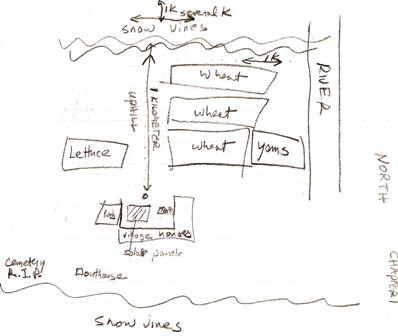
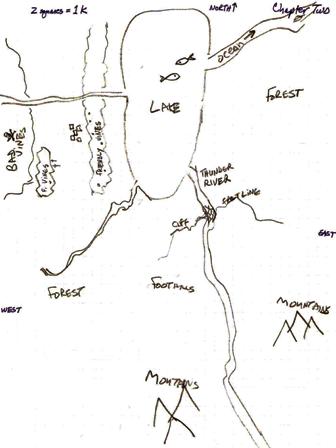
Since the setting is important to the novel Semiosis, I made maps for Chapters 1 and 2 to help me write consistently. If a character in a specific location heads left/north, they should wind up in the same place every time.

Generally, when you write a short story, you might be able to hold the whole idea in your head at once, but novels are too big. Notes, charts, pictures, outlines, and other kinds of memory aids can be a big help not just for consistency but for the writing itself. Although some authors like to write “by the seat of their pants” and see what happens, that approach can take much longer than writing with a plan.

The Chapter 1 map shows the village and its fields.

The Chapter 2 map shows the bigger picture, including the route to Rainbow City. These maps were originally made on graph paper, although the grids did not come through in the scans of the maps to show the scale.

Categories
Uncategorized

My next novel: “Immunity Index”

Here’s the cover art for my next novel, Immunity Index. Notice that the skyline is Milwaukee.

The book will be released on May 4, 2021, and may it be a better year for us all.

I began writing this long before Covid-19 appeared, and as I finished it early this year, I became deeply troubled — then I realized why. This novel tells the story of a better coronavirus epidemic than the one we have. I am heartbroken by our real-life loss and suffering. The challenge to our perseverance and compassion will last for months and years.

More information and preorder links for the novel are here: https://us.macmillan.com/books/9781250317872

The official synopsis somehow fails to mention the woolly mammoth, but he’s in there and he’s loveable:

Sue Burke, author of Semiosis and Interference, gives readers a new near-future, hard sf novel. Immunity Index blends Orphan Black with Contagion in a terrifying outbreak scenario.

In a US facing growing food shortages, stark inequality, and a growing fascist government, three perfectly normal young women are about to find out that they share a great deal in common.

Their creator, the gifted geneticist Peng, made them that way — before such things were outlawed.

Rumors of a virus make their way through an unprotected population on the verge of rebellion, only to have it turn deadly.

As the women fight to stay alive and help, Peng races to find a cure — and the coverup behind the virus.

Categories
Uncategorized

Exactly where is the Planet Pax?

In Semiosis, our colonists wake up in orbit around a planet noted as f at star HIP 30815. Where is that? In the constellation Gemini. But let’s get more precise.

The above photo, which pinpoints the location, comes from In-the-sky.org, which offers guides to the night sky specific to your location. The site can be set to “night mode” so you can use it as you stargaze.

The “HIP” in the name refers to the Hipparcos Catalog, one of a great many lists of stars. The Hipparcos catalog was compiled from the data gathered by the European Space Agency’s astrometric satellite Hipparcos.

The number basically follows the order of the object’s right ascension, that is, its east-west coordinate starting at the March equinox. This is the celestial equivalent of terrestrial longitude, so the number is merely the star’s place in an ordered list.

The “f” designates the planet. By convention, planets are given letters in the order they are discovered. This means there are five other planets at star HIP 30815 (according to the novel, not current science, which hasn’t identified any planets so far).

You can get much more detailed scientific information about the star at Universeguide.com.

Sky-map.org offers photos and additional technical details, such as the variety of names the star has: HD 1989, HD 45506, TYCHO-2 2000, TYC 1328-38-1, USNO-A2 1050-03646671, BSC 1991, HR 2340, and HIP 30815.

Here’s the passage from Chapter 1 of the novel that specifies the star:

We awakened, cold and dizzy, with our muscles, hearts, and digestive systems atrophied from the 158-year hibernation on a tiny spaceship. The computer had brought us into orbit, sent a message to Earth, then administered intravenous drugs.

Two hours later I was in the cramped cabin trying to sip an electrolyte drink when Vera, our astronomer, came flying in from the control module, her tightly-curled hair trailing like a black cloud.

“We’re at the wrong star!”

I felt a wave of nausea and despair.

Paula was spoon-feeding Bryan, who was too weak to eat, and she seemed calm, but her hand trembled. “The computer could pick another one if it was better,” she said.

“It did!” Vera said. “It is. Lots of oxygen and water. And lots of life. It’s alive and waiting for us. We’re home!”

We were at star HIP 30815f instead of HIP 30756, at a planet with a well-evolved ecology, and, I noted, abundant chlorophyll. The carbon dioxide level was slightly higher than Earth but not dangerous. Seen from Earth, both stars were pinpricks in the Gemini constellation near Castor’s left shin. As planned, we named the planet Pax, since we had come to live in peace.

Categories
Uncategorized

Writing advice: a moment of panic

Write what you know is debatable advice, but I think it’s good — if it’s understood in its broadest sense. Write what you know, what you’ve learned, what you’ve observed, what you can know through imagination, what you want to know, and what your emotions know.

Here’s an example. How does it feel when the world is about to end?

By experience, I know it feels horrifying and confusing.

This is what happened. I grew up in Milwaukee. Lake Michigan is to the east. All my life, the sun has risen in the east over water. Water is to the east. Always.

Then one evening I was visiting a friend in Los Angeles, and we were having dinner at an oceanside restaurant. I noticed that the sun was setting over the water … but water is to the east! The sun was setting in the east! The universe was suddenly and horrifyingly wrong!

After a moment, I recovered enough to look around the restaurant. Everyone was talking and enjoying themselves. No one noticed what was happening. Was I the only one? And physically, everything looked okay, but logically, if the Earth had reversed its course or flipped its orientation, there would be consequences. Gravitational disturbances. Big ones, like planet-wide destruction. But people were walking around just fine.

And … oh, I was in California. I’d seen maps. The water is to the west there. The Pacific Ocean.

It was okay! The sun was normal. Life was normal. The universe was normal.

… Dinner was delicious.

I still remember that moment, though: I think I forgot to breathe. I was aware of only one thing, the sight of that sun going down over the water, knowing what it had to mean: an enormously wrong thing, very possibly The End — and then a cascading series of smaller things that were wrong, too, but in a different way that didn’t make sense.

That moment and other imagined or real disasters have taught me that panic often comes mixed with confusion, perhaps waves of confusion and panic as the situation changes. Different people react in different ways depending on their personalities and experiences. I tend to seek more information. Someone else might be more inclined to act immediately. (That person might have made quite a scene at the restaurant. It’s fun to imagine.)

So — once I saw that the world was about to end. I know how it felt to me at that moment. I can write what I know.

Categories
Uncategorized

Short story: “Think Kindly on Our Fossils”

Destroying the Earth, or at least humanity, has long been sort of a literary hobby of mine. This short story was published in Voyage Short Story and Poetry Magazine in 2001 and the Triangulation: End of Time anthology in 2007.

squirrelThink Kindly on Our Fossils
by Sue Burke

When Comet Kabandha was discovered, Travis Hudson gawked from his window at the fuzzy light near the Pleiades stars.

“It’s a mistake,” he mumbled. Plotting comet trajectories was tricky, everyone was saying so. “They’ll check their math and we’ll be fine.”

Astronomers checked and rechecked. Finally, on television, world leaders, united and somber, asked for courage in the remaining three months before the comet struck Earth.

Travis turned off the TV. He had always believed the universe had a purpose, and therefore humanity had a purpose, and therefore he had a purpose, and it had to be something more noble than a head-on collision with a giant ball of dust and ice. He was only 29 and enjoyed his job as a construction site manager. Under his watch, buildings rose to completion, and he felt that he was becoming something, too. Someday, he believed, he would understand more than the efficient scheduling of subcontractors. He had his whole life ahead of him. But no more.

Each day, Comet Kabandha grew closer and more appalling. Riots and chaos — and huge parties — broke out here and there, but for some reason that he didn’t understand and no one could explain to him, life went on in many ways far too normally.

Construction work stopped, which he did understand. He had time to ponder his doom, and finally, after seeing a mention in the news, he drove frantically to the annual Crater Days celebration in Manson, Iowa, to inspect the world’s fifteenth-largest impact crater. It would tell him something — he knew it would.

In Manson, he saw only tents, plywood booths, a midway surrounded by cornfields, and sparser crowds than he had hoped for. His disappointment became anger as he walked in.

“Where’s the crater?” he asked a woman sitting at the official souvenir booth.

She gave him a welcoming smile. “Straight down, twenty-four miles wide, seventy-four million years old. Not as big as the one that wiped out the dinosaurs, of course, or the one that’s coming. Would you like a geological survey?” She held up a spiral-bound report.

Travis kicked the front of a hot dog stand. “You’re all going to die. Do something. Fight back.” He aimed another kick at a telescope for rent.

A teenage girl guarded it, fists raised. “Hey, I want to watch Kabandha catch us. It’s the best show of my life.”

“Your life is over.”

“Not yet.”

He threw a squeeze bottle of mustard at her. “This isn’t a party. Don’t die happy.”

The woman selling souvenirs got up and stood face to face with him. “Look, we’ve got some carnival games and crafts sales and live music at sunset. If it’s not for you, get out.”

Travis drove a few miles, his despair deepening as he considered the cornfields with their half-ripe ears. No one would eat that corn. He spotted a church and blundered in.

“Angels will save us, right? God will take us all into heaven, won’t He? We don’t deserve this.”

The minister had been vacuuming the carpet in the aisles. “Actually, I don’t think we can expect special treatment from the universe. Angels and life-after-death are primitive myths.”

Travis fell to his knees. “But there has to be a soul, a spirit, something more than my body. We’ll transcend our deaths.”

“Of course. Humanity is the consciousness of the universe.”

“We were sent a Savior. I’ve accepted Jesus into my heart. I’ve been good. I deserve better, don’t I?”

“Well,” the minister said, “let us pray for those who survive the coming earthquakes and tidal waves and firestorms and dust and darkness and cold. They’ll suffer and starve and repopulate the Earth. Or else some humble creature will arise to sentience and worship. Or else the comet will bring amino acids for a new form of life. This is not the end. God is eternal beyond our comprehension.”

“But I’m afraid. I’ve never died before.” He prayed for a long time. The minister finished vacuuming.

As Travis left after sunset, a car pulled up and a bride and groom got out and entered the church. The comet and its tail shined overhead.

He went home and wrote: “I, Travis Hudson, being of sound mind and body, do hereby declare that since there’s nothing to leave to anyone anyhow, I will not leave my death to chance, either, or to giant dirty snowballs being tossed at us by a person or persons unknown.”

He sent a bullet into his brain. With a centimeter difference in aim, he would have succeeded. Although it seemed absurd to him, an ambulance came and carted him off to the hospital.

While he was on the operating table, he got as close to death as any man alive, and he awoke from surgery aware of the meaning of life, obvious and amazing. The nurses listened politely, but he came to realize they already knew, or they wouldn’t show up for their shifts.

At his release from the hospital, he had a distracting scar on his forehead, diminished use of his left side, and great inner peace.

By then a storm of meteors tore through the night, dozens falling per second. Northern lights flickered like drunken rainbows. The comet glowed in the west bigger than a full moon, and its blue tail stretched to the far horizon. In the half-light, birds sang like it was dawn. Travis limped to a park bench. A squirrel approached to beg.

“It’s a beautiful night,” he said. He tossed peanuts so it would stay and listen. “I’m a wise man now. Will you evolve into the next thing to suffer self-awareness, little guy? You’ll see eternity but never reach it. You’ll know death but never experience it while you’re alive. You won’t have any excuses for what you do after you become self-aware. The knowledge of death will be the loss of innocence.”

It seemed to be listening. He gave it the entire bag of peanuts. It was going to need them.

“I hope you’ll think kindly on us when you find our fossils.”

He walked away over a hill to dance with dinosaurs. A Tyrannosaurus waved its little arms to beat out waltz time. A squat Euoplocephalus swung its clubbed tail and tore up the turf and flowers as it lumbered, one-two-three, one-two-three. Travis Hudson understood the universe, and the sun would not rise on him again.

© 2001 by Sue Burke

Categories
Uncategorized

Short story: “Zero Hour”

320px-Reloj_digital_2359.svgThis short story was originally published in Daily Science Fiction.

Zero Hour
by Sue Burke

The man had deep worry lines between his eyebrows, although he was only in his twenties. When he woke up after a restless sleep, he immediately looked at the window. Mid-afternoon sun shone through cracks in the blinds. He checked his bedside clock: 5:51 a.m.

The clocks were still wrong … and in a sudden panic, he reached out for his wife. Yes, she was still there, still safe beside him, or as safe as she could be. She lay with her back toward him, her shoulders bare and beautiful.

At 6 a.m. the house audio turned on. The usual mechanical announcers spoke, describing help for victims of a distant earthquake. They said an international peace meeting had been a success, and the weather would be warm and sunny with no break in the drought, but household conservation efforts had exceeded goals.

She stirred, took a deep breath, then another. “Good news?”

“As always,” he answered heartily. It was their private ritual. Rumors circulated about protests and arrests. Just a few days ago the network’s clocks had gone haywire, but then recovered and continued immediately with no other changes. The news had ignored it entirely.

Suddenly he worried that he and his wife hadn’t mentioned the time change out loud, and maybe their silence gave them away.

“Six a.m. in the afternoon. That’s weird,” he said, just to say something.

“Sorry,” she whispered.

He hadn’t meant her to take it that way. He held her tight, hoping that if she knew he still desired her, she would know he didn’t blame her. “It’s a beautiful day,” he said. “Up and at ’em.”

She seemed to understand. She showered quickly while he shaved.

In the kitchen, the screen on the refrigerator recommended healthy breakfasts: whole-wheat cereal, skim milk, oranges, and coffee. It would record their choices, count calories, and adjust subsequent suggestions. He realized that they did as they were told as much out of habit as strategy. The network‛s audio feed continued to play.

She ate silently, staring. Maybe she was listening for clues, for changes in the pattern of information. He wished he could help her.

He worked as a physician’s assistant, a job he might have wanted even if he had been offered a choice of careers. He did what he could to fight back. More patients than ever were making themselves fat as a form of silent, visible protest. They claimed they couldn’t help it and asked him to check for endocrine problems. They were probably buying food on the black market, but they had to pretend to be ill, so he sent them home with the diagnosis they needed.

But other patients arrived dangerously anorexic, or depressed, or paranoid, or toxic with anger, and they needed real help. A few days ago, when the clocks had suddenly reset themselves to 00:00, he had heard hopeful whispers in the waiting room: Maybe something broke. But nothing else happened, life went on as usual, and hopes died.

“Maybe,” his wife said, coffee cup in hand, “I should just go to work and leave Aunt Becky alone.”

That was their code word for the network. He opened his mouth to blurt out no, but stopped. He ate a spoonful of cereal to try to calm himself. It had no taste. He swallowed. “I think you should try to … talk to her again.”

“Again?”

“Well, you got a little change. That must mean something.”

His wife and her team of saboteurs had broken the network apart a few days ago, and for an instant it had stopped, but they hadn’t done enough. It reset itself, she had whispered in his ear when she came home that evening, and he held her for a long time as she wept, while the clocks said it was late morning.

She shook her head, her hair waving softly around her tight face. “But you.…”

“Everyone has family problems.”

She stared at the network speaker.

“But she could be … angry. She could do something.”

He got up, refilled her coffee cup, then emptied the pot into his own. “I’m not angry, not with you. I’m proud of you, whatever she does.”

She drank her coffee. He studied her face as he finished eating, trying to see if she believed him, but he couldn’t guess her thoughts at all. The network feed babbled on and on.

“Okay,” she whispered, and gave him a look that was more worried than hopeful. They got up and stacked the dishes. He hugged her and tried to memorize her body against his, every place where her curves and bones touched him: sternum, ilium, ulna, sartorius, masseter. The names might help him remember her, if he had to.

They left the house and didn’t lock the door behind them. It would lock itself or open itself depending on who tried to enter. He glared at the sidewalk. If they couldn’t lock their own doors, was it their home? Was anything theirs? He acknowledged the anger and tried to let it pass, just as he counseled his patients.

She walked toward her car and quickly got in. He studied her to memorize the movements of her muscles: gluteus, gastrocnemius, biceps, deltoid. He noted the color of her eyes and the curve of her lips. But as her car backed down the driveway, he turned away, ashamed. He knew he should hope that she succeeded, but he only hoped to see her again.