In the author story comments, I talk about what led to this story:
“My favorite words are but and what if. One day I thought about the way that the laws of thermodynamics begin with zero. What if magic had rules that started with zero, too? Our understanding of thermodynamics gives us great powers, but what powers would the rules of magic give us? This story offers one answer, but what if there are better answers?”
Chapter 3 of Interference contains this paragraph:
“Long ago as a graduate student, I had researched a voyage embarked upon by Spanish conquistadors down the Amazon River in search of El Dorado. The travelers did not know that the purpose of the trip had been to gather together the most undesirable conquistadors — a ghastly lot, most notably Lope de Aguirre — beneath an incompetent captain and ship them off to the unexplored jungle, never to be heard from again. Most succumbed to malnutrition, mutiny, murder, and madness.”
You may have heard of the 1972 movie Aguirre, the Wrath of God by Klaus Kinski. I’ve seen it, and I recommend it. I’ve also read a few accounts of the voyage down the Amazon, including the book Lope de Aguirre: El loco del Amazonas by Manuel Lacarta, a history written with poetic intensity about the disastrous voyage. It started in Peru in September 1560 and ended in Venezuela in October 1561.
If you’ve seen the Kinski movie, you may wonder how much of what the film recounts is true. A lot of it is true. Most of all, it truly captures the madness. But it captures only half the horror. The real voyage went on a lot longer than the film version, suffering disaster after disaster.
Malnutrition: The conquistadors had planned to live off the land and steal from the natives. The people of the Amazon, however, when they heard what was headed their way, fled into the jungle, taking their food with them. The conquistadors couldn’t hunt for food because they would be hunted and killed by jaguars, and they couldn’t fish because piranhas would eat their catch along with anyone who fell overboard.
Mutiny: In January 1561, Aguirre killed the captain of the expedition as part of a mutiny, then in May he stabbed the new leader to death and took over the mutiny.
Murder: Aguirre himself killed or ordered to be killed 72 people. Many other people died of starvation, abuse, and battle.
Madness: In March 1561, Aguirre declared war against the Spanish Empire and had himself proclaimed a prince.
Even worse, the conquistadors didn’t all die in the Amazon jungle. Some of them survived and made it to the coast of Venezuela, plundering and murdering. Spanish troops finally arrived and executed Aguirre. The details are too hideous to recount here.
History teaches that something can always go wrong. Indeed, sometimes things that are meant to go wrong can go much, much worse. It’s a frightening lesson.
***
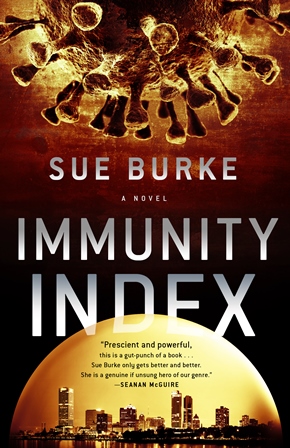
My next novel, Immunity Index, goes on sale May 4. Read an excerpt here. Read a different excerpt here.
(This brief, moralizing rant by Stevland was cut from the original manuscript because the book was getting too long.)
Sadly, I am the only one of my species. In addition to genetic advantages, sexual reproduction provides certain physical pleasures, and thus some hedonistic plants are self-pollinating despite the congenital defects that often occur; self-pollinators must make many seeds to ensure a reasonable number of healthy ones.
More abstemiously, I create asexual, agamospermic inflorescences whose always-healthy seeds result from modified meiotic division of the chromosomes inside the reproductive cells in virgin ovaries, rather than through fertilization by my own pollen. Some genetic crossover occurs, providing a certain amount of variation, although the offspring are very nearly clones. It is the best I can hope for, being alone.
Instead, I use flowers and pollen mostly for other purposes: pollen for communication, and flowers for the sheer beauty.
***
My next novel, Immunity Index, goes on sale May 4. Publishers Weekly has a review.
I made two mistakes when I started writing the novel Immunity Index.
The first mistake was to try “pantsing” as a writing technique — that is, to write from the seat of my pants rather than from a plan and an outline. While my first drafts are always shit (which does not make me at all like Hemingway in any other sense), this first draft was especially bad and required nine painful complete rewrites.
The second mistake was trying to tell a story set in the near future. Events in the future, like the things seen in a convex mirror, are closer than they appear.
This vision of the future, however, started back in the 1980s. As a newspaper reporter, I was covering news about AIDS, then a terrifying new disease. One evening, before a meeting, I was chatting with the Wisconsin state epidemiologist. He said that as bad as AIDS was, it could have been worse. He was a gay man, and we both knew that AIDS was already a disaster, and the disaster would keep growing.
He said, though, we were lucky that AIDS was only communicable, not actually contagious. Worse would have been a fatal illness that could be spread as easily as a cold.…
In 2018, I imagined a deadly, contagious coronavirus. It was fiction. Until it wasn’t.
My fictional story, though, is better than our shared reality. For one thing, the novel has a happy ending — and it has suspense, intrigue, adventure, and a woolly mammoth.
It’s not a sequel to Semiosis and Interference (the sequel, Usurpation, is on the way). Instead, this is the story of separated sisters, a virus, a rebellion — and a cantankerous woolly mammoth.
Photo: Birr Castle gardens, Ireland. Photo by Sue Burke.
(This is a section cut from the manuscript for reasons of length in which Stevland declares his faith.)
Human meteorologists tell me that rain comes as the result of vast movements in the air that bring warmer or cooler, and wetter or drier air masses from here to there, and that the heat from sunshine powers these movements. But the meteorologists are Sun worshippers, and thus they will see the Sun as the causative factor behind everything. The same humans assure me that planets without water are dead, though the Sun shines on them. They do not make the obvious conclusion: Water is life.
I inherited a root that identifies a god of water, a vast animal that lives in the oceans and whose minions are other animals, in particular large intelligent ones, clearly a superstition by its irrationality and ignorance, and the elaborate stories in the root concerning the water god and its minions obscure the facts about water and animals. The stories allege that god sends water to help its animals and that the animals can petition for rain, so I must win the favor of the animals and keep them near. Even less sophisticated plants hold large, intelligent animals in a certain appreciation that points to awe.
It is true that in times of drought, many animals die, go dormant, or leave; animals, especially large intelligent ones, make up a minute part of the biomass of life and their presence is an indicator of water, but it is not a causative agent. Animals irrigate their favored plants, so animals do control water to an extent, and the idea that currying favor with those animals brings the blessing of water is true only in its most mundane sense. The human meteorologists can predict the rain, and with that information, they and we intelligent plants can make plans accordingly.
But water moves as it will, a god of total power that feeds on the Sun’s energy just as we plants do, a god that permeates all life but whose life differs from mine the way a fire differs from the Sun. I must accept its acts, whether helpful or harmful, always impersonal, and I must cope as rationality gives me the tools.
Water may not have sent the human animals, but water has allowed me to grow and understand their role. The belief that animals were divine agents did not prevent us bamboo from slaughtering them in the past; in fact, it may have encouraged it, because to kill an enemy’s minions is to harm the enemy and help oneself, even if the deaths occur so far away that their bodies’ iron cannot be savored. Being divine may be a curse. Humans are mundane, fortunately, yet they are valued not only by me but by other plants.
A reader contacted me to ask how Stevland’s name is pronounced (STEEV-land) and passed on sketches of some Pax creatures made by her daughter, who had also read Semiosis. The sketches were wonderful! The daughter, Rene LeCompte, was kind enough to let me share her art and ask her a few questions via email.
***
Do you make illustrations for all the books you read? Even just in your head?
I don’t usually draw images from the books I read, but I do frequently imagine and visualize them in my head, yes. I especially enjoy authors who are able to clearly describe settings, people, and creatures like the ones in your books. And I always find it interesting as my visualization can change and morph as authors add details, until my final vision of a thing is quite different from my initial impression. It’s very different from watching say, a movie or TV show. I like the work placed on the reader to use their imagination and mind’s eye.
I especially like the ground eagle, which is scarier than I imagined. You seem rather fond of birds. How did your love of birds start? Why parrots in particular?
I am extremely fond of birds; of all the animals on Earth, they are my favorite. My love of birds started probably when I was about 12 years old and got a cockatiel as my first pet. She had a profound impact on me, and was much loved for the 13 years I had her. As I grew older, my love of birds did as well. I now have a Green-cheek conure, a White-capped pionus, and another cockatiel, with hopes to expand my aviary in the future. As for why parrots, they make such good companions. You wouldn’t expect a bird to be cuddly, but my conure is extremely so; she always wants to be on me or in my hands. They still have their wild nature, so my relationship with them comes down to how well I read and understand them. It’s a very different type of relationship from the one I have with my dog. Getting the trust of something so tiny and fragile is a rare and precious thing to me.
For you, what’s the best part of the process of making art? Getting ideas, creating the art, sharing it, or something else?
The best part for me is the making, especially the coloring and detail work. This is the time I really get into the zone, and can work for hours without even thinking about it. I definitely enjoy creating art more than sharing as my social media skills aren’t as good as some other artists’. It is however very gratifying when my art is seen by a truly appreciative audience.
What project(s) are you working on now? How would you describe your creative style?
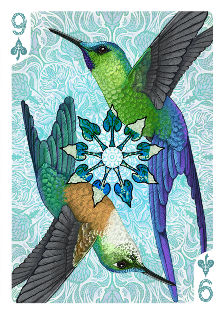
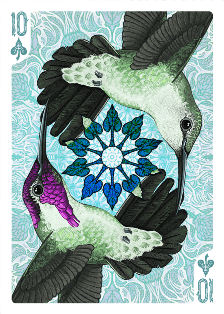
My current project that I just started is a deck of hummingbird-themed playing cards. In the past few years, I’ve become really interested in the style and design of playing cards in general, and this deck would be my third major playing card project, with the other two being owl and parrot themed. Speaking of which, I also currently have the parrot deck in production right now, as the project funded on Kickstarter a few months ago. As for my creative style, I would describe it as illustrative realism — I try to keep any species I draw recognizable, but I don’t aim for hyper-realism. I love color, and I tend to bump any color naturally occurring in an animal up a notch.
What (if anything) is important to you besides making art and wrangling pets?
Self-sufficiency is very important to me — I don’t like to just hire a person to fix a thing or make a thing for me — I like to do it myself so I can understand the process. My major hobbies right now are woodworking and mead making (my hobbies tend to wax and wane as I gain and lose interest in many things). I also really enjoy home renovation, and have done most of the major projects in my house, including putting down a new laminate floor and completely remodelling a bathroom. My philosophy in the past few years has evolved to ‘if someone else can do it, I can too!’ While this might lead me to making a few mistakes, it’s also helped me get the ball rolling on a variety of projects without too much fear of failure.
Is there a link where readers can see your work? And why ‘maggock’?
Yes, I have an Artstation account: https://www.artstation.com/reneelecompte and a Twitter account that’s updated with smaller projects: https://twitter.com/maggock. At this point the ‘maggock’ handle is about 20 years old, and I created it back when I was fresh out of high school. I wanted a handle that sounded like ‘magic’ and that’s what my young brain came up with. Nevermind that it also really looks like ‘maggot.’ Oops. I’ve thought about changing it due to that, but never got around to it.
In the acknowledgments to Semiosis, I wrote: “I owe thanks to Gregory Frost, whose writing exercise about a special kind of wall led to this novel.”
That exercise took place in 1996 at the Clarion Science Fiction and Fantasy Workshop, which I attended. As one of the instructors, Greg assigned several exercises over his week of teaching, one of them involving a wall. As I recall, it went something like this:
“Imagine a wall that appears overnight between two groups about to go to war. They can see through it, they can communicate through it, but they can’t pass through it and attack each other. Begin that story.”
We only had to write the opening paragraphs, but some of us were inspired to continue. Mike VanWie wrote a bittersweet love story in a style we would now call steampunk, but back then we just called it imaginative. Dan Jeffers came up with a comic sword and sorcery novel with sex scenes and other digressions in the appendices.
(The photo shows us hard at work on a different exercise, a group project involving tropes.)
I eventually wrote a science fiction short story in which the wall was a human colony on a distant planet. That story was published in 1999 as “Adaptation” by the magazine LC-39, and later I expanded it into a novel, Semiosis.
Thanks again, Greg. Great oaks from little acorns grow.






 Semiosis