Categories
Uncategorized

I’ll be at C2E2

c2e2-header-logoOn Saturday, March 23, I’ll be at C2E2, the Chicago Comic and Entertainment Expo, at the McCormick Place. It’s famous for its huge “Artist’s Alley” where you can meet famous and up-and-coming comic book artists, for its amazing cosplay — and there’s plenty more to do involving games, anime, and family fun. It really is a good time.

I’ll be on a couple of panels as a literary guest. My schedule:

The Future Is Now
Science fiction and fantasy authors discuss their predictions of near-future SF: what has come true, and what might be coming to pass? What will Chicago look like 50 years or more from now? Featuring: Sue Burke, Cory Doctorow, Mary Robinette Kowal, and Alison Wilgus.
12:30 p.m. to 1:30 p.m.: Panel in Room S405a
1:45 p.m. to 2:45 p.m.: Autographing at Tables 41 and 42

Magic and Mayhem in Science Fiction and Fantasy
How do fantasy and science fiction overlap and inform one another, and what constitutes magic and mayhem in both genres? How are authors breaking traditional rules of the genres and finding new ways to explore other worlds, or putting some extra magic in our own world? Featuring: Cory Doctorow, Mary Robinette Kowal, Alison Wilgus, Mirah Bolender, Sue Burke, and S. A. Chakraborty.
3:00 p.m. to 4:00 p.m.: Panel in Room S405a
4:15 p.m. to 5:15 p.m.: Autographing at Tables 41 and 42

Categories
Uncategorized

Now in paperback

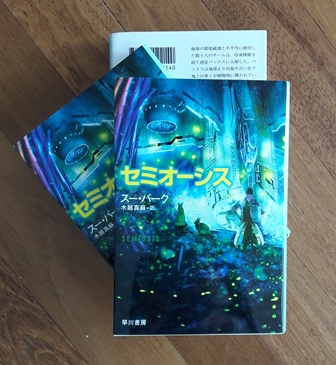
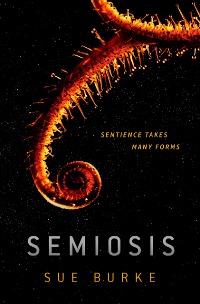
SEMIOSIS_SmallThe novel Semiosis is now available as a trade paperback. You can buy it at Amazon, Barnes & Noble, Powell’s, Books-A-Million, and at your local independent bookstore — find the closest one to you at IndieBound.

Also available in digital audio, e-book, and hardcover.

Categories
Uncategorized

Kitschies nomination for “Semiosis”

Kitschies TentaclesSemiosis has been nominated for the Kitschies Golden Tentacle Award. I am honored — and awed by the other nominees. Perhaps it will impress the judges that the cover art of my book features genuine tentacles.

The Kitschies, a British award, describes itself as a way to reward “the year’s most progressive, intelligent and entertaining fiction that contain elements of the speculative or fantastic.” The Golden Tentacle Award is for debut authors, and the full list of nominees are:

Children Of Blood and Bone by Tomi Adeyemi (Pan MacMillan)
Frankenstein In Baghdad by Ahmed Saadawi (Oneworld)
Semiosis by Sue Burke (Harper Voyager)
Sweet Fruit, Sour Land by Rebecca Ley (Sandstone Press)
The Poppy Way by R.F. Kuang (Harper Voyager)

Other Kitschies award categories are Red Tentacle for the best novel, Inky Tentacle for the best cover art, Invisible Tentacle for the best natively digital fiction, and Black Tentacle awarded at the judges’ discretion.

The winners will be announced at an awards ceremony in London on April 15.

Categories
Uncategorized

The invention of the fippokat

I didn’t invent the fippokat, a small, green, intensely cute creature that plays an important role in Semiosis. As it says in the acknowledgements, my sister-in-law lent me her childhood imaginary animal to use in the novel.

Kathy conceived of the fippokat in grade school, when she also named it. She no longer recalls why — the reason is one of those things lost to childhood. I first learned about it one Christmas when she made a cookie in the shape of a fippokat, sprinkled with green sugar. At my request, she graciously gave me permission to use and abuse the animal in my writing. (She’s a very gracious person.)

She said, “Please remember that according to their crayon biography, they hop and glide and have curly tails and little pink noses.” She asked if they would be eaten.

Yes, they have been eaten and worse. Sorry. When I start writing, bad things tend to happen. In addition, the fipp family has grown. Now there are fippolions, tree fippokats, and in Interference, the sequel to Semiosis, carnivorous fippokats. Watch out!

Kathy has remained gracious throughout it all. Thank you.

Categories
Uncategorized

Earth names for Pax plants and animals


At Stack Exchange, in the Science Fiction and Fantasy website, someone asked which if any of the plants and animals mentioned in the book came from Earth. Many have Earth names: eagles, tulips, bats, pineapples, corals, cactus, lettuce, etc.

The answer: None came from Earth. But I imagined that Pax colonists would do what European colonists did when they came to the Americas: sometimes they gave names to things that reminded them of what they had left behind — even though they were not the same thing.

Here are some examples of how confused we are in the English language regarding bird names as a result of that homesickness.

The European robin (Erithacus rubecula) is a small Old World flycatcher with a lovely song.

The American robin (Erithacus rubecula) is a thrush that shares orange-red coloration on its breast with the Old World bird, but otherwise is entirely different. Like all thrushes, it sings beautifully.

The common Eurasian blackbird (Turdus merula) is also a thrush. In fact, from what I’ve seen, it’s almost indistinguishable from an American robin except for its color. It eats worms, sings just as beautifully, is the same size, behaves the same, and is equally a delight to have in the neighborhood.

The New World blackbird might be one of several species. Here in Chicago, the red-winged blackbird (Agelaius phoeniceus) is common in spring, summer, and fall, and its song, “kong-a-REE,” reminds me of something that Glassmakers might say.

Categories
Uncategorized

Where to find me at Capricon 39

Cap39_Website_Header

This weekend I’ll be at Capricon 39, a science fiction convention held February 14 to 17 in Wheeling, a suburb of Chicago. This year’s theme is “Strange Beasts Arise.”

If you’re there, say hi. In addition to wandering around and having fun, I’ll be on four panels:

Friday, 10 a.m. – Book Reviews vs. Literary Criticism: But Is it Good?
What is the role of a reviewer compared to that of a critic? What are the differences? What serves the genre more? How do we deal with fan reviews, especially those so-called reviews on Amazon and Goodreads?

Friday, 5:30 p.m. – Literary Economics
Most SF and fantasy assumes that there is an endless supply of money, spaceships, horses, swords, ray-guns and … Our panelists will discuss how and why to consider economics in world-building.

Sunday, 10 a.m. – The Business Side of Writing
Okay, so you’ve written your novel. Now what? Our pros guide you through what your next steps need to be and what your options as a writer are.

Sunday, noon – Resurrecting Strange Beasts
Modern genetic science may be able to recreate extinct life forms (such as mammoths). There is also the possibility of creating even stranger creatures (such as griffons, dragons, and even centaurs) by mixing genes from widely different animals. What are the pros and cons of playing with our new genetic toys in this manner?

— Sue Burke

Categories
Uncategorized

Five questions at Breaking the Glass Slipper

Shoes

Megan Leigh at the website Breaking the Glass Slipper has asked me five questions about the novel Semiosis and science fiction: the lure of first contact stories, the affinity between hard SF and horror, communication obstacles in the story, overlooked female SF writers, and why you should read Semiosis. Read it here.

Categories
Uncategorized

Plants in the news: food, flowers, and family ties

638px-Uk_pond_bladderwort2Some plants are carnivorous: they capture and eat animals. But at least one plant, a pond inhabitant called bladderwort, captures plants as well as animals. Botany One describes what they do with them. (Photo from Wikipedia.)

Plants seem to notice not just what but who is around them, and if the plant next to them is genetically close — a family member, so to speak — they might help each other out. Science magazine details how some plants grow better when planted with kin and how others avoid throwing shade on their relatives.

Can plants hear? Apparently certain flowers are listening for pollinators, and when they hear the right buzz, they sweeten their nectar to become more attractive. Read about it in the Atlantic, the New Phytologist, or the scientific article documenting the discovery.

You may know Emily Dickinson as an important poet. She also gathered, classified, and pressed all the local flowers she could into an album — 424 flowers from the Amherst, Massachusetts, region. Brain Pickings reproduces her herbarium. Some of the flowers still show their lovely colors.

Finally, Smithsonian.com ponders the puzzle of the avocado. When North American megafauna went extinct, the wild avocado should have gone extinct, too, since it depended on them for seed dispersal. Instead it managed to hang on until humans took note and domesticated it.

Categories
Uncategorized

Review: The Revolutionary Genius of Plants

The Revolutionary Genius of Plants: A New Understanding of Plant Intelligence and BehaviorThe Revolutionary Genius of Plants: A New Understanding of Plant Intelligence and Behavior by Stefano Mancuso

My rating: 5 of 5 stars

Stefano Mancuso, an authority on plant neurobiology, begins by showing how plants can remember things, although they don’t have a brain. They can move, although they have no muscles. They can imitate items in their surroundings like stones or other plants, although we don’t think they can see. It’s clear that plants pay scrupulous attention to their environment. He describes the ways plants do all this in an entertaining and easy-to-understand way.

Then, in Chapter 4, he pulls these abilities together by stressing the differences between plants and animals. Beings that can move (animals) tend to avoid problems. If the sun is too hot, animals try to find shade. If something wants to eat the animal, it runs away. Beings that are rooted in place (plants) have to solve problems. Beings with brains and other central organs can react faster, but that also makes them more vulnerable. Decapitate an animal and it’s dead. Chop off a branch of a tree, and the tree carries on. Beings with dispersed problem-solving abilities may react more slowly, but they’re more resilient.

How can a being with no central intelligence solve complex problems? Mancuso suggests that plants act more like flocks of birds: each part, each cell, reacts to its environment, and the changes in the cell and changes in the environment affect the other parts of the plant around it. Together, the plant acts as a coordinated whole. He offers several ways for decentralized intelligence to work in order to reach what looks to us like a decision.

He goes on to describe the ways that plants manipulate animals, the lessons we can learn from plants in fields like architecture and robotic design, and how plants respond to weightlessness.

I received this book as a gift, and I lingered over the stunning photos. Plants are beautiful, and the presence of plants seems to soothe human beings.

Most of all, Mancuso’s love for plants permeates the text – and his respect for them. By weight, the vast majority of life on Earth is plants. They are master problem-solvers, he says, and we can learn from them how to solve some of our own problems.

— Sue Burke

View all my reviews

Categories
Uncategorized

I’ll be at an open mic Saturday night

I’ll be reading at an open mic Saturday, January 26, from 7 to 9 p.m. at Second Unitarian Church of Chicago, 656 W. Barry Avenue. Free and open to the public to listen or participate. Light snacks provided, BYOB (bring your own beverage, alcoholic or otherwise).

We hold these open mics every few months at my church. Readings, music, spoken word, dance, and other forms of creative expression are welcome. You can find out more at the Facebook event page.

I’ll read this essay, which I wrote while I was living in Madrid, Spain. Spain is famous for encierros, or running of the bulls, and when I learned there was going to be one at a fiesta in a suburb of Madrid, my husband and I went to watch. (Not to run.) There was no violence, no blood, no harm to the bulls — but no courage on display, either.

Instead, I observed something quite different about humanity, and perhaps not even Ernest Hemingway could have turned it into a novel.

— Sue Burke