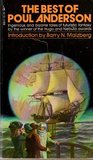
 The Best of Poul Anderson by Poul Anderson
My rating: 4 of 5 stars
Poul Anderson (1926–2001) won multiple awards and much acclaim during his career. His story “Eutopia” in the Dangerous Vision anthology (1967) remains one of my favorites for the way the plot hinges on the final word. This is typical of Anderson. His plots were genius.
Likewise, all nine of the stories in the collection The Best of Poul Anderson are impeccably told – and yet this book left me troubled. A quick summary of the stories might offer a clue about why.
“The Longest Voyage” (1960): Explorers (men) rather like 1700s sailors on Earth are circumnavigating their planet, and they find a high-tech artifact. Won the 1961 Hugo Award for short story.
“The Barbarian” (1956): A spoof of Conan the Barbarian.
“The Last of the Deliverers” (1958): A man arrives in a future Ohio town and debates politics in a satire of the Cold War.
“My Object All Sublime” (1961): A couple of men meet over time travel and crime – to say more would be a spoiler, and there’s a nice twist.
“Sam Hall” (1953): A man fights an oppressive government. Nominated for a Prometheus Award and Retro Hugo Award.
“Kyrie” (1968): A woman falls in love with a doomed alien. Nominated for a Nebula Award.
“The Fatal Fulfillment” (1970): A man falls afoul of a repressive system of psychological control.
“Hiding Place” (1961): A space opera story involving Nicholas Van Rijn, one of Anderson’s recurring characters.
“The Sky People” (1959): In the future on a resource-depleted Earth, a savage attack falls on a peaceful city, and a brave captain (male) saves it.
You may have noticed a certain dearth of women in significant roles. And consider the description of the only woman who is a protagonist: Her ship’s captain regards her as “gauche” and “inhibited,” and he tries to suppress his “distaste” – “but her looks! Scrawny, big-footed, big-nosed, pop eyes and stringy, dust-colored hair….”
When women are introduced in these stories, they often lead with their breasts and sex appeal: “her build left no doubt [of her mammalian life form],” “the rich black dress caressed a figure as good as any in the world,” “blond, big-eyed, and thoroughly three-dimensional,” “her gown was of shimmerite and shameless in cut,” “young and comely, and you didn’t often see that much exposed female flesh anymore,” “a stunning blonde,” “she was nice-looking … and he thought he could get her into bed.”
In “The Hiding Place,” Nicholas Van Rijn has brought a female paid sex companion on his trip whom he keeps underclad and verbally and physically mistreats. In fairness, he’s an ass to everyone, but her abuse has a rapey edge – and he’s the hero of the story. In “The Sky People,” the rescuing fleet has bare-chested woman aboard who “comfort” the men as their only means to join a exciting mission of discovery. Couldn’t they be full members of the crew and share in the adventure without prostituting themselves?
I was born in 1955. I grew up in a time when girls could only wear skirts to school – among many other arbitrary, humiliating, harmful rules, such as no competitive sports; women could legally be paid less than men for the same work if they could even get the same work; reproductive rights didn’t exist. As a headstrong girl, I chafed at the restrictions, stereotypes, and peremptory limited horizons. Reading these stories is a return to the nightmare time when I was legally a second-class citizen.
Poul Anderson can’t be held too much at fault for not seeing that, though. Second-wave feminism didn’t begin in the United States until after most of these stories were published, and progress toward equality was (and still is) slow. Other authors of that time, in and out of science fiction, were equally blind to what we can easily see now.
My question is this: What are we blind to now? What in today’s fiction will future readers point at and wonder how we could have missed something so utterly glaring?
We’re all idiots, we just don’t know what kind of idiot. Reading this book with its painful flaws ought to keep us humble.
…
(An essay with a related theme is at Tor.com: The Sad But Inevitable Trend Toward Forgotten SF.)
 This may seem like a question for poets, but botanists know why roses have thorns.
 This is my new favorite plant, a Rhipsalis creuscula or
  The Locus Science Fiction Foundation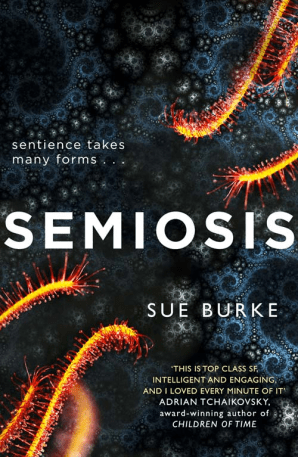

 A host of The Nerd Cantina podcast interviewed me at the Chicago Comic and Entertainment Expo last month, and you can hear it in this week’s show,
 The members of Spectology: The Science Fiction Book Club Podcast may have thought harder about my book than I did. In the episode
  Semiosis