Categories
Uncategorized

Short story: “Zero Hour”

320px-Reloj_digital_2359.svgThis short story was originally published in Daily Science Fiction.
Zero Hour
by Sue Burke

The man had deep worry lines between his eyebrows, although he was only in his twenties. When he woke up after a restless sleep, he immediately looked at the window. Mid-afternoon sun shone through cracks in the blinds. He checked his bedside clock: 5:51 a.m.

The clocks were still wrong … and in a sudden panic, he reached out for his wife. Yes, she was still there, still safe beside him, or as safe as she could be. She lay with her back toward him, her shoulders bare and beautiful.

At 6 a.m. the house audio turned on. The usual mechanical announcers spoke, describing help for victims of a distant earthquake. They said an international peace meeting had been a success, and the weather would be warm and sunny with no break in the drought, but household conservation efforts had exceeded goals.

She stirred, took a deep breath, then another. “Good news?”

“As always,” he answered heartily. It was their private ritual. Rumors circulated about protests and arrests. Just a few days ago the network’s clocks had gone haywire, but then recovered and continued immediately with no other changes. The news had ignored it entirely.

Suddenly he worried that he and his wife hadn’t mentioned the time change out loud, and maybe their silence gave them away.

“Six a.m. in the afternoon. That’s weird,” he said, just to say something.

“Sorry,” she whispered.

He hadn’t meant her to take it that way. He held her tight, hoping that if she knew he still desired her, she would know he didn’t blame her. “It’s a beautiful day,” he said. “Up and at ’em.”

She seemed to understand. She showered quickly while he shaved.

In the kitchen, the screen on the refrigerator recommended healthy breakfasts: whole-wheat cereal, skim milk, oranges, and coffee. It would record their choices, count calories, and adjust subsequent suggestions. He realized that they did as they were told as much out of habit as strategy. The network‛s audio feed continued to play.

She ate silently, staring. Maybe she was listening for clues, for changes in the pattern of information. He wished he could help her.

He worked as a physician’s assistant, a job he might have wanted even if he had been offered a choice of careers. He did what he could to fight back. More patients than ever were making themselves fat as a form of silent, visible protest. They claimed they couldn’t help it and asked him to check for endocrine problems. They were probably buying food on the black market, but they had to pretend to be ill, so he sent them home with the diagnosis they needed.

But other patients arrived dangerously anorexic, or depressed, or paranoid, or toxic with anger, and they needed real help. A few days ago, when the clocks had suddenly reset themselves to 00:00, he had heard hopeful whispers in the waiting room: Maybe something broke. But nothing else happened, life went on as usual, and hopes died.

“Maybe,” his wife said, coffee cup in hand, “I should just go to work and leave Aunt Becky alone.”

That was their code word for the network. He opened his mouth to blurt out no, but stopped. He ate a spoonful of cereal to try to calm himself. It had no taste. He swallowed. “I think you should try to … talk to her again.”

“Again?”

“Well, you got a little change. That must mean something.”

His wife and her team of saboteurs had broken the network apart a few days ago, and for an instant it had stopped, but they hadn’t done enough. It reset itself, she had whispered in his ear when she came home that evening, and he held her for a long time as she wept, while the clocks said it was late morning.

She shook her head, her hair waving softly around her tight face. “But you.…”

“Everyone has family problems.”

She stared at the network speaker.

“But she could be … angry. She could do something.”

He got up, refilled her coffee cup, then emptied the pot into his own. “I’m not angry, not with you. I’m proud of you, whatever she does.”

She drank her coffee. He studied her face as he finished eating, trying to see if she believed him, but he couldn’t guess her thoughts at all. The network feed babbled on and on.

“Okay,” she whispered, and gave him a look that was more worried than hopeful. They got up and stacked the dishes. He hugged her and tried to memorize her body against his, every place where her curves and bones touched him: sternum, ilium, ulna, sartorius, masseter. The names might help him remember her, if he had to.

They left the house and didn’t lock the door behind them. It would lock itself or open itself depending on who tried to enter. He glared at the sidewalk. If they couldn’t lock their own doors, was it their home? Was anything theirs? He acknowledged the anger and tried to let it pass, just as he counseled his patients.

She walked toward her car and quickly got in. He studied her to memorize the movements of her muscles: gluteus, gastrocnemius, biceps, deltoid. He noted the color of her eyes and the curve of her lips. But as her car backed down the driveway, he turned away, ashamed. He knew he should hope that she succeeded, but he only hoped to see her again.

Categories
Uncategorized

The Tully monster: Illinois’ scary official fossil

Tullimonstrum_NT_small_cropped

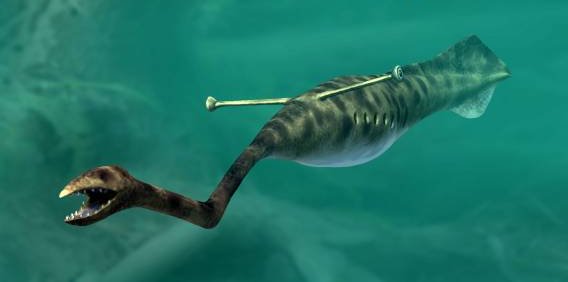
In life, it was only about a foot long, but it might trigger nightmares if you saw it swim past. It would wriggle like a worm or an eel through the water. At the end of an elephant-like snout, a toothy mouth would reach out and tear into onto your flesh to suck out nutrients as it waved its eyes at you…

Since 1989, the Tully monster has been the official state fossil of Illinois.

It lived about 300 million years ago. At that time, Illinois lay near the equator. Dense swamps were pierced by meandering, muddy rivers full of animals like the early relatives of jellyfish and shrimp. The mud rapidly buried creatures that died and preserved them even if they had soft bodies.

The nodules containing these fossils were discovered around Mazon Creek in the 1850s and attracted fossil collectors. In the 1950s, Francis Tully found something new and took it to the Field Museum of Natural History, where the paleontologists named it Tullimonstrum gregarium or “Tully’s common monster,” because Mr. Tully had found it, it was highly unusual (a monster), and there turned out to be quite a few of that kind of fossil at Mazon Creek. And only at Mazon Creek. They may have been common worldwide, but only special circumstances could preserve an animal like that.

It had a long, soft, segmented body with no shell or backbone. At one end were fins. At the other writhed a trunk-like snout with jaws and teeth. In the middle were two eyes on stalks.

Is it a worm? A mollusc? A very early vertebrate? Hard to know. Beyond all doubt, creepy.

We don’t know what creatures, if any, we’ll find on other planets, but Earth’s past is a warning. We might not like it.

Categories
Uncategorized

Plantpot dapperlings!

dapperling 1

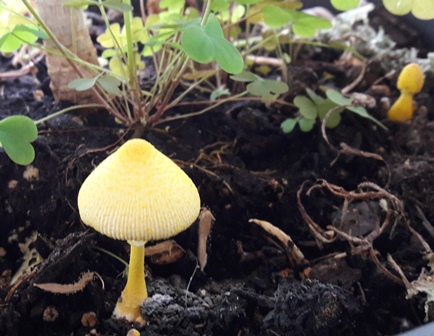
Mushrooms have popped up in one of my house plant pots. Specifically, they’re plantpot dapperlings, Leucocoprinus birnbaumi. This tropical and subtropical saprotroph has found its way into greenhouses and house plants around the world.

These mushrooms are probably a good sign, according to some observers. It means that the soil is being enriched as the fungus breaks down dead material. The mushrooms are also hard to get rid of and probably not worth the effort. Just admire them, and maybe set tiny figurines of dancing fairies around them to celebrate.

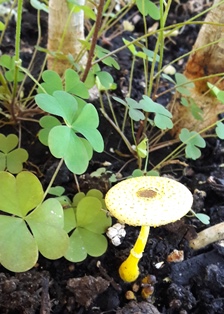
Like a few other mushrooms, they’re poisonous, so don’t eat them. The clover-shaped leaves in the picture are yellow wood sorrel, Oxalis stricta, which is edible and makes a nice, lemony-sour garnish on salads and other dishes. The big stalks are Madagascar dragon trees, Dracaena marginata ‘Tricolor.’ That plant is toxic to dogs and cats but not people — still, I don’t plan to eat it. Too pretty.

dapperling 2I think I know where the mushrooms came from. I recently repotted the plants into soil I bought at the local gardening center. According to the package, the soil contained one or more of the following: composted organic material, aged pine bark, cow manure compost, sedge peat, sand, perlite, and composted spent mushroom soil. Fine stuff, and it probably came with a full ecology of microorganisms and fungus spores, now growing in my living room.

(The soil also produced a plague of fungus gnats. I’m trying to get rid of them slaughter them without mercy.)

Categories
Uncategorized

Goodreads review of “Station Eleven”

Station ElevenStation Eleven by Emily St. John Mandel

My rating: 5 of 5 stars

We’re all going to die, but probably not almost all of us at once. We may be prepared for our own death, even if it comes suddenly, but not the sudden deaths of almost everyone we know. We all have personal failures that we can come to terms with during our lives or as we see death approaching — but how can we come to terms with the failure of so many deaths at once?

Emily St. John Mandel explores these questions in Station Eleven through intertwined lives and deaths that take place before and after a sudden flu kills 99.6% of the world’s population. Science fiction? Yes. A literary novel? Yes, and more literary than science fiction, more character than action. I love both kinds of novels, and I loved this.

For my tastes, the ending works a little too hard to tie a lot of loose ends together into a somewhat optimistic ending, but not too much work to weaken the book for me. The truth of the emotions withstand a hint of forced optimism. If our world ends, the fragments of art that survive might sustain us, and our new lives will give new meaning to the art that the artists never intended. Amid desolation, this can give us strength.

View all my reviews

Categories
Uncategorized

My votes for the 2019 Hugo Best Novelette Award

Hugo_Logo_1_200pxHugo Award winners will be announced on Saturday at CoNZealand, the 78th World Science Fiction Convention, being held virtually from New Zealand. The ceremony will begin at 11 a.m. NZST, 6 p.m. CDT Friday Chicago time, so I’ll be able to watch live. George R.R. Martin will be toastmaster, along with some special guests.

I’ve read all novelettes, which are stories between 7,500 and 17,500 words, and here are my votes. (My votes for the short stories are here.) Overall, the stories cover a fair spectrum of current science fiction and fantasy, and if you never read in the genre, this is as good an introduction as any. You may find some of the stories move you in a different way than they moved me. (SFF Book Reviews offers some divergent opinions.)

6. “The Blur in the Corner of Your Eye” by Sarah Pinsker (Uncanny Magazine, July-August 2019)
A mystery writer finds a man dead, apparently in an accident, and eventually learns the truth. While the story is complex and creepy, it never develops much tension, and, for my tastes, it’s resolved too easily.

5. “For He Can Creep” by Siobhan Carroll (Tor.com, 10 July 2019)
A cat battles Satan for the soul of a poet. Light and stylish, this is perfect for cat lovers and preserves the place for humor in the genre, which is hard to do and, in my opinion, never done often enough.

4. “Away With the Wolves” by Sarah Gailey (Uncanny Magazine: Disabled People Destroy Fantasy Special Issue, September/October 2019)
Can a werewolf story be sweet and gentle? Yes. And in my opinion, there’s always a need for sweet and gentle stories in the genre.

3. “The Archronology of Love”, by Caroline M. Yoachim (Lightspeed, April 2019)
Everyone in a colony on a distant planet died while investigating strange alien technology, and researchers have come to find out why. Some of the dead were loved ones. In a way, the story is one long, slow goodbye — or rather, the search for a way to say goodbye.

2. Emergency Skin, by N.K. Jemisin (Forward Collection, Amazon)
Bitter anger propels this story as the protagonist discovers a lack of beauty and truth, and the means to recover it. Wonderfully told, but for my tastes, didactic — still, the underlying premise rings true.

1. “Omphalos”, by Ted Chiang (Exhalation, Borzoi/Alfred A. Knopf; Picador)
What if Creationism were true? That is, what if God created the universe 8912 years ago? We could still learn a lot from archeology and other scientific studies. But what if we learned something we didn’t want to believe? The story carefully questions that premise, but I’m a little disappointed by the ending, a conclusion that many people in our own universe have already reached.

Categories
Uncategorized

On sale today!

The kindle version of Semiosis is on sale today, July 24, at Amazon for only $2.99.

Categories
Uncategorized

My votes in the Hugo Award Best Short Story category

CoNZealandI’ll be attending CoNZealand, the 78th World Science Fiction Convention, which will be held virtually for the first time — because 2020 is an unprecedented year. The convention will run from July 29 to August 2, and the Hugo Awards will be presented on August 1.

As a member of CoNZealand, I get to vote on the awards. I’ve read all the short stories, and here are my votes. (The Hugos uses ranked voting.) They’re all good stories, well worth reading, and my ranking is a bit arbitrary because I had to choose, and my opinions are a bit harsh because I needed to be judgmental to choose. Your opinions may vary from mine and still be correct.

6. “As the Last I May Know” by S.L. Huang (Tor.com, 23 October 2019)
An emotionally riven tale about a war-winning weapon that can only be used at a great price. It almost feels like a vivid fable rather than a remotely probable story, although it leaves the reader with a lot of questions and doubt — and doubt is the point of the price of the weapon.

5. “And Now His Lordship Is Laughing” by Shiv Ramdas (Strange Horizons, 9 September 2019)
This classic-style horror story involves a dollmaker in India during British occupation — so classic that the ending can be guessed less than halfway through. Righteous anger undergirds the narration, but the conventional plot weakens it.

4. “A Catalog of Storms” by Fran Wilde (Uncanny Magazine, January/February 2019)
As storms become sentient, a small town’s children fight back. The writing evokes a timeless dreamlike quality and creates sharp characters: pathos abounds. The point of view character is a child, however, which traps us in a limited horizon that is both claustrophobic and kind of a cheat, since the larger picture can go unexplained.

3. “Do Not Look Back, My Lion” by Alix E. Harrow (Beneath Ceaseless Skies, January 2019)
A husband must send her wife off to war one more time, and she just can’t bear to do it again. This is another story that questions war, and it also questions and subverts gender roles, and it rent my heart. I wouldn’t be surprised if it wins the Hugo.

2. “Blood Is Another Word for Hunger” by Rivers Solomon (Tor.com, 24 July 2019)
The enslaved people in this story want freedom more than they want revenge, but even magic can’t fulfill every wish. A haunting story that could also deservedly win the Hugo.

1. “Ten Excerpts from an Annotated Bibliography on the Cannibal Women of Ratnabar Island” by Nibedita Sen (Nightmare Magazine, May 2019)
This was my choice for the Nebula Award (it didn’t win), and I’m still wowed by the story. In 1891, something tragic happened, and we’re still living with the consequences. This very short story, told in an unconventional style, smacks the reader upside the head with nuance, ambiguity, and pitiless social criticism. Its densely packed details make it hard to read and irresistible to re-read: very much a story of our moment, and I mean that as high praise.


Categories
Uncategorized

My Goodreads review of “Rosewater”

Rosewater (The Wormwood Trilogy, #1)Rosewater by Tade Thompson

My rating: 5 of 5 stars

I shouldn’t have enjoyed this novel, considering what a horrible person the narrator is. Kaaro steals, cheats, and lies. He’s angry, impatient, insolent, violent, and lazy. He disobeys superiors and abuses people when he thinks they deserve it or when he just doesn’t care. But he’s also honest with the reader, observant, and often a victim of people worse than himself who exploit him, so his anger is righteous. So is his fear. And his love.

Kaaro finds himself in the middle of a ghastly situation. Aliens have come to Earth, but little is known about them. As a result of their presence and the changes they’ve made to the planet, Kaaro is a “sensitive”: he has certain psychic powers. These powers get him in and out of all kinds of trouble. Slowly, episodically, he learns more about the aliens and his abilities, and none of what he learns is good.

The author, Tade Thompson, displays his skill, moving through Kaaro’s past and present to weave a coherent, expanding, multi-faceted disaster. He makes Kaaro, with all his faults, the perfect person to tell a spellbinding story. This is the first of a trilogy, and the series is nominated for a 2020 Hugo Award. On the basis of the first novel, it’s a strong contender.

View all my reviews

Categories
Uncategorized

The source of the Constitution of Pax

OrangeTreeAs I was writing the novel Semiosis, I realized that the colony would need a Constitution (read it here), and it would have an influence on the plot. I also knew that writing a constitution from scratch would be tedious, but perhaps I could copy one. The United States has its Constitution, which I’d studied in school; it has some interesting, specific peculiarities. Roberts Rules of Order offers a model constitution/bylaws, brief and generic. I was searching for one that could suggest some of the aspirations that the Pax settlers could share — and I had an idea.

My religious faith is Unitarian Universalist. The Unitarian Universalist Association, our national organization, has a set of bylaws. I took a look (available here as a pdf). At 28 pages of mind-numbing detail, it was way too long and specific for my little colony, but it expressed the right high aspirations.

My UU friends who have read the excerpts that head the chapters in Semiosis know that I shamelessly plagiarized parts of the UUA Article II as the Pax Article II.

Here’s the Pax version:

ARTICLE II Principles and Purposes
We, the citizens of Pax, covenant to affirm and promote the inherent worth and dignity of all sentient beings and of the interdependent web of existence of which we are a part; justice, equity and compassion in our relations with one another; the right of conscience and the use of the democratic process within our Commonwealth; the goal of community with hope, peace, and freedom for all. Grateful for this opportunity to create a new society in full harmony with nature, we enter into this covenant, promising to one another our mutual trust and support.

The UUA:

ARTICLE II Principles and Purposes
We, the member congregations of the Unitarian Universalist Association, covenant to affirm and promote: The inherent worth and dignity of every person; Justice, equity and compassion in human relations; Acceptance of one another and encouragement to spiritual growth in our congregations; A free and responsible search for truth and meaning; The right of conscience and the use of the democratic process within our congregations and in society at large; The goal of world community with peace, liberty and justice for all; Respect for the interdependent web of all existence of which we are a part. Grateful for the religious pluralism which enriches and ennobles our faith, we are inspired to deepen our understanding and expand our vision. As free congregations we enter into this covenant, promising to one another our mutual trust and support.

I also used other parts of the bylaws as a general template for Pax’s mind-numbing details of committees, meetings, quorums, and rules. One obvious bit of plagiarism: the title of “moderator” as the presiding officer of the General Assembly. It sounds so gentle — moderate, even. For the record, no UUA moderator has ever been a mass murderer. On Pax, things didn’t always go so well. High aspirations will only get you so far on a distant planet during a terrifying fight for survival.


Categories
Uncategorized

Dead tree art

GreenLadyMotherPeaceIn 2014, a lot of trees in Chicago parks began dying, infected by the Emerald Ash Borer. The Chicago Park District and Chicago Sculpture International created the Chicago Tree Project to turn those dead trees into public art.

This recently transformed tree is Green Lady/Mother Peace by chainsaw artist Gary Keenan, which you can also see on Facebook.

Enjoy more dead tree art at the Chicago Tree Project gallery.