Sue Burke’s most recent science fiction novel is Usurpation, the conclusion of the trilogy that began with Semiosis and Interference. She began writing professionally as a teenager, working for newspapers and magazines as a reporter and editor, and began writing fiction in 1995. She has published more than 40 short stories, along with essays, poetry, and translations from Spanish into English of short stories, novels, poetry, and historical works. Find out more at https://sueburke.site/
The 30th annual Parsec Short Story Contest is open for submissions until March 31, 2026. This year’s theme is “metamorphosis.” Entries should be unpublished and be no more than 3,500 words. The contest is open to writers who have not met the eligibility requirements for SFWA full membership. No entry fee. Full contest rules and information are here.
The winners will be chosen by a team of three judges. I’m one of them. What will I be looking for? A good story, well told, of course. I’ve judged other contests, and I’ve seen a number of otherwise excellent stories that drop the ball at the end. The manuscript reaches “the end” a paragraph or two before the story does, failing to complete the emotional arc of the characters. Just saying. Good luck!
My flash fiction piece “The Souvenir You Most Want” won second place in the 2002 Parsec Contest, which had the theme “Met by Moonlight.” Read it here.
My short story “Think Kindly on Our Fossils” appears in the 2007 Triangulation: End of Time anthology, published by PARSEC Ink. You can purchase it here.
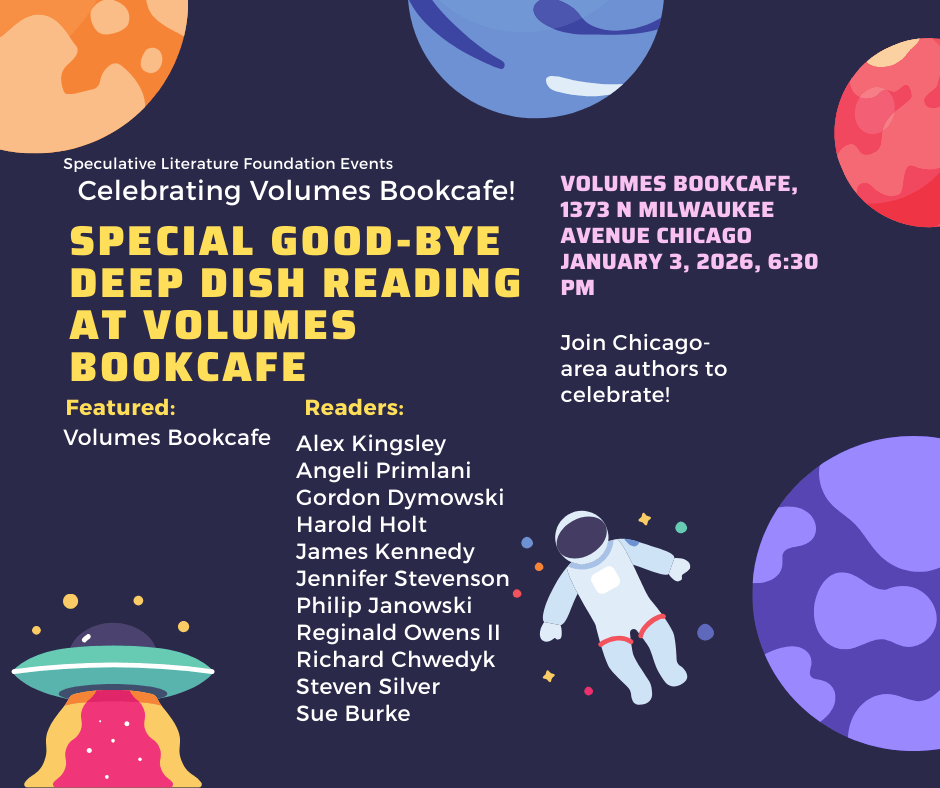
Volumes Bookcafé is closing its doors. The bookstore in Chicago’s Wicker Park neighborhood, owned by two sisters, lost too much business when a Barnes & Noble opened two blocks away. This is the store that hosted all my book launches. Rebecca, one of the owners, has become a friend.
To say goodbye, the Speculative Literature Foundation will host a Deep Dish reading at the store at 6:30 p.m. Saturday, January 3, 1373 N. Milwaukee Ave., Chicago. Come, enjoy the performances, and buy a book. Volumes has a carefully curated selection.
The readers will be Alex Kingsley, Angeli Primlani, Gordon Dymowski, Harold Holt, James Kennedy, Jennifer Stevenson, Philip Janowski, Reginald Owens II, Richard Chwedyk, Steven Silver, and me.
I shouldn’t have been surprised that my living room plants had organized. There’s a lot of community-building going on these days, especially here in Chicago.
“I speak for all of us,” the dragon tree said. “You marched for No Kings, so why are you thinking about decorating us? This holiday is for Three Kings. That’s three times worse.”
It took me a moment to figure out what they were talking about. Every year, one of my houseplants impersonates a Christmas tree. This year, they were a little on edge, understandably. It’s been a rough year.
“Let me tell you the holiday story,” I said. Plants are attentive, and they listened quietly. “So you see, the Three Kings are wise men.”
“Wise. Completely different kings, then. If we’re decorated, we’re protesting in favor of joy to the world, right? In that case, we all want to be decorated. The living room will be a massive pro-holiday rally.”
Every year, the plants have opinions about holiday decorating, and I’ve learned that plants are stubborn. So, this year, everyone gets to celebrate. It’s the season of joy and community around here. Happy holidays to you, too.
Pumpkin pie, some assembly required. This pumpkin came from Waupun, Wisconsin, which explains its classic appearance.
Pumpkins are squashes, but are squashes pumpkins? Some are. Regarding your holiday pumpkin pie, if the pumpkin comes from a can, it’s at least 95% certain that it is from the Dickinson pumpkin, which is more or less a butternut squash. But as Libby’s Pumpkin insists, the Dickinson is really a pumpkin—and that’s true. Botanically speaking, “pumpkin” is a squishy squashy category.
Anyway, I can attest that a good butternut squash/Dickinson pumpkin is a little more flavorful than the classic pie pumpkin, so don’t feel cheated. And both of those taste better than the variety of pumpkin we carve for Halloween. A jack-o-lantern makes a great addition to the compost heap, not the dinner table.
One more fun fact: Almost all pumpkins for canned pie filling are grown in and around the village of Morton, Illinois, near Peoria. So when you eat your pumpkin pie, think about the Land of Lincoln. In these fraught political times, what can we learn from Honest Abe?
Anthologies tend to make less money than novels, yet they keep appearing. And I keep reading them. An anthology offers the chance to read a carefully curated selection, and I love short stories as an art form.
I liked it a lot. Like every good anthology, the stories offer a range of approaches, including literary science fiction, magical realism, and dark fantasy. Some are set in the present, such as the war in Ukraine, others in the future, and they feature settings around our planet and beyond. Some are grim, many hopeful.
My favorite is “The Plasticity of Being” by Renan Bernardo, which illustrates the paradoxes of offering help to poor people. I also especially enjoyed “Bodies” by Cat McMahon about the dangers of being a clone, and “Thirteen Ways of Looking at a Blackened Husk of a Planet” by Adeline Wong about the emotional weight of being a student, with hints of poetry. But I could go on. There’s the quiet wisdom of “Batter and Pearl” by Steph Kwiatkowski, and the aspiration of “Father Time Dares You to Dream” by Trae Hawkins — and both stories take place near me.
My blurb:
Each author offers us a unique ecological niche to reveal what our present and future could be, ranging from wrenching disasters to elating possibilities of recovery. These stories are personal and lyrical, and the breadth of imagination and styles make this anthology dazzling. Every story is a gem.
You can read or listen to a story I translated from Spanish into English by Ramiro Sanchiz, “Trees at Night” (Árboles en la noche) at the November 2025 issue of Clarkesworld Science Fiction and Fantasy Magazine. The podcast of the story is read by Kate Baker.
Sanchiz is a Uruguayan writer whose work has been described as “new weird.” “Arboles en la noche” is available in the original Spanish at the magazine Contaminación futura 8.
In the story, a librarian at a hospital-like sanatorium befriends a young patient for reasons that eventually become clear. It offers a distant echo of the novel Roadside Picnic by Arkady and Boris Strugatsky (which I recommend): aliens come to Earth, and what they leave behind is incomprehensible to humans.
Rather than the self-destruction in the Strugatsky novel, in “Trees at Night” the response is estrangement. I don’t know how to summarize the story without spoilers. This sentence, taken from close to the end, might say enough:
“The Sanatorium rose far away, its sight mostly blocked by trees; the sun had already set, and a globular cluster of stars sparkled in the sky to remind all us humans that we were not on Earth and, in fact, we did not know where we were.”
Since it’s Halloween, let me tell you a true story about a ghost. I don’t believe in ghosts, but I want to believe in this one. It happened quite a few years back when I was living in Milwaukee and I went to visit a friend’s house in the Bay View neighborhood.
I didn’t know the house was haunted. I simply said the big, colorful framed poster hanging at the top of the stairs looked lovely, especially in that spot.
“Do you want to know why it’s there?” My friend was eager to tell me. She and her family had moved into the house not long ago, and they had decided that the space at the top of the stairs seemed like a natural place for art, which it was.
So they hung up a picture. It fell down. They put it up again. It fell down the stairs and broke. They tried another picture, carefully securing it to the wall, and it, too, fell down the stairs and broke. They couldn’t figure out what the problem was.
Then one day they were talking with the elderly neighbor who had lived next door all his life. He listened to their story and sighed sadly. Decades earlier, the family in that house had a teenage son who was gay, which in those days was a terrible taboo, so he had committed suicide by throwing himself down the stairs. Ever since then, things fell down the stairs for no reason — or perhaps because the boy was still there in spirit.
My friend and her family decided to try an experiment. They bought the most beautiful gay rights poster they could find, put it in a nice frame, and hung it at the top of the stairs, hoping the boy might understand that things had changed.
“And it’s still there!” she said. “I’m not sure I believe in ghosts, but maybe we helped his spirit rest in peace.”
Now, I knew the neighborhood. The street in front of that house was built over an underground stream, Deer Creek. Maybe, when heavy trucks went past, they made the ground shake and the movement somehow focused on that stairway.
Or maybe there was a troubled spirit in that house, a forlorn teenage boy who had lived there many years ago. And possibly, if he had been born decades later, he could have lived at peace with himself and still be alive.
Come to the Deep Dish Reading at 6 p.m. Thursday, Oct. 23, at After-Words Bookstore, 23 E. Illinois St., Chicago, organized by the Speculative Literature Foundation. Featuring Devi Bhaduri, Tina Jens, Philip Janowski, Brendan Detzner, Harold Holt, Katherine Ervin, Winifred Burton, and Sue Burke.
If you haven’t yet read Usurpation, here’s your chance to buy it at a more economical price. The trade paperback will be released on Tuesday, October 21, available from any bookseller.
This is the third book in the Semiosis trilogy. As you may recall, Stevland, an aggressive, intelligent plant on a distant planet, longs to send his seeds to Earth. In the second book of the trilogy, Interference, he finds a way.
Now Stevland’s descendants grow everywhere, but no one on Earth knows they are intelligent, and humans have fallen into a violent crisis. They need help. But how? Stevland sends advice: “Compassion will give you courage. Love will be ferocious.”
Apples are my favorite fruit — but is it the forbidden fruit? Probably not. The idea seems to have come from a mistranslation or artistic liberty rather than the gospel truth.
The Bible’s Book of Genesis tells the story of the serpent who talks to Eve about a particular fruit that, if she ate it, would cause her to “be as gods, knowing good and evil.” (Gen. 3:4, St. James Version). It doesn’t say which fruit, and many different fruits have been proposed. The idea that it’s an apple could come from a confusion between the Latin word “malus” for evil and “malum” for apple. Or the Latin word “pomum” for fruit; in French, it became “pomme” and eventually meant apple. Or the Biblical story became mixed with Greek legends about apples.
In any case, apple trees are a good example of how plants manipulate us. Apple trees grow tasty fruit so that we pick it, eat it, and spread the seeds when we toss away the core. Like many kinds of fruit, some varieties of apples even change color as they ripen to encourage us to eat them. Apple trees now grow all over the planet and enjoy tender loving care. Like every plant, apples want to take over the Earth — or at least conquer every niche they can fit into. Apples have used us humans to achieve world domination.
It’s apple season. Enjoy! And consider the mutualism that brings you this sweet treat. Just because you eat something, you might not be the apex predator. You might be cheap labor.



 Semiosis