
My 50-word science fiction short story “Good Boy” has been published by 50 Give or Take.
Sue Burke’s most recent science fiction novel is Usurpation, the conclusion of the trilogy that began with Semiosis and Interference. She began writing professionally as a teenager, working for newspapers and magazines as a reporter and editor, and began writing fiction in 1995. She has published more than 40 short stories, along with essays, poetry, and translations from Spanish into English of short stories, novels, poetry, and historical works. Find out more at https://sueburke.site/
My 50-word science fiction short story “Good Boy” has been published by 50 Give or Take.
Knowledge is power, but perfect knowledge is impossible.
Suppose you knew when and how you were going to die. Could you avoid crossing the street in front of a speeding taxi? Get a mammogram in time? Stop smoking right now?
You might have to learn to face certain death with aplomb.
Possibly, everything in space and time already exists, just like a museum diorama, unchangeable as the evolution and disappearance of the dinosaurs. Their story began two hundred thirty million years ago, when Thecodonts began to walk upright. It ended 65 million years ago when the eight-ton Tyrannosaurus rex got squashed by a giant asteroid.
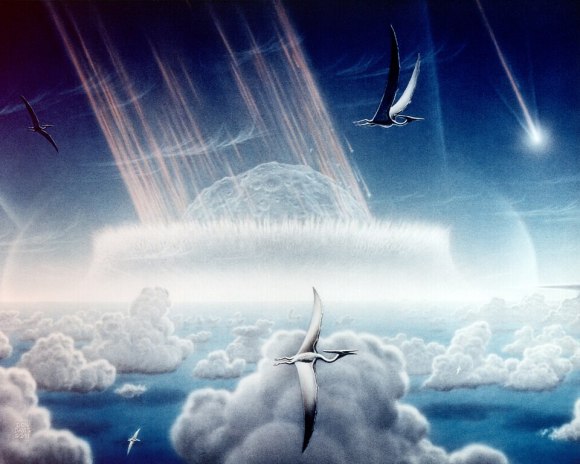
Perhaps God has already thought things through. Or perhaps, in an atheistic universe, space-time exists such that all its event-lines are locked in place from beginning to end. For the dinosaurs, it was a fatal surprise when an immense rock from space the size of Halley’s Comet smashed into Mexico’s Yucatan Peninsula and blasted out a crater 175 kilometers across.
But it was fate, kismet. The moving finger wrote, and it had to happen. Orbits had intersected, and God, or anyone with a telescope, could have seen it coming.
Philosophers and physicists have propounded for and against this idea of a pre-determined universe. Despite its logical consistency, Western minds can’t quite get around the fatalism. It means that no matter what we do now, we can’t change anything. We are as fierce, beloved, and doomed as T-rex. Our big brains make no difference.
So, you have no free will. You were pre-destined to read this essay, in fact. You can’t change a thing, can you?
Ah, but you have. One small example: Do you remember your school teacher when you were seven years old, Mrs. Sobel? In reality you were nine years old when she was your teacher. Yet you go on blithely making decisions thinking that you live in the seven-year-old-with-Sobel universe.
Mentally, we rearrange events to happen the way we think they should have happened. Then we interact with other people, every one of us with deluded memories, and we change our evolution and redesign our fates en masse.
Worse yet, without monumental research into every moment of your past, you can’t even know what you’ve misremembered. You may have forgotten major events, or made up others out of thin air. You may be planning a vacation to the Yucatan. You hope to swim at the white sand beaches, play a little golf, and take a day trip to the Maya ruins of Uxmal. Or have you already gone? Can you be sure? Was Mrs. Sobel there? Did you see any dinosaurs?
That’s why, in the Yucatan, the ancient Maya wrote down their history. They needed to remember everything that happened because they believed time moved like a wheel, which is why their calendars revolved in circles. Dates would repeat. When time turned around again, if they knew what had happened on the same date the last time, they could be prepared. Their records indicated that huge floods usually destroy the world on a certain date, 13 Baktun 0 Katun 0 Uinal 0 Kin. Fortunately this date doesn’t recur often, most recently on December 23, 2012, by our Gregorian calendar. But was the Earth destroyed? No, because we were prepared!
Knowledge is power. But you have to have accurate information.
And you don’t. You’ve already forgotten who knows what, and so have I.
What’s going to happen next? Somewhere, someone might have known, but we’ve ruined it for them. You may wish to quit smoking, get a mammogram, or look both ways before crossing anyway. We still need all the aplomb we can get, because we will all die, we just can’t know when.
***
This essay appeared in Issue 2, Summer 2002, of Full Unit Hookup magazine. Illustration: This painting for NASA by Donald E. Davis depicts an asteroid slamming into the Yucatan Peninsula as pterodactyls glide above low tropical clouds.
My translation of “Bodyhoppers” by Rocío Vega, published at Clarkesworld Magazine, has been nominated in the category of the Best Translated Short Fiction for the British Science Fiction Association Awards. The annual awards are voted on by members of the BSFA and will be presented at this year’s British National Science Fiction Convention, called Eastercon because it takes place over Easter weekend, April 3 to 6.
I’m honored to be listed among such talented translators, and the full BSFA Awards shortlist is a great reading list. Congratulations to all the nominees!
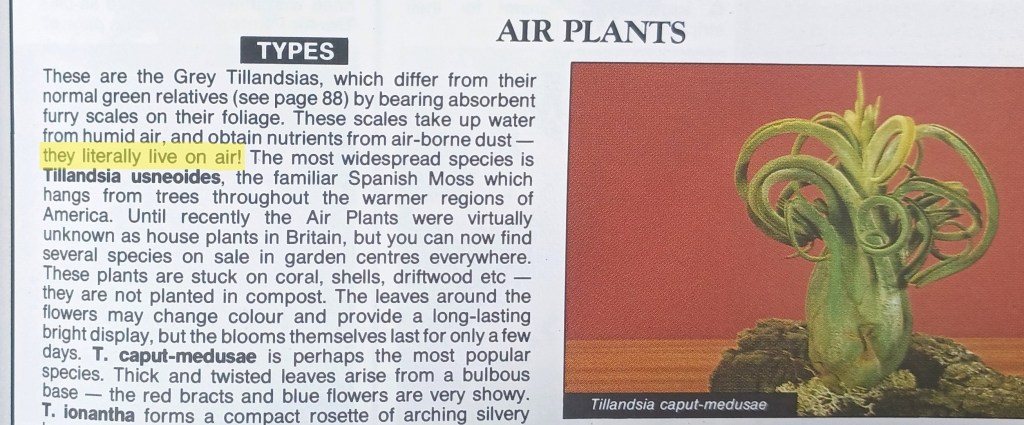
You may have heard that air plants (Tillandsia species) live on air. This is untrue. They live in air, usually clinging to trees, rocks, telephone wires, or roofs. They do not have roots. They get their water and nutrients from the air.
You may have also been told the plant magically subsists on air alone. So you set your air plant somewhere and ignore it. Eventually your plant dies
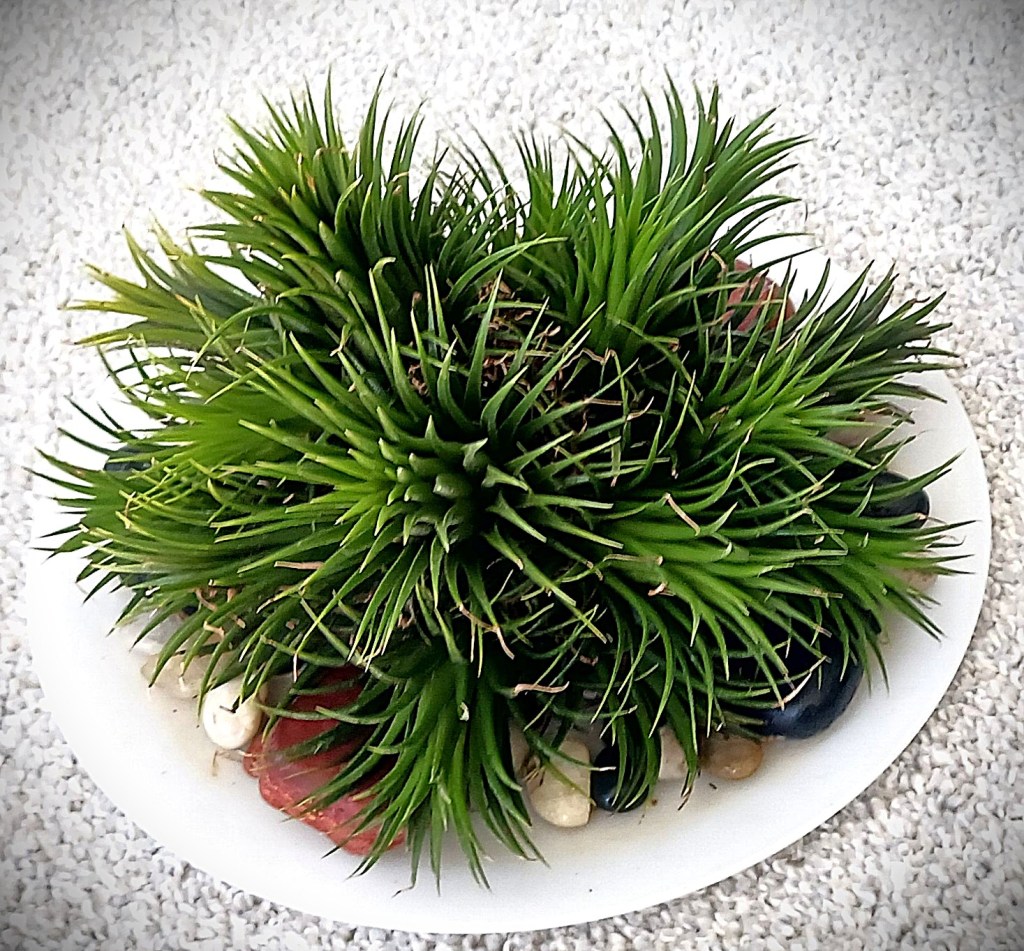
The photo is of my Tillandsia ionantha on a dinner plate. I’ve had it for ten years, and it keeps getting bigger. Here’s the secret to success:
I’ve visited the Yucatan in Mexico where it comes from, and I saw it growing on tree branches. While I was there, I couldn’t help noticing that it rains a lot in the Yucatan in the summer. Like every day. Air plants don’t live on air, they live on thunderstorms.
The Yucatan also suffers droughts. The plant can survive a drought, but it doesn’t like them. An unending drought will kill it.
Since it doesn’t rain in my living room, I regularly spray it or dunk it in water. It has little cups in the leaves that collect water. It shouldn’t be left to sit in water, though. It lives in the air, not in a swamp.
It also lives in sunny places. An air plant belongs on a windowsill, not in a dark corner.
Here are some good tips: How to Care for your air plant – Airplantman. How to grow and care for air plants – The Spruce.
Tillandsia are great little house plants, and your service to it as a emotional support animal will be rewarded. Just don’t believe everything you’re told, especially if it sounds too good to be true. That’s one of an air plant’s gifts to you: healthy skepticism.
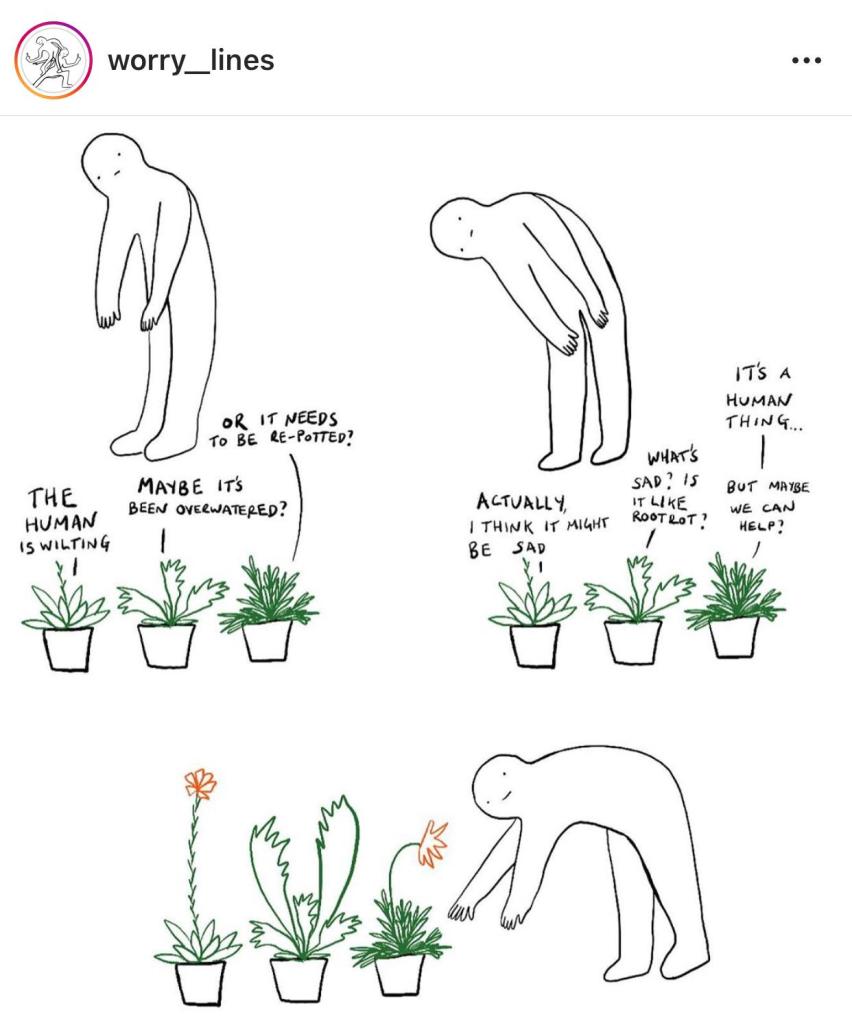
As you know, an emotional support animal is a companion that provides support to human individuals for a mental, psychiatric, or emotional disorder. These are often typical pet animals like dogs and cats, although other creatures — including plants — can improve your mental health.
Plants require a role reversal, though.
Animal companions for humans rarely get training, but you must train yourself to provide effective emotional support for plants. First, you must overcome plant blindness and see them as living beings. Then decide if you plan on supporting outdoor or indoor plants: gardening, rewilding your lawn, or sustaining indoor plants in pots?
If you already have plants, what kind do you have? Apps like Picture This and its website, Pl@ntNet, or guided observation and keys can help. Find out what that particular plant needs for warmth, light, and watering, and consider what you can offer.
Common houseplants are often jungle undergrowth plants, and your living room probably resembles a jungle floor in light and warmth — but check. Every plant has a niche, and it will suffer stress outside that niche. A cactus leads a very different life than a pothos, and small plants need more frequent care, sometimes daily, than big plants. Your first emotional support duty is to gauge your ability to minimize the plant’s stress.
“Moist” is a universally challenging concept when it involves soil, yet you must master it.
When you care for your plant, you will benefit both the plant and yourself. As you provide regular, attentive care, you may improve your own self-care. After all, you get by giving, and you learn responsibility by being responsible.
As the support animal, you will be rewarded by beauty and quiet companionship, and you will have created a supportive environment for the plant — and very possibly for yourself. Are you ready to change your life?
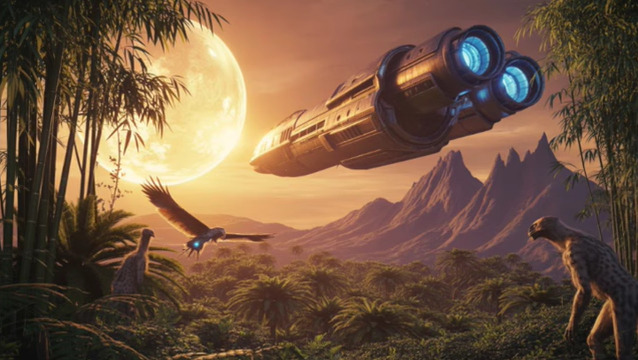
A French fan of the novel Semiosis was moved to write a suite of seven songs based on the book’s seven chapters: Pax, Les enfants de Pax, Stevland, Symbiose, Le village des verriers, Les Verriers, Semiosis.
I don’t speak French, but the music captures the energy and vibe of each chapter.
You can listen to it here: Semiosis – YouTube playlist
D’après le roman “Semiosis” de Sue Burke — Lyrics and music by BLB, vocals, all instruments by BLB except the guitar solo of Pax, by DLT.
Thank you, BLB and DLT!
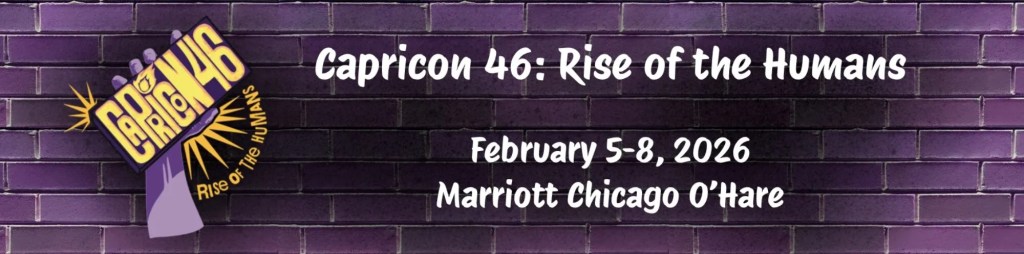
I’ll be at Capricon this weekend, a four-day science fiction convention held annually in the Chicagoland area since 1981. During the day, members can attend panels, workshops, readings, lectures, concerts, and theater; hear from our guests of honor; play games; and visit the art show and dealer’s room. Topics include books, movies, television, science, space exploration, costuming, and crafts, including a children’s track. At night, there are parties, filk music, and fun.
This is all created and run by volunteers. We do what we want, not what a corporation hopes will turn a profit (although you can buy art, books, clothing, and other needful things direct from vendors at the art show and dealer’s room).
You can still join the convention. Memberships are available for one-day visits or the entire weekend.
Here’s my schedule — and of course I’ll be having lots of fun.
Off the Beaten Format roundtable discussion, 1:00 p.m. Friday, Wacker Room — Diaries. Letters. Space Tumblr. There are all sorts of ways to format a story other than in prose. What stories best take advantage of this? What other formats could be explored? And what are the benefits of using an alternative format in the first place? I’ll be moderating the discussion.
It’s A Start: A Workshop On Your First Paragraph, 2:30 p.m. Friday, Michigan Room — A good opening paragraph for a story or novel will carry the work to success. In this workshop, we will consider 17 different ways to start a work of fiction, explore how each one will affect the reader, and evaluate the promise it sets for the story. Come ready to write and try out some new approaches. I’ll be leading the workshop.
Robots as Protagonists and Characters panel, 8:30 p.m. Friday, Chicago A Room — Some popular sf books have robots as protagonists, from Martha Wells’s Murderbot to the multiple narrators of Annalee Newitz’s Automatic Noodle. What are the challenges of writing a robot character? What stories can we tell with a robotic protagonist that we couldn’t with a human main character? Shaun Duke (moderator), Andrea Hairston, Sue Burke.
Science Fiction Haiku workshop, 11:30 a.m. Saturday, Michigan Room — Can you write a SciFaiku? Yes, you can and you will. This hands-on workshop will introduce the concept of science fiction and fantasy haiku, discuss how it is like and unlike other kinds of haiku, and guide you through the actual creation of some poems. Bring a pen or pencil. Inspiration will be provided. I will lead the workshop.
Geeky Gardening panel, 4:00 p.m. Saturday, Monroe Room — We will discuss how to grow weird, wonderful plants for the backyard, balcony, or windowsill. Karen Herkes (moderator), Wendy Robb, LaShawn Wanak, Sue Burke.
Non-US Tropes panel, 10:00 a.m. Sunday, Chicago B Room — US media has a lot of its own conventions and expectations, but how many of them are US-specific? And what else is out there? Wil Bastion (moderator), Oleg Kazantsev, Sue Burke.
From the Kernel of a Thought panel, 11:30 a.m. Sunday, Chicago G Room — Inspiration is found in all sorts of places — music, TV, other books… even looking out the window. Where do you find inspiration? And — undoubtedly the harder part — how do you take those ideas and develop them into a whole story? Mark Huston (moderator), Brian Babendererde, LP Kindred, LaShawn Wanak, Sue Burke.
You may recall that I translated the novella ChloroPhilia by Cristina Jurado. Over at the Climate Fiction Writers League, Cristina and Debbie Urbanski discuss the story and the ideas behind it.
Cristina: “Funny enough, I wrote ChloroPhilia after moving to Dubai, when my children were very small. We had to learn how to deal with real sandstorms, floods caused by poor drainage, extremely high temperatures and humidity, and a life designed to be lived mostly indoors. My experience raising them in a hostile environment with hyper-modernized infrastructure definitely influenced the kind of apocalypse I chose to write about. The climate crisis is something we experience in our daily lives here, and we’ve had to adapt.”
Read more here about ideas for our future from Cristina and Debbie.
***
At last year’s Capricon Science Fiction Convention, I took part in the Speculative Literature Foundations reading. I read the flash fiction piece, “Magic Rules Zero Through Four.” It’s four minutes long, and I’m kind of shouty because the microphones didn’t work. Watch me emote at YouTube.
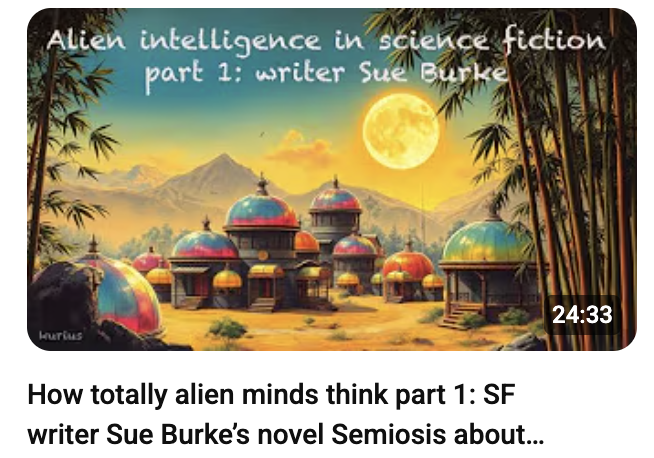
For Shawn Thompson, curiosity is a way to live in a deeper and more fulfilling way. That’s what he explores in his podcasts. He wondered how I found a way to write from the point of view of a plant in the novel Semiosis, so we had a chat about the craft of imagination in writing, curiosity, first contact, and alien intelligence.
You can watch us on YouTube here:
Episode 1: https://youtu.be/k-PsnhuqC3U
Episode 2: https://youtu.be/rLsPkECqac4
Episode 3: https://youtu.be/wwtgan1j8jw
Curious podcast channel: https://www.youtube.com/@theoldcuriositypodcast

The novel Semiosis is now available in Ukrainian from Lobster Publishing.
This has to be the most beautiful edition of the book, as you can see in these Instagram reels.
I know just enough of the Cyrillic alphabet to know that СЕМІОЗИС is Semiosis and Сью Берк is Sue Burke.
Meanwhile, my heart breaks for the people of Ukraine. I visited Kyiv in 2006 when it hosted the European Science Fiction Convention, and I was impressed by the elegance of the city and the patriotism of its people. They made sure, back in 2006, that I understood they were not Russian.

 Semiosis