Categories
Uncategorized

Windycon 2026: Sanctuary Among the Stars

Windycon is Chicagoland’s longest-running science fiction convention. It’s now in its 52nd year and will be held October 9 to 11 at the Hyatt Regency Hotel conference center in Rosemont, Illinois.

The convention is relatively small, no more than 1000 people, and literary based — that is, focusing more on written works than movies and TV, although those won’t be forgotten, and astrophysics will get consideration, too.

Windycon 52’s chair, Austin “Alchemist” Regan says, “This year’s theme, Sanctuary Among the Stars, was inspired by the countless alien worlds, distant civilizations, and unlikely alliances that fill the science fiction we love, and by the people who gather here to celebrate them.

“Across books, movies, and series, we are shown again and again that the universe is vast, strange, and beautifully varied. We meet beings from worlds unlike our own, speaking unfamiliar languages, carrying different histories, values, and ways of seeing reality itself. Yet the stories that stay with us are the ones where those differences do not divide, they connect.”

Here are the panels I’ll be on. There will also be games, cosplay, crafts, theater, an art show, workshops, a vendor’s hall, readings, music, and parties.

If you want to come for a day or for the weekend, you can register at the door.

Slower than Light Interstellar Societies, 6 p.m Friday, October 9, Mirabel Room. How can a unified society exist when communication can take years and travel can take decades? If every journey is a one-way trip, how can planets stay connected? Sue Burke, moderator; Clif Flynt, Geoff Strayer, and Jim Plaxco.

What’s the Right FTL Method for Your Story? 8 p.m. Friday, October 9, Narita A Room. Science fiction has given us multiple ways of reaching other stars quickly — warp drives, jump gates, long-distance teleportation. Each one comes with pluses and minuses. Which one fits best for your story? Sue Burke, moderator; Mark Roth and Mimi Aruguete.

Speculative Literature Foundation Deep Dish Reading, noon Saturday, October 10, Paris Room. Join the Speculative Literature Foundation for the next installment of its Deep Dish Reading Series, which celebrates the work of local Chicago science fiction and fantasy writers. I plan to read Meditate Like the Stars. Alex Kingsley, moderator; Gregory Stark, G.E. Moore, Richard Chwedyk, Brendan Detzner, Alex Jennings, Llewella Forgie, Sue Burke, and Fannie Price.

Worldbuilding: Creating a Universe from a Blank Page, 9 p.m. Saturday, October 10, Tegel Room. It’s time to create your epic book or game series, and you want to set it in a rich and vibrant universe. How do you approach such a daunting task? How do you keep it familiar enough to be relatable, but also unique enough to carry the reader away to a brave new world? Do you start by creating an exhaustive bible outlining the characters, politics, and environment before writing the first word of the narrative, or do you jump into the story and then keep track of the details as you go? We’ll talk about all of this and much more as we guide you through this formidable challenge. Sue Burke, moderator; Malda Marlys, Victor Ladis Schultz, and Andrew Gaska.

To Live Forever: The Longest Human Dream with Larry Niven, 12 noon Sunday, October 11, Charles De Gaulle Room. Humanity has been trying to cheat death for as long as we’ve been telling stories. From ancient legends of magical fountains and miraculous potions to modern medicine and the latest promises of longevity, the desire to live longer has inspired everything from profound discoveries to bizarre schemes and dangerous extremes. Join legendary science fiction author Larry Niven for a wide-ranging discussion of our fascination with immortality and the many paths humanity has taken in pursuit of it. We’ll explore the history, science, speculation, and fiction surrounding longevity, including the ethical questions that arise when extending human life becomes possible. How far would humanity go to defeat death? And what might happen if we actually succeeded? Larry Niven, moderator; Paul Hah and Sue Burke.

The Theory Behind Utopia, 1 p.m. Sunday, October 11, Mirabel Room. What does a perfect society look like, and what can imagining one teach us about the world we live in? Utopian science fiction has a long and fascinating history, using imagined societies to explore ideas about politics, technology, culture, equality, freedom, and human possibility. Join us as we explore where utopian science fiction comes from, the theories and ideas that have shaped it, and the many forms utopian thinking has taken across science fiction and fantasy. From visions of ideal societies to stories that challenge the very idea of perfection, we’ll examine how these imagined worlds reflect the hopes, fears, and aspirations of their creators. Most importantly, we’ll consider why utopian fiction still matters and how imagining different ways of living can influence the way we think about our own society and the future. Sue Burke, moderator; Terry O’Brien and Alex Kingsley.

Categories
Uncategorized

My vote for the Nebula Award for Best Short Story

Nebula Awards logo

Relatively few people usually vote for the shorter works for the Science Fiction and Fantasy Writers’ Nebula Awards, and we only had a month to evaluate all the works on the ballot with its many categories, so I started with the short stories, which was doable. This year, I wasn’t entirely impressed. I thought some of the stories were simple and shallow — but not all of them.

“Because I Held His Name Like a Key” by Aimee Ogden (Strange Horizons 6/16/25) — An immortal being seduces a human, and we all know what’s going to happen next. This is a low-energy retread of a familiar story.

“Laser Eyes Ain’t Everything” by Effie Seiberg (Diabolical Plots 5/25) — A woman who uses a wheelchair discovers that superpowers will not overcome indifference to accessibility needs. The story works better as grievance catharsis than literature.

“The Tawlish Island Songbook of the Dead” by E.M. Linden (PodCastle 2/18/25) — The ghosts left behind on Tawlish Island feel lonely as the descendants go on with their lives elsewhere. Nostalgia and sadness make for a sweet but oft-told story.

“Through the Machine” by P.A. Cornell (Lightspeed 5/25) — An actor’s image is used to make movies that he never participated in, and he feels bad about it. Although the storyline is timely, it is explored with little emotional nuance, and the telling struck me as simplistic.

“In My Country” by Thomas Ha (Clarkesworld 4/25) — In a strange country, people are permitted by law to speak plainly or not at all. This story is sort of a parable, and its telling is not plain, and that kind of story can make you feel.

My vote: “Six People to Revise You” by J.R. Dawson (Uncanny 1-2/25) – Liza is sure she needs to change to find peace because a corporation is persuasively selling its services for change to vulnerable, anxious people. But what to change and why? It’s hard to find good advice. The unflinching characterization told me early on that Liza was self-deluded. What could make her wise up?

Categories
Uncategorized

Your Name in Landsat   

NASA/USGS’s Landsat program has compiled the longest continuous space-based record of Earth’s land in existence. The data is used to make informed decisions about Earth’s resources and environment.

Just for fun, Landsat created a tool by which you can enter your name — or any other word — and see it spelled out in images of Earth. Hovering over the picture tells you where in the world the picture is from with a link to more information.

I made it spell out Stevland: S is Rio Chapare, Bolivia; T is Lena River Delta, Russia; E is Breiðamerkurjökull Glacier, Iceland; V is Padma River, Bangladesh; L is Regina, Saskatchewan, Canada; A is Lake Guakhmaz, Azerbaijan; N is Yapacani, Bolivia; D is Lake Tandou, Australia.

***

If you’re looking for a rock-hard science fiction novel, The Mary Sue has ten suggestions. One of them is Semiosis:

“Do you ever feel like your houseplants could be watching you? That maybe they’re more aware of their surroundings than their innocent, leafy, seemingly helpless without you watering them bodies would have you believe? Sue Burke’s Semiosis will justify all of your paranoid plant musings, turning them into scientific reality! The novel concerns a group of crash-landed astronauts, who begin to believe that the plants on their new alien planet home have more to them than meets the eye. The novel is a deep down dig into the roots of botanical science, and is chloro-filled with all the real life ways that plants are evil psychopaths. Seriously, Earth’s plants are murdery enough, but sentient planet-ruling plants from beyond the stars? Diabolical.”

***

Dragonfly.eco calls itself “an exploration of eco-fiction, blowing your mind with wild words and worlds.” It just interviewed Cristina Jurado about her novella ChloroPhilia, which I translated from Spanish into English. Cristina currently lives in Dubai, United Arab Emirates, and she explains how living there with its “insidious, powerful” sandstorms and hostile heat helped her create the story’s setting.

Categories
Uncategorized

Usurpation: Love will be ferocious

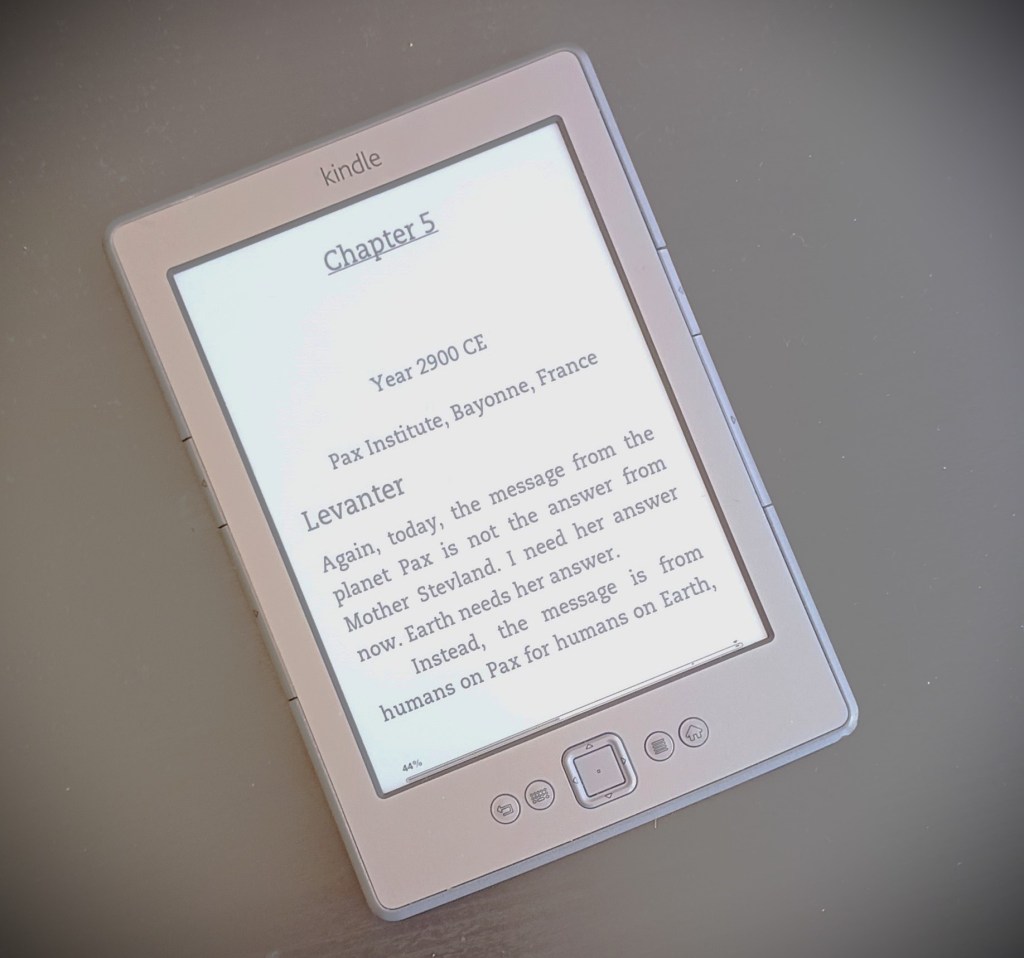
The novel Usurpation is the third in the Semiosis trilogy. The first book, Semiosis, takes place on a distant planet called Pax where the dominant species is an intelligent plant, rainbow bamboo. Stevland is the reigning bamboo. At the end of the second book, Interference, Stevland has sent his seeds to Earth, where the rainbow bamboo are flourishing, but no one knows they’re intelligent.

Then, at the end of Interference, Stevland sends a message to the bamboo on Earth: “…I must share a secret about humans. They are ours to protect and dominate.”

A bamboo named Levanter asks, “Tell us how.”

Stevland’s response finally arrives in Usurpation: “…Compassion will give you courage. Love will be ferocious.”

That’s all I can say without spoilers. In fact, I’ve probably spoiled enough already.

Usurpation will be released on October 29. I’ll be celebrating at 6:30 p.m. Wednesday, October 30, at Volumes Bookcafé, 1373 N. Milwaukee Ave., in Chicago, with Alex Kingsley, whose first novel, Empress of Dust, has just been released. You’re invited!It’s the day before Halloween, so you’re encouraged to cosplay.

You can see me at a Speculative Literature Foundation event read the opening of Chapter 3 of Usurpation in this 3-minute video. (All the novels in the trilogy are available as audiobooks, narrated by Caitlin Davies and Daniel Thomas May, who do a much better job than me.)

You can read a few reviews of Usurpation at NetGalley, and a recent review of Semiosis at Space Cat Press. Semiosis was named one of the 75 best science fiction books of all time by Esquire Magazine.

If you want an autographed copy of my next novel and you can’t come to the launch party, you can order it through Volumes Books here.

Categories
Uncategorized

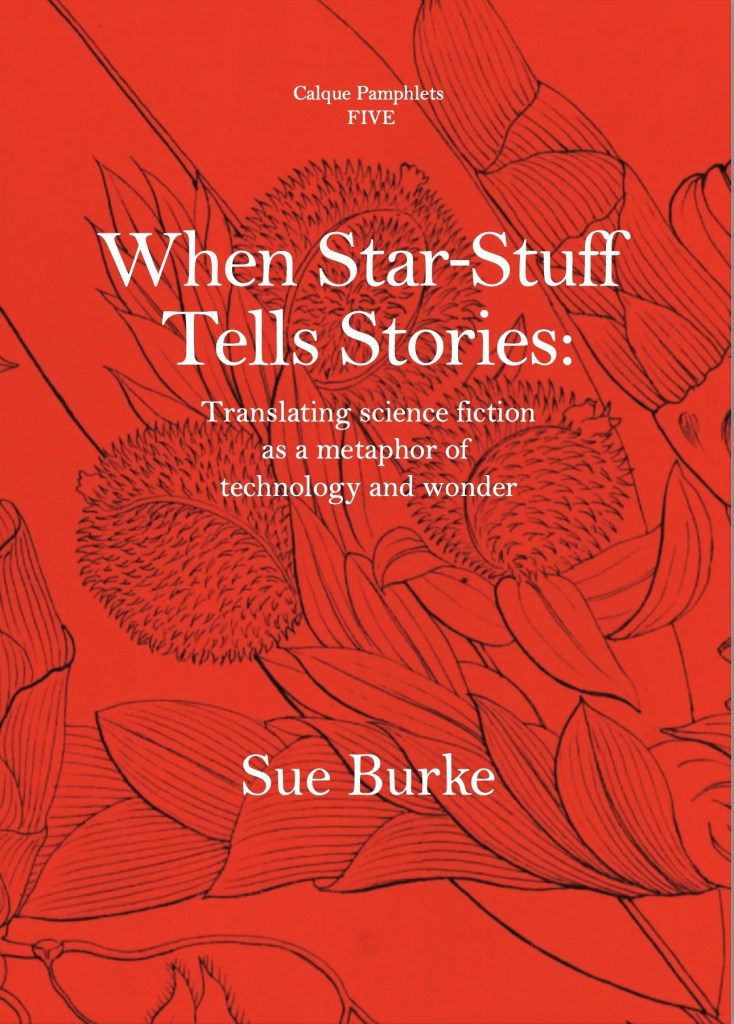
“When Star-Stuff Tells Stories” – now on sale

“If and when aliens make first contact, who should answer? Maybe humankind should turn to people like me, translators of science fiction. We’ve already thought through this kind of problem.”

That’s the opening sentences of my essay When Star-Stuff Tells Stories: Translating science fiction as a metaphor of technology and wonder. Calque Press has just published a limited edition of it as a 24-page pamphlet, and you can learn more and buy it here.

It’s one of a series of essays and other short works published by Calque. They’re meant to provide an opportunity for writers to think aloud about their own experiences and knowledge — and they are beautifully printed on high-quality paper. The publisher is fussy about the look and feel.

Here’s Calque’s description of When Star-Stuff Tells Stories:

Starting from the very earliest forms of human communication, the ways in which language developed into languages, and created the role of the translator, Sue Burke offers an invaluable guide to the importance and difficulties of translation on Earth, and gives us fascinating speculation about what might happen if we ever do come into contact with extraterrestrial intelligence. This pamphlet addresses questions of what communication is, and how the translator is uniquely positioned to work at escaping the bounds of the medium and bringing pure meaning into an intelligible form.

Categories
Uncategorized

My Goodreads review of ‘Alien Clay’

Alien Clay by Adrian Tchaikovsky

My rating: 5 of 5 stars


Because this novel won’t be available in the United States until September, a fan of Adrian Tchaikovsky in Britain sent me a copy of the book, knowing that I’m a fan, too.

In Alien Clay, Tchaikovsky creates a world so hostile and hungry that no one wants to explore it. Instead, Earth sends convicts to work as forced prison labor, including Arton Daghdev, a scientist who has no use for orthodoxy. At some point, a life-form on the planet had created buildings and writing. Where did those intelligent beings go?

The story moves fast and in a direction that allows for exploration of the philosophy of life and life forms, which Tchaikovsky does especially well. Answers emerge as to what kind of life could thrive in the planet’s continual chaos, and what that kind of life will do to humans if it gets the chance. In the last two pages, the book takes a turn that is logical, reasonable, and very creepy.

Thank you to the mutual fan who sent this! I enjoyed it immensely and now find myself asking a lot of “what if” questions: What if this kind of biology worked with the life-forms I encounter here on Earth?


View all my reviews