If you weighed every living thing on Earth, what kinds of things would weigh the most?
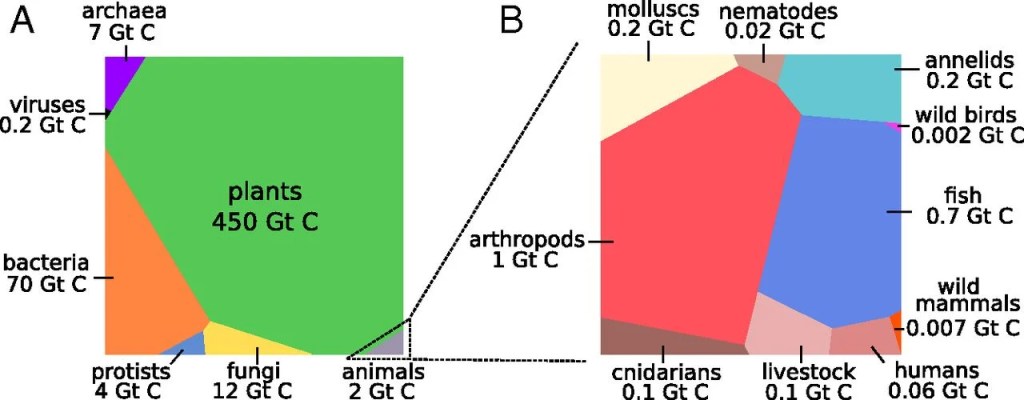
Scientists Yinon M. Bar-On, Rob Phillips, and Ron Milo tried to answer that question. They estimated the amount of carbon stored in organisms — that is, in our planet’s biomass: wild birds, viruses, fish, plants, fungi, etc. Overall, it amounts to roughly 550 gigatons of carbon. Their six-page paper, “The biomass distribution on Earth,” was published in 2017 in Proceedings of the National Academy of Science of the United States of America.
The numbers are rough but revealing. The authors come to several conclusions, including “the mass of humans is an order of magnitude higher than that of all wild mammals combined.”
You can see it in the chart. Humans amount to 0.06 gigatons. We outweigh wild mammals, which are a mere 0.007 gigatons; our livestock outweighs us both at 0.11 gigatons. Wild birds amount to 0.002 gigatons, while domesticated poultry weigh three times more. Chickens are by far the most numerous bird on the planet.
Plants rule the planet at 450 gigatons of life, but the authors of the study estimate that since the start of human civilization, the total biomass of plants has fallen to half its previous level.
We rule the Earth and have changed it in ways we don’t notice day to day. The big picture is instructive. It tells us how a single species can entirely reshape the structure of life on a planet.


