Knowledge is power, but perfect knowledge is impossible.
Suppose you knew when and how you were going to die. Could you avoid crossing the street in front of a speeding taxi? Get a mammogram in time? Stop smoking right now?
You might have to learn to face certain death with aplomb.
Possibly, everything in space and time already exists, just like a museum diorama, unchangeable as the evolution and disappearance of the dinosaurs. Their story began two hundred thirty million years ago, when Thecodonts began to walk upright. It ended 65 million years ago when the eight-ton Tyrannosaurus rex got squashed by a giant asteroid.
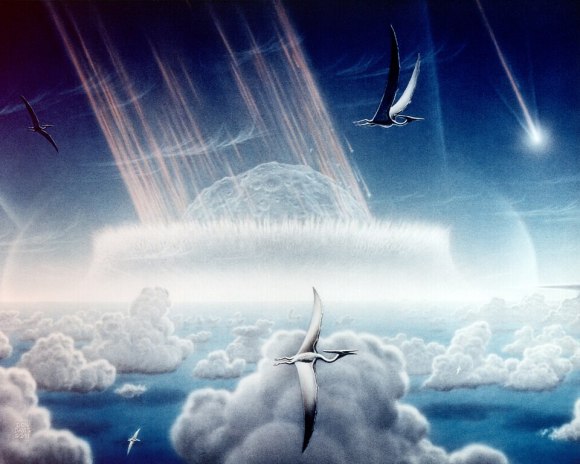
Perhaps God has already thought things through. Or perhaps, in an atheistic universe, space-time exists such that all its event-lines are locked in place from beginning to end. For the dinosaurs, it was a fatal surprise when an immense rock from space the size of Halley’s Comet smashed into Mexico’s Yucatan Peninsula and blasted out a crater 175 kilometers across.
But it was fate, kismet. The moving finger wrote, and it had to happen. Orbits had intersected, and God, or anyone with a telescope, could have seen it coming.
Philosophers and physicists have propounded for and against this idea of a pre-determined universe. Despite its logical consistency, Western minds can’t quite get around the fatalism. It means that no matter what we do now, we can’t change anything. We are as fierce, beloved, and doomed as T-rex. Our big brains make no difference.
So, you have no free will. You were pre-destined to read this essay, in fact. You can’t change a thing, can you?
Ah, but you have. One small example: Do you remember your school teacher when you were seven years old, Mrs. Sobel? In reality you were nine years old when she was your teacher. Yet you go on blithely making decisions thinking that you live in the seven-year-old-with-Sobel universe.
Mentally, we rearrange events to happen the way we think they should have happened. Then we interact with other people, every one of us with deluded memories, and we change our evolution and redesign our fates en masse.
Worse yet, without monumental research into every moment of your past, you can’t even know what you’ve misremembered. You may have forgotten major events, or made up others out of thin air. You may be planning a vacation to the Yucatan. You hope to swim at the white sand beaches, play a little golf, and take a day trip to the Maya ruins of Uxmal. Or have you already gone? Can you be sure? Was Mrs. Sobel there? Did you see any dinosaurs?
That’s why, in the Yucatan, the ancient Maya wrote down their history. They needed to remember everything that happened because they believed time moved like a wheel, which is why their calendars revolved in circles. Dates would repeat. When time turned around again, if they knew what had happened on the same date the last time, they could be prepared. Their records indicated that huge floods usually destroy the world on a certain date, 13 Baktun 0 Katun 0 Uinal 0 Kin. Fortunately this date doesn’t recur often, most recently on December 23, 2012, by our Gregorian calendar. But was the Earth destroyed? No, because we were prepared!
Knowledge is power. But you have to have accurate information.
And you don’t. You’ve already forgotten who knows what, and so have I.
What’s going to happen next? Somewhere, someone might have known, but we’ve ruined it for them. You may wish to quit smoking, get a mammogram, or look both ways before crossing anyway. We still need all the aplomb we can get, because we will all die, we just can’t know when.
***
This essay appeared in Issue 2, Summer 2002, of Full Unit Hookup magazine. Illustration: This painting for NASA by Donald E. Davis depicts an asteroid slamming into the Yucatan Peninsula as pterodactyls glide above low tropical clouds.

 Semiosis