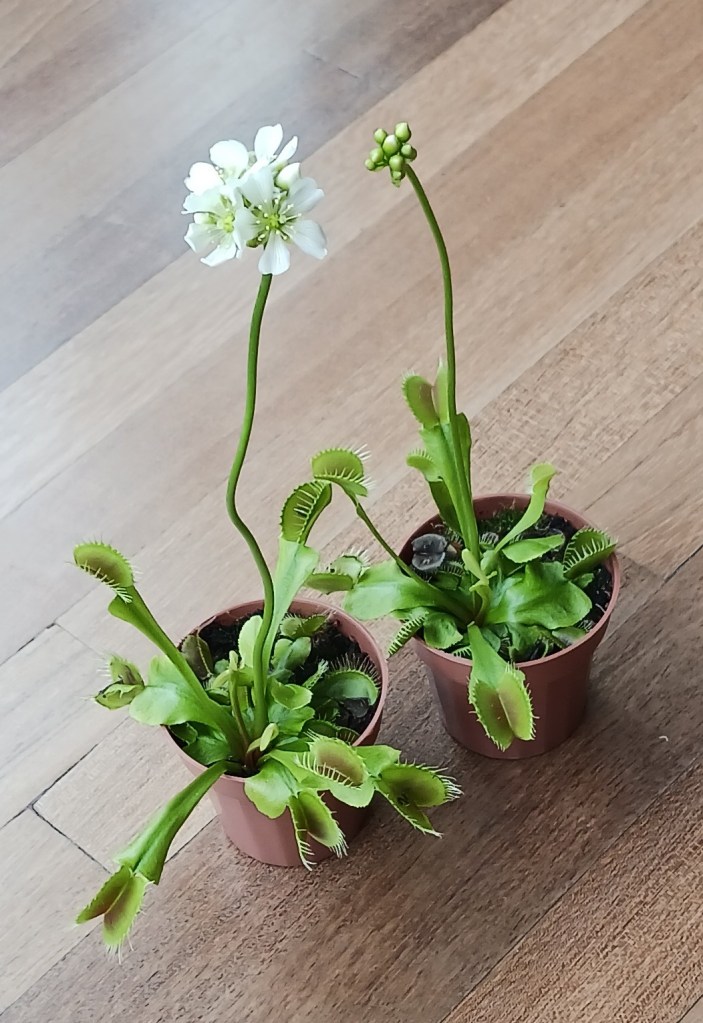
I wondered what kind of insect would visit a Venus flytrap flower, and surprise! Until just seven years ago, no one had tried to answer that question. Researchers were too distracted by the Venus flytrap’s carnivorous activities. The plants are native to the coastal bogs of North and South Carolina, and the question of their pollinators was finally investigated by an entomologist and her team from North Carolina State University, with results published in 2018.
They found out that pollinators and prey are different kinds of little creatures. Generally, flyers pollinate, and crawlers get eaten.
I bought a couple of Venus flytraps because their traps are depicted on the cover of my upcoming novel, Usurpation. They need plenty of sunshine, and I live in a high-rise building that’s effectively a vertical greenhouse, so they’ve been doing well. In fact, they’ve flowered, which led me to ask questions, and the internet led me down a fruitful rabbit hole.
I found “Venus Flytrap Rarely Traps Its Pollinators,” published in The American Naturalist: Vol. 191, No. 4. (Find a link to the PDF here.) Entomologist Elsa Youngsteadt and the university team trapped and examined “diverse arthropods” (insects and spiders) from flowers and traps. They discovered that the main pollinators were sweat bees, little bees native to the Americas with a metallic sheen who are also important pollinators of wild flowers and crops like fruits and sunflowers.
Other major Venus flytrap pollinators were longhorn beetles and checkered beetles. Like the bees, they could fly to the flowers.
The flytraps ate a wide variety of insects and bugs, mostly spiders, other kinds of beetles, and ants, especially fire ants. (Yay, team flytrap!)
The consumption of pollinators could be a “conflict of interest for the plant,” the report said, so how do the plants avoid this conflict? The researchers didn’t find a clear answer, but probably it’s because the flowers are on six-inch stems above the leaf traps, so flying insects have plenty of room to maneuver.
But should I have allowed my plants to flower? For any plant, flowers are expensive to produce, so some internet experts said I should have cut off the flower stems right away. Others said if my plants are growing well and I can give them good growing conditions, I don’t have to. Mine were already in bloom when I found that out, so I’m hoping tender loving care will make everything all right.
As for prey for my plants, because there are hardly ever insects in my apartment, I’ve been feeding them reconstituted freeze-dried bloodworms, bought in the fish food section of a pet store. Online experts agree they serve most carnivorous plants well. Mine seem happy, and I think their surprising flowers are pretty.

 Semiosis