Write what you know is debatable advice, but I think it’s good — if it’s understood in its broadest sense. Write what you know, what you’ve learned, what you’ve observed, what you can know through imagination, what you want to know, and what your emotions know.
Here’s an example. How does it feel when the world is about to end?
By experience, I know it feels horrifying and confusing.
This is what happened. I grew up in Milwaukee. Lake Michigan is to the east. All my life, the sun has risen in the east over water. Water is to the east. Always.
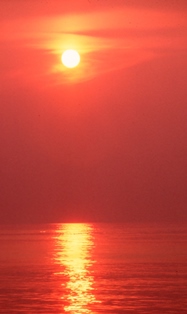
Then one evening I was visiting a friend in Los Angeles, and we were having dinner at an oceanside restaurant. I noticed that the sun was setting over the water … but water is to the east! The sun was setting in the east! The universe was suddenly and horrifyingly wrong!
After a moment, I recovered enough to look around the restaurant. Everyone was talking and enjoying themselves. No one noticed what was happening. Was I the only one? And physically, everything looked okay, but logically, if the Earth had reversed its course or flipped its orientation, there would be consequences. Gravitational disturbances. Big ones, like planet-wide destruction. But people were walking around just fine.
And … oh, I was in California. I’d seen maps. The water is to the west there. The Pacific Ocean.
It was okay! The sun was normal. Life was normal. The universe was normal.
… Dinner was delicious.
I still remember that moment, though: I think I forgot to breathe. I was aware of only one thing, the sight of that sun going down over the water, knowing what it had to mean: an enormously wrong thing, very possibly The End — and then a cascading series of smaller things that were wrong, too, but in a different way that didn’t make sense.
That moment and other imagined or real disasters have taught me that panic often comes mixed with confusion, perhaps waves of confusion and panic as the situation changes. Different people react in different ways depending on their personalities and experiences. I tend to seek more information. Someone else might be more inclined to act immediately. (That person might have made quite a scene at the restaurant. It’s fun to imagine.)
So — once I saw that the world was about to end. I know how it felt to me at that moment. I can write what I know.

 Semiosis